
Daily Podcast full article
Tesla’s 3 Biggest 2027 Reveals Could Change America Forever!
Tesla’s 2027 moment is not just another product cycle. The Semi, Optimus and Cybercab now sit at the same crossroads: they have to move from spectacle to dependable infrastructure, from bold demos to daily work, and from future-facing promises to measured output in freight yards, factories and city streets [1].
The 2027 test: not invention, but repetition
Tesla has already proved it can make the Semi, Optimus and Cybercab impossible to ignore. The harder 2027 question is whether it can make them boring in the best possible way: available, reliable, serviceable and economically rational. The latest picture is more grounded than the hype cycle suggests. In the past 72 hours, fresh reporting has pointed to three concrete fronts: heavy-truck charging infrastructure, a still-cautious Optimus production path, and a Cybercab fleet that is growing in registrations but remains short of a fully transparent commercial scale-up .
That matters because Tesla’s claimed transformation of America depends less on any single unveiling than on whether three very different systems can mature together. The Semi has to prove it can move freight with less downtime and lower operating cost. Optimus has to move beyond controlled tasks and become useful labor. Cybercab has to make autonomous ride-hailing more than a carefully bounded rollout. Each one can change an industry; all three scaling at once would change the economic map.
1. Tesla Semi: the truck is real, but the corridor is the product
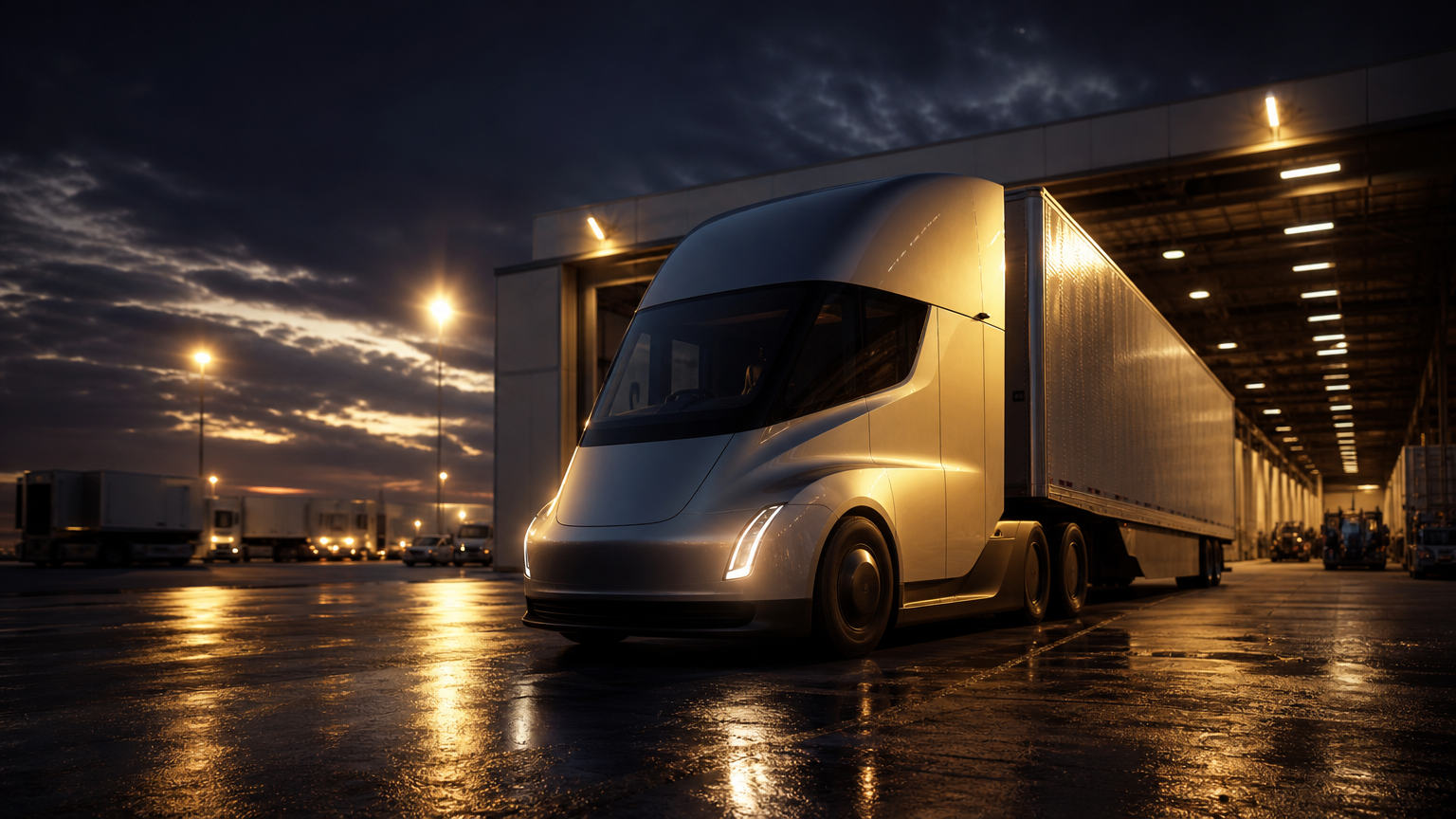
The Semi is the most industrial of the three reveals because its success will be measured by fleet managers, not fans. The frozen baseline is clear: Tesla began Semi deliveries from Nevada on September 24, 2026, to customers including PepsiCo, DHL and US Foods, while reiterating a long-term factory target of 50,000 trucks per year, or roughly 137 units per day . That target is not a marketing number anymore. It is a manufacturing exam.
The most important fresh development is infrastructure. FreightWaves reported on October 14 that Pilot Travel Centers and Tesla have opened their first Megacharger site for heavy-duty electric trucks in Ellabell, Georgia, with six charging stalls . The same report says 12 more heavy-duty sites are under construction, with three nearly finished in Tulare, California, Fort Stockton, Texas, and North Las Vegas, Nevada . For a long-haul truck, those places matter as much as the factory line. A Semi that cannot recharge predictably on freight corridors is not a national freight product; it is a regional depot truck.
The hardware claims are significant. Each site is expected to have four to eight stalls using Tesla V4 cabinet technology, and each stall can deliver up to 1.2 megawatts, enough for a Tesla Semi to recover 60% of its charge in 30 minutes, according to the FreightWaves report . That moves the discussion from “Can the truck drive 500 miles?” to “Can fleets schedule it like a diesel asset?” In trucking, time is the hidden currency. A charging stop that breaks route planning, driver hours or dock appointments can erase the savings from cheaper energy.
The economics remain mixed. A current analysis of electric-truck operating costs notes Tesla’s claim that the Nevada factory can build up to 50,000 trucks annually, but also warns that upfront price, lost federal credits, commercial electricity demand charges and depot infrastructure can weaken the simple fuel-savings story . That is the right lens for 2027. The Semi does not need to win every lane. It needs to dominate the lanes where range, payload, charging windows and route density align. If it does, Tesla could reshape freight one corridor at a time.
2. Optimus: the reveal America should judge by hands, not walking
Optimus is the most radical of the three because it aims at labor itself. Yet the latest tracker-style reporting is notably careful. Tesla News Wire’s October 15 Optimus status page says the Gen 3, or V3, robot is intended as Tesla’s first mass-production design, but its public reveal had slipped from Q1 to mid-2026 and still had not happened as of late September . That delay is not a side issue. For a humanoid robot, the reveal is less important than whether the final design can survive factory use, repeated manipulation and maintenance cycles.
The current status also separates pilot production from volume production. The same tracker says Tesla’s Fremont first-generation line replaced Model S and Model X lines and is described as designed for 1 million robots per year, but Tesla’s own Q2 update still listed Optimus as “Construction,” while reports of production entry were contested and lacked confirmed weekly counts . In other words, Optimus remains a scaling thesis, not yet a proven product business.
The most important technical question is dexterity. A humanoid that walks smoothly can still fail at the work humans actually do: gripping irregular objects, threading a screw, handling flexible materials, opening doors, cleaning corners, or recovering safely from a dropped item. Tesla’s advantage is its AI and manufacturing culture, but real-world robotics punishes overconfidence. Homes and factories are not video demos; they are full of edge cases.
For 2027, the right Optimus milestones are simple. How many robots are built each week? How many hours do they operate before intervention? What tasks do they complete without a human resetting the scene? What is the cost of repair after repetitive use? Until those metrics appear, Optimus is potentially historic but not yet economically legible.
3. Cybercab: registrations are rising, but deployment is still the proof
Cybercab is the most visible consumer-facing reveal because it promises a new ownership and transport model. CyberCab.News reported on October 15 that Texas DMV records showed Tesla registering another 30 purpose-built Cybercabs, raising the state count from 319 to 349, while Model Y robotaxis stayed at 420 and Tesla’s total Texas Robotaxi fleet reached 769 vehicles . The same report cautioned that a state registration is not the same thing as a live paid-ride count, because a registered vehicle may be testing, parked or waiting for service deployment .
That distinction is essential. A fast registration curve suggests manufacturing and fleet preparation are moving. It does not, by itself, prove revenue, utilization, safety performance or customer demand. Cybercab’s 2027 test is therefore not whether Tesla can add rows to a state database, but whether the vehicle can deliver a dense, repeatable, low-cost service in ordinary traffic.
Tesla is also experimenting with ownership structure. A current briefing reported that Tesla opened an interest form for businesses that want to buy Cybercab fleets for the Robotaxi Network, but the form did not include price, delivery dates or revenue-sharing terms . That is a potentially huge strategic signal. If Tesla can persuade entrepreneurs, fleet operators or local businesses to finance vehicles and infrastructure, it could scale faster while shifting some capital risk outside the company.
But the missing terms are the story. Without price, delivery schedule, insurance model, maintenance obligations and revenue split, the Cybercab opportunity is still a door, not a contract. In 2027, the market will need to see whether Cybercab is a Tesla-owned taxi network, a franchise-like fleet model, or some hybrid between Uber, Airbnb and automotive leasing.
Why these three products belong in the same story
The Semi, Optimus and Cybercab look different, but they share the same bottleneck: reliable autonomy plus scalable hardware. The Semi needs charging and uptime. Optimus needs hands, safety and task completion. Cybercab needs regulatory confidence, utilization and fleet operations. All three require Tesla to become not just an automaker, but an operator of industrial systems.
That is why 2027 could matter so much for America. If the Semi scales, freight costs and diesel exposure could fall on the best routes. If Optimus works, labor shortages in warehouses, factories and services could look very different. If Cybercab scales, urban mobility could shift from car ownership toward autonomous access. But if any of these products remain limited, expensive or opaque, the revolution stays partial.
Tesla’s next reveal, then, is not really a stage event. It is the daily scoreboard: trucks delivered, chargers opened, robots working, Cybercabs carrying paying riders, and customers coming back for more. The future does not arrive when a product is announced. It arrives when it works every day.
Sources from the last 72 hours
- [1]Tesla’s 3 Biggest 2027 Reveals Could Change America Forever!Oct 15, 2026, 1:32 PM
- [2]Tesla Optimus Tracker: status and timelineOct 15, 2026, 2:00 AM
- [3]Closing In: Tesla Adds 30 More Cybercabs, Texas Count Hits 349Oct 15, 2026, 2:00 AM
- [4]Tesla invites Cybercab fleet buyers, with no price attachedOct 15, 2026, 2:00 AM
- [5]Electric Truck Diesel Prices: Why EVs Still StruggleOct 15, 2026, 2:00 AM
- [6]Pilot, Tesla open first Megacharger site, 12 more underwayOct 14, 2026, 2:00 AM
AI-generated article based on recent web research, then preserved as a dated editorial snapshot.
Comments
Be the first to comment.