
Daily Podcast full article
CERN gives Mistral an exabyte
CERN and Mistral have signed a statement of intent to build Flare, a Large Physics Model for collider research, using CERN’s scientific data and simulated LHC collisions as a proving ground for European AI. The promise is faster, broader particle-collision analysis; the risk is forgetting that a plausible model output is still not a discovery until physicists validate it.
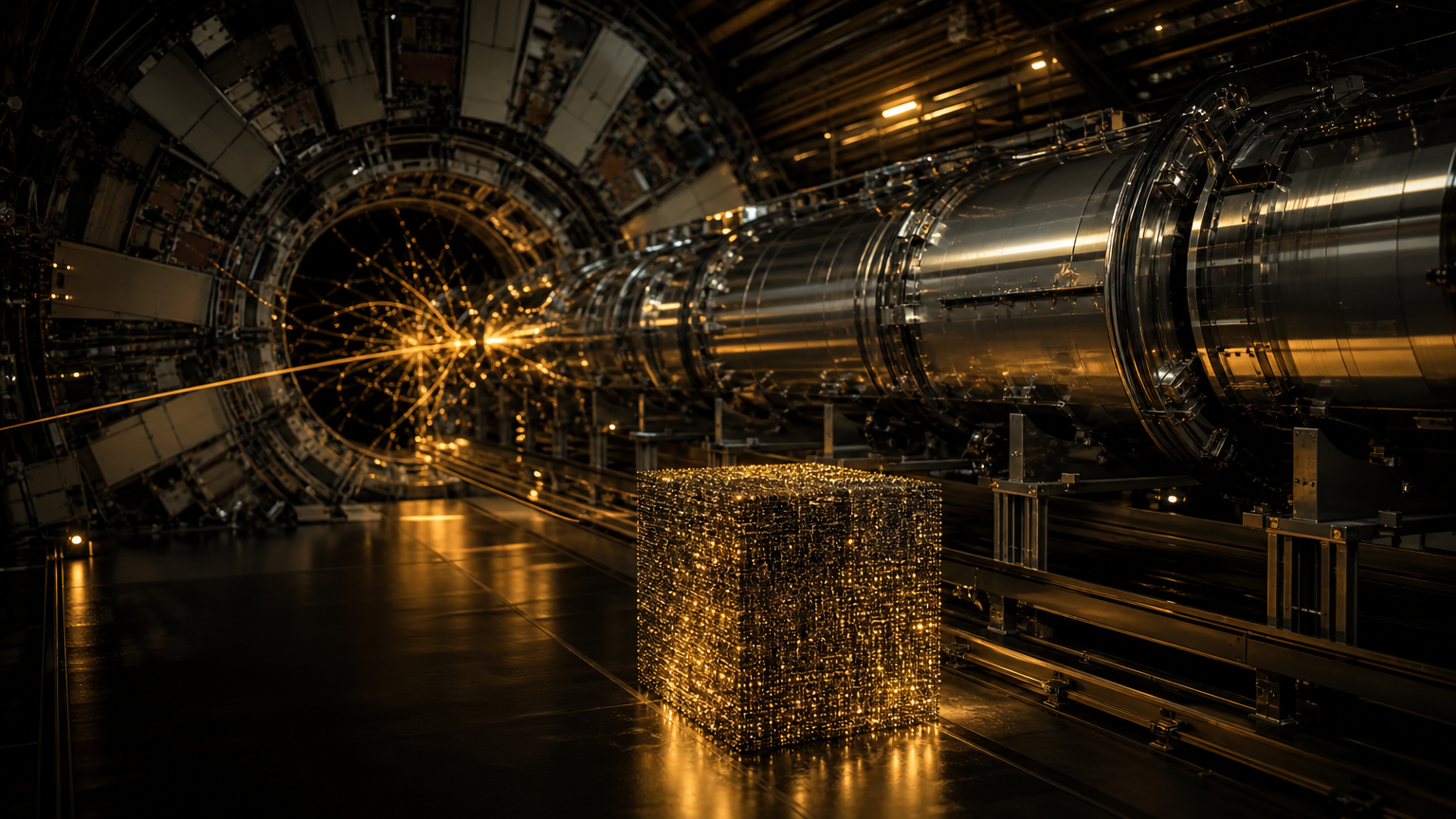
A foundation model walks into the collider
CERN and Mistral’s new partnership is not another chatbot story wearing a lab coat. It is a long-term strategic effort to develop foundation models for scientific discovery, beginning with high-energy physics and the Large Hadron Collider . Reuters identified the proposed model as Flare, a “Large Physics Model” that CERN says would be the first foundation model for collider physics .
The deal matters because CERN is not short of data, complexity or standards. The laboratory says it has stored around one exabyte of experimental data from the LHC, equal to one million terabytes, and expects the number of collisions to rise tenfold with the High-Luminosity LHC, expected around 2030 . Reuters reported that the statement of intent gives Mistral access to one of the world’s largest scientific datasets as the French AI company tries to compete at the frontier of scientific AI .
But the phrase “CERN gives Mistral an exabyte” needs one careful footnote. The planned training described by CERN is on billions of simulated proton-proton collisions, while the exabyte figure refers to CERN’s stored experimental LHC data to date . In other words, Flare’s scientific environment is defined by the real archive, the simulation pipeline and the reconstruction problems around them; the public material does not say that a one-exabyte raw dump will simply be poured into a model.
What Flare is supposed to do
The ambition is to replace a fragmented workflow with a model that can operate across several collider-physics tasks. CERN says the Large Physics Model would be designed to reconstruct particle collisions, identify particles, flag unexpected signals and evaluate future detector designs . Today, collision reconstruction depends on a chain of specialised algorithms that progressively transform detector signals into the particles and objects used in physics analysis .
That existing chain is already computationally sophisticated. CERN says machine learning has long improved specialised parts of the reconstruction process . The novelty claimed for Flare is not “AI enters physics,” but a broader architecture: one pretrained model that learns across the reconstruction chain and supports multiple tasks within a single system .
Reuters framed the idea as analogous to large language models, except trained on collision data rather than text . That comparison is useful but limited. Language models learn statistical regularities in words, code and images; a collider model has to respect detector geometry, calibration uncertainty, conservation laws, rare-event statistics and the brutal asymmetry between ordinary background events and signals that might matter. A fluent answer is not enough. In particle physics, the model has to survive error bars.
Why Mistral wants the collider
For Mistral, CERN is a prestigious partner and a difficult benchmark. The company is widely viewed as one of Europe’s strongest AI challengers, and Reuters noted that the Paris-based lab is seen as Europe’s best chance to catch up with US and Chinese competitors in frontier AI . A physics model gives Mistral a demanding use case beyond general-purpose assistants, enterprise copilots and open-weight model releases.
The collaboration also fits Europe’s political and industrial narrative. CERN contributes fundamental-physics expertise, scientific data and large-scale computing, while Mistral contributes experience in training large-scale AI models . CERN’s announcement presents the partnership as a way to combine European excellence in AI and fundamental science, with possible benefits beyond high-energy physics .
CERN Chief Information Officer Enrica Porcari said high-energy physics offers a uniquely rigorous environment for developing and testing AI, and said the goal is to advance capabilities that can serve and be shared by the physics community . Mistral’s Johannes Brandstetter, vice-president of AI for engineering, described the collaboration as a chance to explore what large-scale models can bring to the growing complexity of particle physics .
Those statements matter because they point to a crucial governance question: will Flare become a broadly usable scientific tool, or a closed strategic asset? Reuters reported that no timeline or budget was disclosed, and AI Affairs also noted that access terms, milestones and deployment details remain unspecified . Until those details exist, the partnership is best understood as a major research commitment, not a released product.
The exabyte is only the beginning
The LHC’s data scale is often the headline, but the real difficulty is not just storage. Collider experiments produce enormous streams of detector signals that have to be calibrated, reconstructed, filtered and compared with simulations. Physicists are not merely asking whether a model can find patterns; they need to know whether it can preserve uncertainty, avoid bias, generalise across detector conditions and withstand independent review.
That is why Flare’s promised role in flagging unexpected signals is both exciting and dangerous. A model that notices subtle correlations across billions of simulated collisions could help researchers look where older tools might not. It could compress expert workflows, speed up reconstruction, improve detector-design studies and make complex analysis chains more coherent. But an anomaly score is not a new particle. It is a reason to investigate.
The scientific culture around CERN is built for that skepticism. Claims are tested against controls, systematic errors, independent analyses and reproducibility standards. In that environment, a foundation model can become a powerful assistant precisely because it cannot be treated as an oracle. The Large Hadron Collider may be gaining a very talkative lab partner, but the lab partner will still have to show its work.
What has not been announced
The most important absence in the announcement is performance. Current coverage notes that no Flare experimental results have been disclosed . There is no public benchmark showing that Flare reconstructs collisions better than existing systems, no published error analysis, no access model, no compute plan and no delivery date .
That does not weaken the importance of the partnership; it defines its stage. CERN and Mistral have announced a strategic direction and an ambition to build a single pretrained Large Physics Model for collider physics . The next test will be whether Flare can demonstrate measurable value in the places that matter: reconstruction quality, computational efficiency, robustness to detector variation, anomaly-detection discipline and usefulness to real analysis teams.
If it succeeds, Flare could become a template for domain-specific foundation models: AI systems trained not on the open web, but on the structured, instrumented and validated data of a scientific field. That is a different future from chatbots that answer questions about science. It is closer to an AI instrument inside the scientific workflow itself.
For now, the story is simple but consequential. CERN has opened a path for Mistral into one of the most data-rich and validation-heavy environments on Earth. Mistral gets a proving ground where hand-waving will not pass peer review. And collider physics gets a new bet: that a foundation model can help humans see more clearly inside the debris of proton-proton collisions, without confusing eloquence for evidence.
Sources from the last 72 hours
- [1]CERN and Mistral join forces to accelerate AI for scienceOct 15, 2026, 2:00 AM
- [2]CERN and Mistral partner to build Flare, a new AI model for physicsOct 15, 2026, 2:02 PM
- [3]CERN and Mistral sign intent to develop a Large Physics ModelOct 15, 2026, 8:35 PM
- [4]CERN and Mistral plan Flare to combine particle-physics AI tasksOct 15, 2026, 2:00 AM
AI-generated article based on recent web research, then preserved as a dated editorial snapshot.
Comments
Be the first to comment.