
Daily Podcast full article
SpaceX serves Pentagon and ISS
On October 15, SpaceX executed two very different forms of orbital service: a classified U.S. Space Force launch from Vandenberg and a Dragon cargo docking at the International Space Station. Together, they show how Falcon 9 and Dragon now support both national-security space operations and the everyday logistics of human spaceflight.
One company, two missions, one day
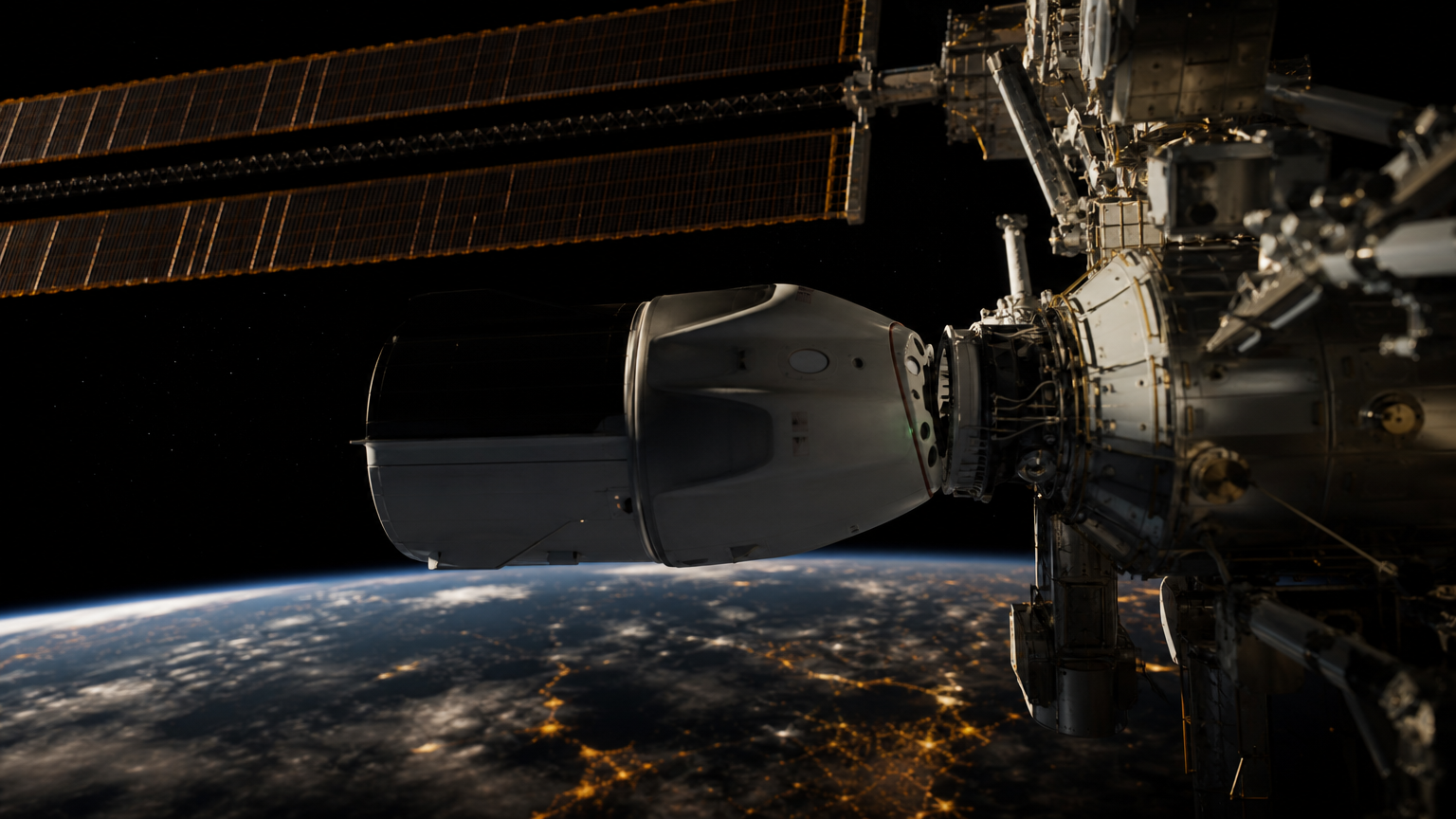
SpaceX’s October 15 schedule offered a compact picture of what the company has become: not just a launch provider, but a standing piece of American space infrastructure. In California, a Falcon 9 lifted a classified U.S. Space Force mission, USSF-481, from Space Launch Complex 4 East at Vandenberg Space Force Base at 5:01 p.m. PDT, or 8:01 p.m. EDT . In orbit around Earth, a Dragon cargo spacecraft docked to the International Space Station’s Harmony module at 10:27 a.m. EDT, bringing more than 6,300 pounds of food, supplies, equipment and science hardware for Expedition 75 .
The two operations were not the same kind of mission. One was deliberately opaque: the U.S. military did not disclose the payload’s purpose, and SpaceX’s webcast ended after the first-stage landing, before any public view of deployment . The other was unusually transparent, with NASA describing the Dragon’s cargo, its docking port, its science payloads and its expected stay at the orbital laboratory . Yet the juxtaposition matters. The same commercial launch ecosystem is now trusted for classified military requirements and for the regular supply chain that keeps astronauts productive aboard the ISS.
The classified side of cadence
The national-security mission, designated USSF-481, was launched on a Falcon 9 from Vandenberg on a southerly trajectory, with hazard notices suggesting a low Earth orbit inclined about 80 degrees from the equator . Space.com described the payloads as “mysterious” and said they were headed to an undisclosed destination, underscoring how little was publicly released about the spacecraft themselves . The secrecy is not incidental; it is part of the mission architecture. When the customer is the U.S. Space Force and the payload is classified, the public event is essentially the rocket phase: liftoff, ascent, booster return, then silence.
Even within that silence, the operational facts are revealing. The Falcon 9 first stage used for USSF-481 was booster B1081, flying for the 28th time . Spaceflight Now reported that B1081 landed on the droneship “Of Course I Still Love You” a little more than eight minutes after liftoff, while Space.com likewise reported a successful droneship landing about 8.5 minutes after launch . That detail is not a footnote. It is the economic and logistical core of SpaceX’s value proposition to national-security customers: a sensitive spacecraft can be launched on a booster with a long flight record, recovered at sea and placed back into the broader launch fleet.
This is where the strategic tradeoff appears. Reuse and cadence give the Pentagon speed, repetition and cost discipline. They also concentrate an extraordinary amount of national launch capacity inside one commercial contractor. USSF-481 was not presented to the public as a science mission or a commercial communications launch. It was a classified Space Force payload, and the ability to put it up quickly from Vandenberg depends on a supply chain, launch team, range interface and booster fleet that SpaceX has made routine. That routineness is powerful. It is also a dependency.
Dragon turns rocket science into logistics
The ISS mission showed the other side of the same transformation. NASA said Dragon docked to the space-facing port of Harmony at 10:27 a.m. EDT on October 15, completing SpaceX’s 35th Commercial Resupply Services mission to the station . Space.com reported that the cargo Dragon rendezvoused with the ISS after a more than two-day orbital pursuit and docked as the station flew about 250 miles above South Africa at roughly 17,500 mph . That is the paradox of modern station logistics: a delivery can be routine in program terms and still be technically unforgiving in orbital mechanics.
The cargo manifest also explains why repeatable resupply matters. NASA said Dragon carried more than 6,300 pounds of food, supplies and equipment, including the final set of International Space Station Roll-Out Solar Arrays, or IROSAs, planned for installation later in the fall . Aviation Week also reported that CRS-35 delivered crew supplies, scientific research and the final two roll-out solar arrays to the seven-person station . These are not merely “groceries.” They are the materials that preserve crew time, keep station systems healthy and refresh the laboratory’s research agenda.
NASA’s own list of investigations points to the ISS as an industrial and biomedical test bed, not just an orbital outpost. The Dragon carried hardware for work on artificial retinas, 3D heart tissue models, unconventional glass formation in microgravity and brain organoids that may help identify treatment targets for neurodegenerative diseases . In practical terms, every successful cargo docking protects continuity: experiments can be installed on schedule, consumables can be replenished, replacement parts can be staged and the crew can focus on operations rather than scarcity.
Routine does not mean easy
The temptation is to call these flights routine because Falcon 9 launches often and Dragon has docked many times. But the October 15 pair shows why “routine” is not the same as “simple.” USSF-481 required a classified mission flow, a Vandenberg launch, a southerly ascent profile and a droneship recovery in the Pacific . CRS-35 required a precise launch from Cape Canaveral, a two-day chase of the ISS, autonomous approach and docking at Harmony’s zenith-facing port . Both depended on mature hardware, trained teams and stable interfaces with government customers.
For NASA, Dragon’s regularity is part of the bridge from today’s ISS to tomorrow’s commercial stations. A cargo vehicle that can repeatedly launch, rendezvous, dock, remain attached for about a month and return time-sensitive research to Earth is more than a supply truck . It is an operational pattern. Future private stations will need exactly that pattern: predictable delivery, return capability, autonomous navigation and enough reliability that customers plan their research around it.
For the Pentagon, Falcon 9’s regularity is a different kind of bridge. It links military space ambitions to commercial launch economics. A classified payload can ride on a booster whose earlier career included NASA, national-security, European, rideshare and Starlink missions . That mix shows how SpaceX’s civil, commercial and military work reinforce one another. A booster fleet made busy by commercial demand can be available for government missions; government demand, in turn, strengthens the case for maintaining rapid launch readiness.
The meaning of October 15
Taken separately, each October 15 event fits an established pattern. The Space Force launches secret spacecraft; NASA receives cargo at the ISS. Taken together, they show a structural change in space operations. SpaceX is serving the Pentagon and the ISS not as an occasional contractor, but as a repeatable operating layer.
That brings benefits: speed, reuse, standardized procedures and a demonstrated ability to support different government needs on the same day. It also raises questions: how much strategic capacity should rest on one provider, and how quickly can alternatives mature if launch demand keeps rising? The classified payload is staying quiet, and rightly so. But the larger message is loud enough. In 2026, national security and orbital housekeeping both depend on the same industrial rhythm: Falcon 9 launches, Dragon docks, boosters land, and the next mission moves to the front of the line.
Sources from the last 72 hours
- [1]SpaceX Dragon Docks with Science, Supplies, and Roll-Out Solar ArraysOct 15, 2026, 4:33 PM
- [2]SpaceX launches classified mission for the US Space Force (video)Oct 16, 2026, 2:30 AM
- [3]SpaceX Cargo Dragon delivers more than 6,000 pounds of supplies to the ISSOct 15, 2026, 4:27 PM
- [4]SpaceX Cargo Dragon Delivers Rollouts, Research To ISSOct 15, 2026, 2:00 AM
- [5]SpaceX launches a classified payload for U.S. Space ForceOct 16, 2026, 2:23 AM
AI-generated article based on recent web research, then preserved as a dated editorial snapshot.
Comments
Be the first to comment.