
Daily Podcast full article
No One Is Ready for the World Elon Musk Showed Last Night
Elon Musk’s new Tesla Roadster reveal looked like a flying-car stunt, but the more important story was the system behind it: Tesla hardware, SpaceX propulsion, autonomous ambition, robotics, satellite infrastructure and AI all pointing toward a single Musk operating environment rather than a normal consumer vehicle launch [1].
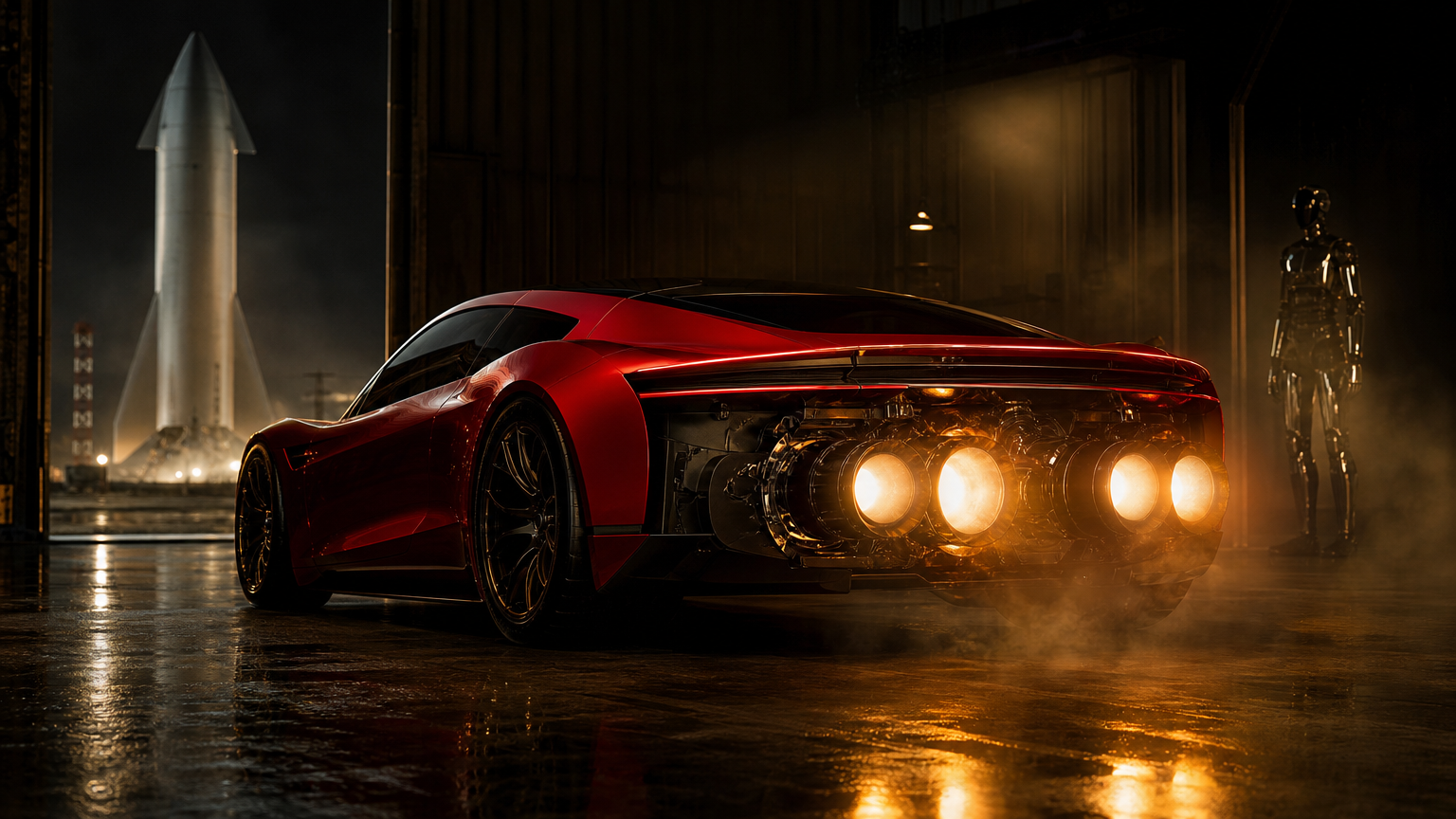
A car reveal, or a systems demo?
The next-generation Tesla Roadster was unveiled at a SpaceX test facility in McGregor, Texas, near Waco, and that location said almost as much as the car itself . A conventional automaker reveals a halo sports car under studio lights, with a price, a production date, and a list of trims meant to reassure buyers. Musk staged the Roadster as if it were an aerospace experiment that happened to wear license plates.
The demonstration showed a Roadster using cold-gas thrusters and an active suction system to leave the ground, spin, cling to an inverted ramp, and return to pavement in a cloud of white vapor . Tesla and SpaceX engineers effectively turned the car into a boundary object: too automotive to be a rocket, too rocket-like to be judged as an ordinary car.
That is why the reveal matters even if the Roadster never becomes a meaningful seller. Musk was not simply saying, “Here is a fast EV.” He was saying, “Here is what happens when the companies in my orbit start behaving like modules in one technological stack.”
The specs were absurd by design
The headline numbers were engineered to overwhelm. Tesla said the Roadster can accelerate from zero to 60 mph in less than a second, and Musk said consumer production is not expected until 2028 . TechCrunch reported three trims: a road-ready Performance version, a Thrust version with rear cold-gas thrusters, and a one-seat Rocket version with 10 thrusters positioned around the car . Tesla’s reservation structure, as reported by TechCrunch, put the Performance reservation at $50,000, the Thrust reservation at $250,000, and the Rocket model in invitation-only territory .
Car and Driver reported that the Roadster prototype used a fan system to generate enough suction to hold itself to an inverted structure, then used SpaceX-supplied thrusters to fly forward, roll, and land . Musk also claimed the car would exceed 230 mph and said he wanted to push toward half the speed of sound, while acknowledging that the vehicle may not be legal in every jurisdiction .
Those details are fascinating, but they also make the commercial question sharper. What everyday problem does this solve? No parent needs a 0-to-60 run that threatens the passenger’s neck. No commuter needs a vehicle that can hop over a Cybertruck. No regulator is waiting eagerly to approve a road car that can suddenly elevate itself in traffic. The Roadster is not practical transportation. It is a signal flare.
The real product is integration
The Roadster’s clearest message was not speed. It was integration. AP reported that Tesla executives said they had “borrowed” SpaceX technology to get the Roadster into the air . CBS described the vehicle as a tangible example of Tesla and SpaceX collaboration, with propulsion, pressure-vessel and control hardware from the rocket company placed inside a Tesla product .
That is the part traditional auto analysis risks missing. The Roadster is not positioned like a Model 3, a Model Y, or even the original Roadster. It is a theatrical proof that Musk’s companies can be narrated as one machine. Tesla supplies the vehicle platform, batteries, manufacturing mythology and consumer-facing brand. SpaceX supplies pressure systems, propulsion culture and an engineering tolerance for controlled explosions. Starlink sits in the background as a communications layer. Optimus represents the robotics manufacturing ambition. xAI and Neuralink, though not proven as components of this car, belong to the larger story Musk keeps telling: intelligence, mobility, connectivity and human-machine interfaces converging.
The reveal did not demonstrate a finished xAI-Starlink-Neuralink-Tesla product. It did something subtler. It made the idea of a unified Musk ecosystem feel less like investor fan fiction and more like an engineering aesthetic. A flying Roadster is not necessary. But as a symbol, it compresses the thesis into one image: a car no longer has to be only a car.
Tesla may be saying goodbye to the car company era
Axios framed the event as a possible farewell to Tesla as a conventional car company, arguing that Musk increasingly presents Tesla as an AI and robotics company rather than an automaker . That framing fits the Roadster perfectly. The first Tesla Roadster helped prove that electric cars could be desirable. The new one seems designed to prove that the category “car” is too small for Musk’s ambitions.
Musk reportedly told the audience that, in the long term, the Roadster would be the only manually driven car Tesla makes . If taken seriously, that line turns the Roadster into a paradox: it is a celebration of driving released by a company whose strategic future depends on humans not driving. The Roadster is the “last human-driven car” as spectacle, souvenir and tombstone.
That is why the event felt less like a sales pitch than a reboot screen. Tesla has been under pressure to defend its aging mainstream lineup, prove autonomy at scale, and show that robotics is more than a stage demo. A rocket-assisted Roadster does not solve those business problems. But it refreshes the myth. Sometimes even Musk needs a reboot to update the system.
The regulatory wall is not a footnote
The reveal’s most sober detail was not technical; it was legal. AP quoted legal experts warning that state rules and federal oversight would make any public-road flying function difficult to approve . CBS reported that Tesla’s website said the flying model is not approved for public road use and that it was not immediately clear which agency would oversee such a vehicle . CBS also reported that the FAA said the Roadster does not meet its definition of an aircraft, while NHTSA had not immediately responded to a request for comment .
That ambiguity is the point. If the Roadster is a car, road safety agencies matter. If it flies, aviation logic intrudes. If it only hops, flips or uses compressed air for track stunts, perhaps it exists in a gray zone closer to motorsport or private demonstration than consumer mobility. Musk thrives in such gray zones, but customers do not drive gray zones to work.
The business case is weak, and that may not matter
The Roadster is unlikely to move Tesla’s near-term revenue needle. Axios said production is not expected until 2028 and that Tesla has not announced a final price . CBS cited analyst Dan Ives saying the Roadster should not be modeled as a growth driver because production will likely be limited . AP also noted that Tesla was taking reservations while fine print warned there was no guarantee when, or whether, the vehicle would be delivered .
That would be damning if this were a normal car. But the Roadster is not normal, and perhaps not even primarily a car. It is a halo product in the oldest sense: an object that radiates meaning onto everything around it. The question is whether the halo still works after years of delays, missed timelines and increasingly extravagant promises.
For believers, the answer is yes: only Musk would be reckless enough to try this, and only Tesla-SpaceX could make it look plausible. For skeptics, the answer is also yes, but inverted: only Musk could turn a delayed sports car into another deposit-taking spectacle with uncertain delivery.
No one is ready because the categories are breaking
The Roadster reveal was easy to mock and hard to dismiss. As a consumer vehicle, it looks wildly impractical. As a regulatory proposition, it looks unfinished. As a revenue product, it looks marginal. But as a preview of Musk’s preferred future, it was brutally clear.
The world Musk showed last night is not organized by industries. It is organized by platforms: cars that borrow from rockets, robots that belong in factories and vehicles, satellite networks that become mobile infrastructure, AI systems that become control layers, and human-machine interfaces that may one day make the steering wheel feel antique.
No one is ready for that world because our institutions still sort reality into separate boxes: automaker, aerospace company, telecom provider, AI lab, robotics firm, medical-device company. Musk’s reveal treated those boxes as temporary folders on the same desktop. The Roadster may never be the car people need. But it may be the clearest image yet of the operating system Musk wants to install around them.
Sources from the last 72 hours
- [1]Tesla reveals SpaceX-powered Roadster that flies and falls with styleOct 16, 2026, 3:17 AM
- [2]With flying Roadster, Tesla waves goodbye to the car businessOct 16, 2026, 11:13 PM
- [3]With Tesla Roadster debut, Elon Musk shows "flying cars are real"Oct 16, 2026, 11:31 AM
- [4]Revealed! New Tesla Roadster Takes Flight with SpaceX ThrustersOct 16, 2026, 3:30 AM
- [5]Tesla’s new Roadster car can thrust itself in the air. But don’t expect to drive it anytime soonOct 16, 2026, 3:52 PM
AI-generated article based on recent web research, then preserved as a dated editorial snapshot.
Comments
Be the first to comment.