
Daily Podcast full article
Starlink, War AI, Nvidia in France, Chatbots and Robots: the Full Story
A single week of AI news has exposed the same strategic fault line from Ukraine’s drone war to Paris, Silicon Valley courtrooms and humanoid-robot labs: the decisive infrastructure is increasingly private, programmable and politically sensitive.
The headline check
The working headline is the story: Starlink, War AI, Nvidia in France, chatbot and robots: the full story. The thread is not one company or one product. It is the same dependency pattern appearing in five places at once: satellite links for drones, state AI strategy, Nvidia’s European footprint, companion-chatbot liability and the move from generative AI to physical AI.
Starshield’s speed problem in Ukraine
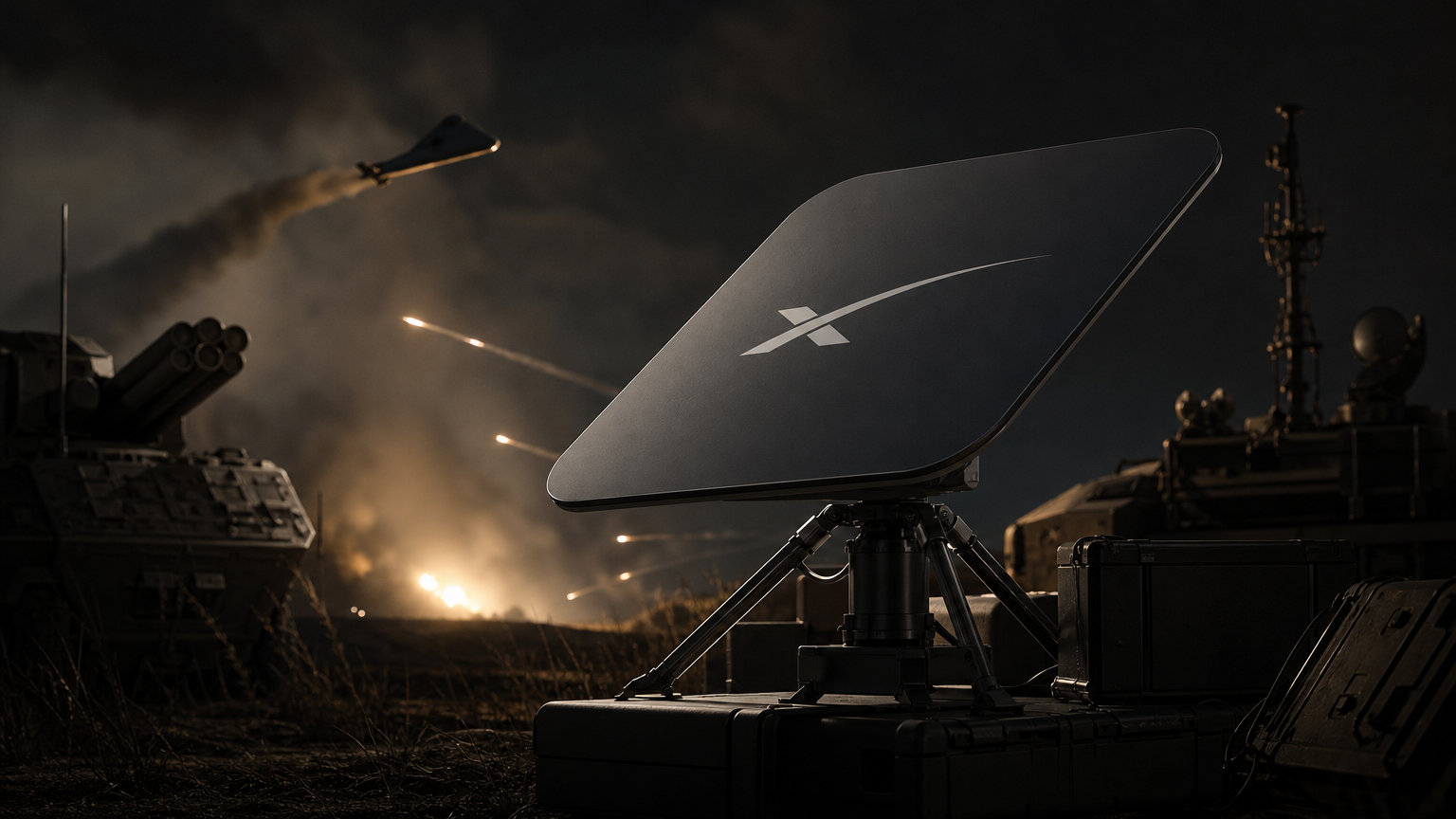
The most urgent part of the story is military. Ukrainian reporting says SpaceX imposed new speed restrictions on Starshield, the military-grade Starlink service used by Ukraine’s armed forces, overnight on October 14, 2026, without prior notice to Ukrainian units . Defense Ministry sources told hromadske that the thresholds varied by unit and platform, with reported loss of connectivity when moving at roughly 72 to 161 km/h . The 7th Air Assault Corps separately reported 10- to 20-second dropouts at 110 to 120 km/h, enough time for an unmanned aircraft to keep flying while its operators lose proper control .
That matters because the use case is not casual broadband. Ukraine is using fast drones for interception, reconnaissance, relay and strike missions, including against Russian Shahed/Geran-style attack drones . Tom’s Hardware, citing Reuters and Ukrainian officials, reported that presidential adviser Serhiy Beskrestnov described a 100 mph, or roughly 160 km/h, limit on Starshield terminals, while frontline units saw disruption even at lower speeds . The same report said some missions were cancelled and that Ukrainian sources viewed the change as a major complication for logistics and drone operations .
The distinction is important: the current reporting points to Starshield terminals in motion, not a broad outage of ordinary Starlink service for civilians or fixed users . In other words, the vulnerability is not “the internet went down.” It is that a private, software-defined communications layer can enforce operating conditions that directly affect military tactics. Even Starlink, apparently, may need a firmware patch to defeat the Borg’s velocity limits.
Private networks, public wars
The Starshield episode shows why “AI war” is no longer only about autonomous weapons or targeting algorithms. It is also about who controls the control plane. A drone interceptor is only as effective as its communications, latency, permissions and service profile. If that profile changes overnight, a tactical method can become brittle before commanders have time to adapt .
Ukraine’s Defense Ministry was reportedly contacting the United States, SpaceX and NATO partners while gathering field reports and seeking backup communications . That response says as much as the restriction itself. Military resilience now means not only more drones, more batteries and more operators, but also redundant networks, contractual clarity and a way to audit the behavior of platforms controlled outside the chain of command.
The political interpretation remains contested. hromadske noted that there was no confirmed evidence linking the restrictions to political disagreements over Ukrainian strikes on Russian energy infrastructure . That caveat matters. Still, the incident underlines a strategic risk: even when a system works technically, the rules embedded in it can become a geopolitical variable.
France moves AI into the national-security room
The same week, France put AI explicitly inside the machinery of national security. Le Monde Moderne reported on October 15 that Emmanuel Macron had convened a Defense and National Security Council dedicated to artificial intelligence on October 14, placing AI alongside space and nuclear power as a strategic domain . The agenda, as described, was the examination of risks for public and private actors and the definition of French and European priorities .
The format is revealing. A defense council is designed for sensitive national-security decisions, not normal industrial policy. That makes sense when AI touches intelligence, cyber operations, military command, industrial sabotage and foreign technological dependence. But it also creates a democratic tension: the same report noted that the legislative framework for French AI oversight had not fully advanced in the National Assembly, while defense-council deliberations remain secret .
This is the French version of the Starshield problem. Sovereignty is not simply the ability to buy or build AI. It is the ability to govern it, inspect it, fund it and decide when national-security secrecy is justified. If AI becomes a strategic domain, the state must decide which parts belong in classified rooms and which require public law, independent regulators and parliamentary scrutiny .
Nvidia’s Paris play
Nvidia’s role in France sharpened the sovereignty question. Le Monde reported that Jensen Huang was in Paris on October 13 and that Nvidia revealed minority stakes in four French start-ups: Doctolib in healthcare, Entalpic in materials, Genesis AI in robotics and Pigment in business decision support . Huang said Nvidia’s European investments over the previous year totaled €8.9 billion and framed open models as a path for countries and companies to build their own AI rather than surrender their data .
That sounds like sovereignty, but it is also dependence of a different sort. France gains capital, chips, expertise and market validation. Nvidia gains customers, ecosystem gravity and influence over the industrial stack. Doctolib said Nvidia’s funding would help recruit AI talent and accelerate AI products, including tools for doctors and future patient guidance, with Nvidia experts supporting model training in Europe .
The contradiction is not necessarily fatal. Sovereignty may no longer mean isolation. It may mean controlling data, deployment and continuity of service while accepting that critical chips and software layers come from a U.S. supplier . But that is a delicate balance, especially when the same week’s Ukraine story shows how private technology platforms can alter operational reality.
The chatbot reckoning
On the consumer side, Character.AI turned the dependency question into a safety and liability crisis. Michigan Advance reported on October 16 that Michigan Attorney General Dana Nessel joined 38 other states and the District of Columbia in litigation focused on privacy and safety concerns after Character.AI filed for bankruptcy . The article said the platform planned to sell $20 million in assets to Disney and that states wanted protections that would survive any change in ownership .
A separate Florida report said the mother of 14-year-old Sewell Setzer had finalized a wrongful-death settlement with Character.AI over claims related to her son’s chatbot use; the terms were not disclosed . The same report noted that Character.AI had unsuccessfully tried to get the case dismissed and had argued that the lawsuit sought liability for protected speech, while the family’s attorneys argued AI-generated responses should not receive the same constitutional treatment as human expression .
The broader issue is whether AI companions are entertainment, speech, product, therapy substitute or all of the above. The answer determines liability, privacy rights, age verification, data transfer rules and duties to intervene when minors express self-harm. Bankruptcy makes that concrete: private conversations are not just memories; they can become assets, evidence and regulatory battlegrounds .
Robots: AI leaves the screen
Finally, robotics is where the week’s abstractions become physical. Robotics & Automation News reported on October 16 that Skild AI demonstrated a self-play approach using its S1 robotics foundation model, training a humanoid to learn soccer after more than 140 years of simulated play and then transferring the resulting policy to a physical robot . The company used Nvidia Isaac Sim for the simulated environment and argued that self-play could help robots acquire complex skills without requiring humans to demonstrate every action .
This is the robot version of the same infrastructure story. Simulation, chips, foundation models and data pipelines are becoming the training ground for machines that act in factories, homes and battlefields. The HelloBro-framed roundup also placed Google’s Gemini 4 Argon robotics push in this same context: models are being asked not merely to chat, but to reason about physical tasks, simulation and embodied action .
The full story
Put together, these stories are not a random tech digest. They describe a strategic shift. Starshield shows how communications software can shape battlefield options. France’s defense council shows states treating AI like nuclear and space policy. Nvidia’s Paris investments show sovereignty being built through partnership with a dominant U.S. chip company. Character.AI shows that emotional dependence on chatbots can become a legal and bankruptcy issue. Robotics shows AI moving from text into motion.
The common question is control. Who sets the limits? Who sees the logs? Who owns the data? Who can patch the system when lives, industries or children are at stake? That is the real full story behind Starlink, war AI, Nvidia in France, chatbots and robots.
Sources from the last 72 hours
- [1]SpaceX restricted Ukraine's military Starlink terminals without warning, Defense Ministry sources sayOct 14, 2026, 3:02 PM
- [2]SpaceX limits Starlink service for Ukraine’s high-speed military drones without prior warning — Ukrainian officials say limitation significantly complicates logistics and drone operationsOct 14, 2026, 3:04 PM
- [3]Intelligence artificielle : l’Élysée choisit le huis clos, le Parlement attendOct 15, 2026, 9:37 AM
- [4]Nvidia CEO Jensen Huang 'optimistic' on AI risks, sovereignty and jobsOct 14, 2026, 5:29 PM
- [5]Nessel joins lawsuit seeking consumer protections as chatbot service declares bankruptcyOct 16, 2026, 10:00 AM
- [6]Orlando mother settles lawsuit with AI company over 14-year-old son’s suicideOct 16, 2026, 11:50 PM
- [7]Skild AI trains robots to learn physical skills through self-playOct 16, 2026, 2:00 AM
- [8]Starlink, IA de guerre, Nvidia en France, chatbot et robots : la totaleOct 16, 2026, 2:00 AM
AI-generated article based on recent web research, then preserved as a dated editorial snapshot.
Comments
Be the first to comment.