
Daily Podcast full article
Taiwan criminalizes illicit AI exports to China
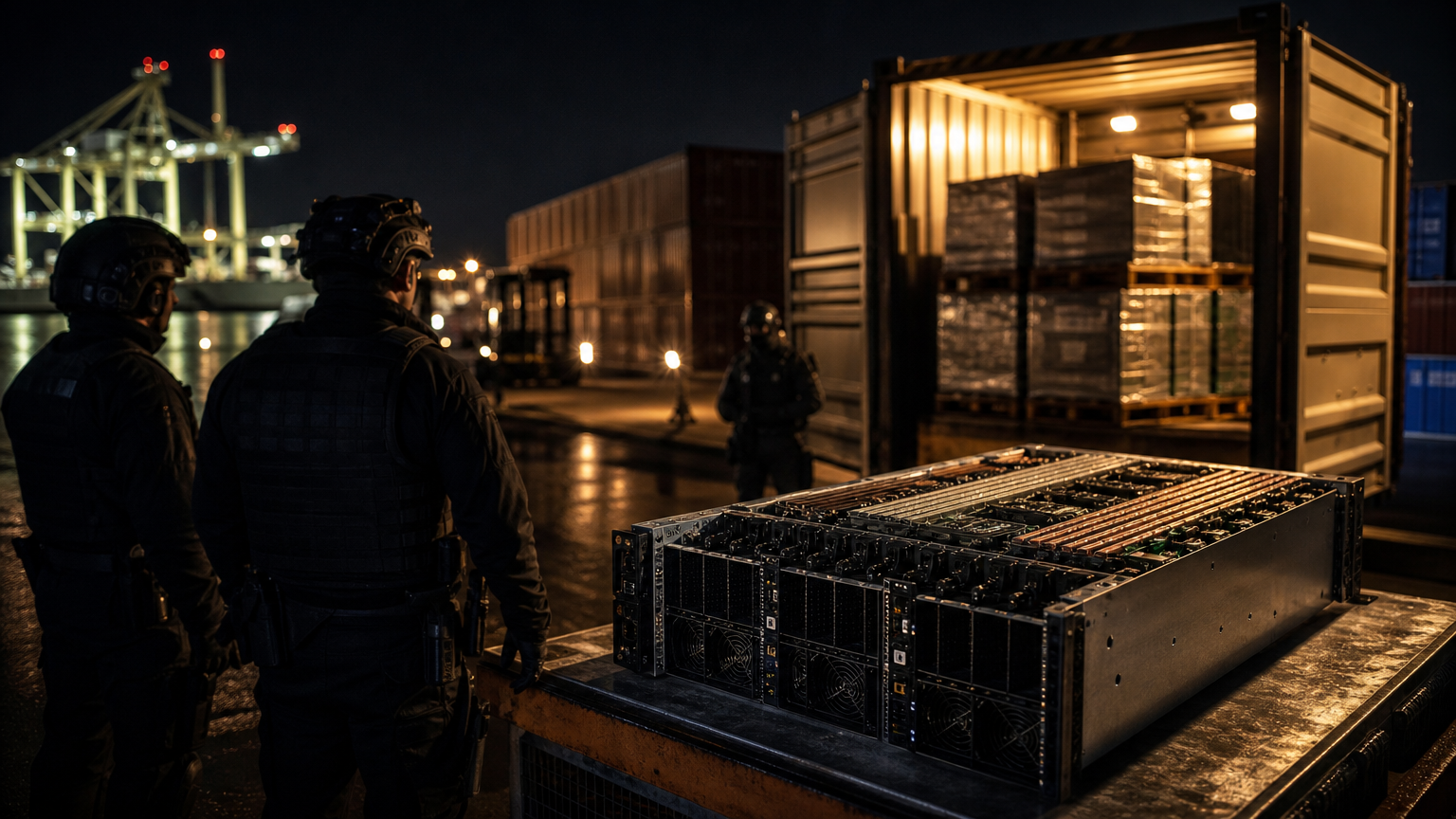
Taiwan is moving AI servers and advanced chips into the core of its export-control regime, turning unauthorized shipments to China into a criminal matter under the Foreign Trade Act. The shift follows U.S.-Taiwan trade commitments and recent Super Micro-linked smuggling investigations, and it gives prosecutors a sharper tool against gray-market routes feeding China’s AI supply chain.
A narrow rule with global consequences
Taiwan’s new export-control push is not a symbolic adjustment. Taipei plans to add artificial intelligence servers and cutting-edge semiconductors to its controlled-items list, and once the measures take effect, unauthorized shipments of restricted AI hardware to China will become a criminal offense under Taiwan’s Foreign Trade Act, Economic Affairs Minister Kung Ming-hsin told Bloomberg News . The immediate target is specific: AI servers and advanced chips moving toward China without authorization. The broader message is larger: Taiwan is no longer willing to be merely the manufacturing base through which other countries’ export-control rules are enforced indirectly.
The penalty is designed to change behavior. Reporting on the measure says violations could bring up to five years in prison and a fine of roughly $92,500, a step that would give Taiwanese prosecutors a direct export-control charge rather than forcing them to rely on adjacent offenses such as false documentation or fraud . That legal distinction matters because AI servers are not generic electronics. They are the dense hardware packages that turn advanced GPUs, networking, memory and power systems into training infrastructure for frontier models.
Kung linked the move to Taiwan’s commitments under a U.S.-Taiwan Agreement on Reciprocal Trade, saying some Taiwanese controls will correspond to American measures because Taipei made commitments in that pact . Taiwanese financial media also reported that the minister gave the same explanation in a Bloomberg interview on October 12, adding that the exact product scope and start date still await official publication . In practical terms, the story is not that every AI component is suddenly forbidden. It is that Taiwan is preparing to draw a criminal line around the classes of AI hardware most likely to be diverted into China’s restricted supply channels.
From compliance warning to criminal exposure
Until now, the legal gap has been obvious. Taiwan could warn exporters that shipping certain AI hardware to China might violate U.S. rules, but Taiwan did not have a direct criminal provision for unauthorized AI-chip exports to China under its own export framework . AI Affairs described the planned change as a way to give prosecutors a direct charge under the Foreign Trade Act once the items are added to the controlled list . That is the core of the policy shift: a suspect shipment would no longer have to be converted into a paperwork case before it could become a serious criminal matter.
That change follows months of pressure created by alleged smuggling schemes involving Nvidia-equipped servers. Tom’s Hardware reported that U.S. authorities have pursued one of their largest cases against three Super Micro-linked individuals, including co-founder Yih-Shyan “Wally” Liaw, who are accused of smuggling $2.5 billion worth of AI servers . The same report said Taiwanese authorities later raided Super Micro’s Taipei offices in connection with an Nvidia B300 smuggling probe that led to the indictment of nine people . Super Micro, Nvidia and Taiwan’s prosecutors sit at different points in that story, but the policy implication is the same: enforcement has moved from chips in the abstract to servers, purchase orders, end-user certifications and transshipment routes.
Taiwanese coverage also emphasized the same legal hinge. Economic Daily reported that Taiwan currently lacks a direct criminal penalty for unauthorized AI-chip exports to mainland China and that suspected smugglers have had to be pursued under other existing laws . Once the new controls take effect, shipping restricted AI hardware to China would be handled under the Foreign Trade Act rather than treated as a secondary compliance problem . That is why the five-year penalty is more than a headline number. It changes the risk calculation for distributors, brokers, logistics firms, financing intermediaries and data-center shell buyers.
Why Washington cares
The U.S. has restricted Chinese access to advanced AI chips for years, especially parts from Nvidia and AMD, but enforcement becomes difficult when the product is assembled, financed, warehoused or transshipped through third jurisdictions . Taiwan is central to that problem because it anchors much of the semiconductor and AI-server supply chain. It is not simply a supplier of chips; it is where advanced manufacturing, server assembly, board-level integration and high-value logistics intersect.
That is why alignment with U.S. rules matters. Bloomberg’s report, as summarized by Bloomberg Law, said Taiwan is tightening controls to align more closely with U.S. restrictions and join a broader clampdown on the smuggling of cutting-edge semiconductors to China . Tom’s Hardware added that the U.S.-Taiwan trade deal cut U.S. tariffs on Taiwanese goods to 15% in exchange for commitments including direct investment in the U.S. technology industry . The export-control move therefore belongs to a larger bargain: market access and industrial cooperation on one side, tighter policing of sensitive hardware flows on the other.
The policy also reflects a shift in how governments understand AI infrastructure. A single accelerator matters, but an export-controlled AI server matters more because it packages compute into a deployable form. Smugglers do not need to move a national AI factory in one shipment; they can move racks, boards, systems, replacement units and paperwork through a chain of friendly or careless intermediaries. A criminal rule aimed at servers therefore attacks the modular nature of the gray market.
Beijing, business and the gray market
The measure is likely to irritate Beijing. Tom’s Hardware noted that the policy may provoke China, which had already condemned Taipei after Taiwan placed Huawei and SMIC under export restrictions last year . From Beijing’s perspective, Taiwan aligning its rules with Washington’s technology controls looks like another layer in a U.S.-led containment strategy. From Taipei’s perspective, the issue is harder to separate from national security, legal credibility and the island’s role in the global AI supply chain.
For businesses, the immediate effect will be compliance friction. Distributors that previously treated end-user paperwork as a sales hurdle will have to treat it as criminal-risk evidence. Logistics firms will need to know not only where a shipment is going, but whether the declared destination is plausible for the hardware volume, power requirements and data-center infrastructure. Buyers claiming that servers will remain in Taiwan may face deeper checks, especially if the transaction structure involves shell companies, sudden rerouting or unusual overseas intermediaries.
Cnyes reported that the new measures’ exact items, scope and implementation method still need government publication . That uncertainty matters. Companies will need thresholds: which AI servers, which accelerators, which semiconductor generations, which end users, which destinations and which re-export scenarios. A vague regime can chill legitimate trade; a precise regime can make enforcement more predictable. The policy challenge for Taipei is to close the smuggling loophole without trapping ordinary electronics trade in an overly broad dragnet.
The new enforcement center of gravity
The significance of Taiwan’s move is that it places enforcement directly around the hardware that trains frontier AI systems. Export controls used to be discussed mainly as licensing paperwork between governments and chip vendors. This case shows a different model: prosecutors, customs officials, distributors, server makers and data-center operators all become part of the enforcement perimeter.
If implemented as described, the policy will push the global AI hardware market toward stricter traceability. Whitelisted buyers, end-use declarations, post-shipment audits and distributor due diligence will become more important. Gray-market routes through third countries will not disappear, but they will become more expensive and legally dangerous. The weakest link in a diversion scheme may no longer be the chip vendor; it may be the broker who cannot prove where the server actually went.
Taiwan’s decision also underscores how AI competition is becoming physical again. Models may be digital, but the leverage sits in power-hungry boxes full of restricted silicon. By criminalizing illicit exports of those boxes to China, Taipei is telling the market that AI compute is now treated less like ordinary IT equipment and more like strategic infrastructure. For smugglers, the difficulty setting just changed from paperwork puzzle to prison-risk hard mode.
Sources from the last 72 hours
- [1]Taiwan to Curb AI Chip Exports to China as Part of US Trade DealOct 16, 2026, 7:49 AM
- [2]Taiwan targets illicit AI server exports to China with five-year prison terms — strict new controls follow US tariff deal and Super Micro raidOct 17, 2026, 2:00 AM
- [3]AI 晶片走私大陸將追刑責 龔明鑫:台灣擬加緊出口管制與美接軌Oct 16, 2026, 8:26 AM
- [4]《彭博》專訪龔明鑫 台灣準備對中國緊縮AI晶片出口管制Oct 17, 2026, 12:20 AM
- [5]Taiwan plans criminal penalties for unauthorised AI chip exports to ChinaOct 16, 2026, 3:00 PM
AI-generated article based on recent web research, then preserved as a dated editorial snapshot.
Comments
Be the first to comment.