
Daily Podcast full article
New Elon Musk's Tesla Bot Optimus Gen 3 Capabilities Leaked
Tesla’s latest Optimus Gen 3 leak points to a less prototype-like humanoid: smoother body panels, hidden joints, more human proportions, upgraded hands, tactile sensing and a production strategy tied to Cybercab-style factory redesign. The important caveat is that the freshest reporting still frames many details as leaked or reported, not as a formal Tesla launch.
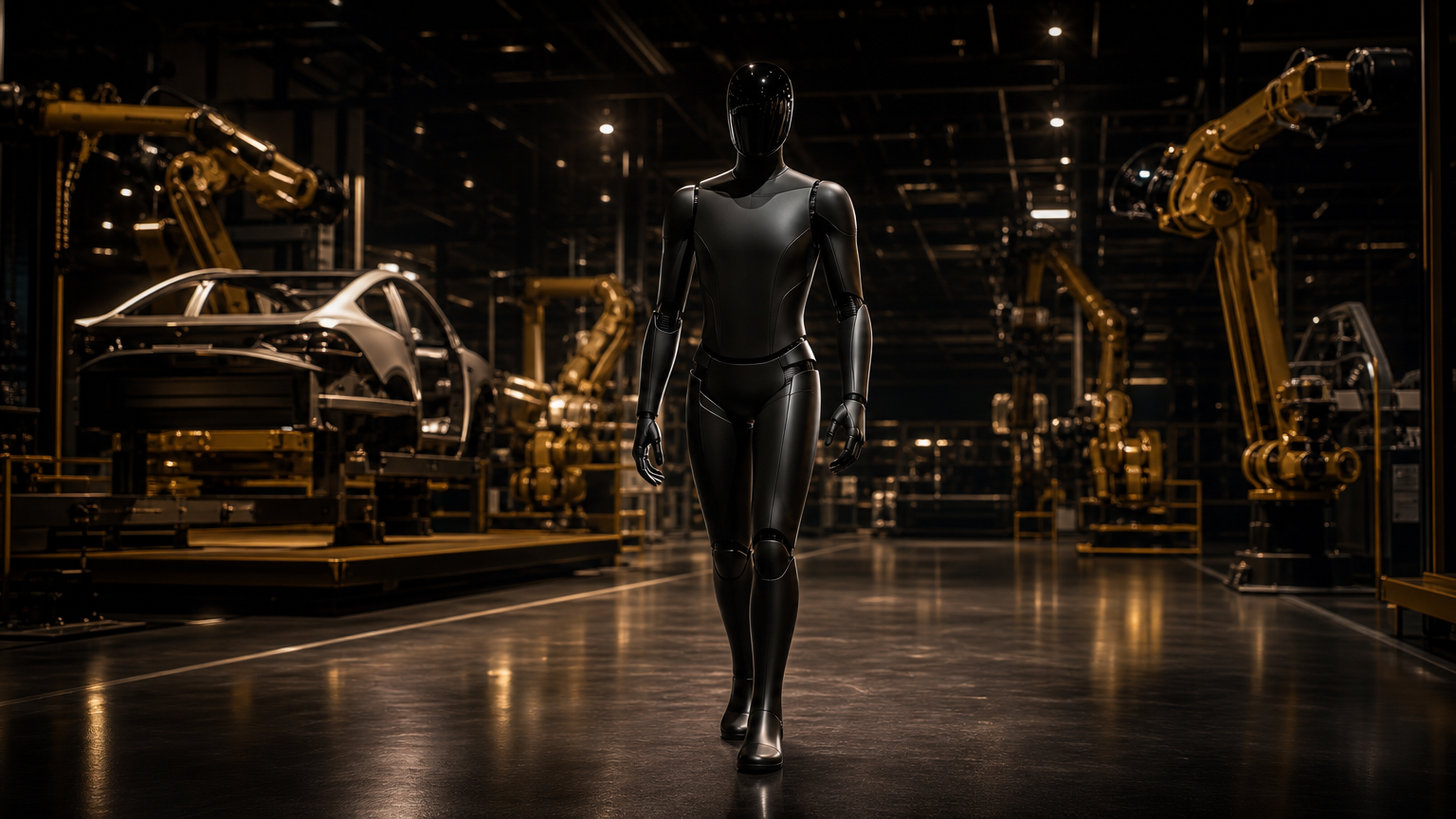
A leak that makes Optimus look less like a lab robot
The new Optimus Gen 3 story is not just about another Tesla robot render. It is about Tesla trying to move the Bot from “interesting demonstration” toward something that could survive daily work in factories, warehouses and eventually homes. The latest report describes a humanoid with a smoother shell, fewer exposed mechanical elements and darker exterior components replacing some of the earlier, more industrial-looking surfaces .
That matters because exposed linkages, wiring and drive mechanisms are not only aesthetic problems. In a practical robot, they are snag points, dust traps, service risks and safety concerns. The reported Gen 3 direction suggests Tesla wants Optimus to look more like a finished appliance and less like a walking engineering bench . The redesign reportedly includes hips, knees and ankles that more closely follow human proportions, which could help the robot navigate spaces built for people rather than for industrial machines .
The leak therefore sits at the intersection of form and function. A cleaner exterior can be read as styling, but in robotics it also signals a push toward longer duty cycles, easier cleaning, simpler maintenance and safer operation around people. If earlier Optimus versions were meant to prove that Tesla could make a humanoid walk and manipulate objects, this version appears aimed at proving the machine can be packaged for real use .
Hands are the center of the upgrade
The most consequential reported change is in the hands. The leak says Optimus Gen 3 is expected to move toward 22 degrees of freedom in each hand, compared with roughly 11 on Gen 2 and about 20 on the interim Optimus 2.5 design . For a humanoid robot, that difference is not cosmetic. Hand dexterity determines whether the machine can do more than carry boxes, press buttons and perform carefully rehearsed tasks.
A hand with more controllable motion can wrap around irregular objects, regrip tools, stabilize a glass, turn a handle and manipulate soft or fragile materials. The report also says Tesla may shift more drive mechanisms into the forearms, which could reduce hand weight and improve precision at the fingertips . That would be consistent with a broader design goal: make the hand less like a bulky gripper and more like a fast, sensor-rich human tool.
However, the exact specification picture remains unsettled. A current RobotHub ranking lists Optimus Gen 3 with 75 total degrees of freedom and 25 hand degrees of freedom, which differs from the 22-hand-DOF figure in the leaked-capability report . That discrepancy is a useful reminder that the public still does not have a confirmed Tesla spec sheet for Gen 3. The direction is clear: more dexterity. The final number is not.
Touch sensing is what could make dexterity useful
More joints alone do not make a robot useful. Without tactile feedback, a hand can be highly articulated and still clumsy. The latest report says Tesla is developing a 3D tactile touch sensor system with sharply increased sensing density in the hands, including force sensing at the fingertips and across the palms . If accurate, that could be one of the most important practical upgrades in Gen 3.
Tactile sensing would let Optimus adjust grip pressure in real time. The same robot could hold a fragile glass, lift a heavier object, slide a part into place or detect that an item is slipping . The report cites a target lifting capacity of about 40 pounds, or just over 18 kilograms, while also describing the goal of kitchen-level delicacy . That combination is the whole challenge of a general-purpose humanoid: the machine must be strong enough for warehouse work but careful enough for homes.
This is where the leak becomes more ambitious than a design refresh. A sealed shell and human-like proportions make Optimus easier to imagine in ordinary environments, but tactile sensing is what might allow it to perform useful work without constant resets and supervision. In other words, Gen 3’s real test is not whether it can look polished in a render. It is whether it can recover when an object shifts, a surface is slippery or a human gives an imprecise instruction.
AI5, batteries and the autonomy question
The report also connects Optimus Gen 3 to Tesla’s future AI5 computing platform. AI5 is described as offering about eight times the computing power of AI4, more than nine times the memory capacity and roughly five times the memory bandwidth . That matters because a humanoid robot has to perform several demanding tasks simultaneously: perception, balance, object recognition, hand control, path planning and speech interpretation.
The catch is timing. The same report says AI5 is aimed at mass production in 2027, meaning current or near-term units may still rely on earlier hardware . That creates a gap between the Gen 3 capability story and the near-term deployment story. Tesla can design around AI5, but it still has to build, validate and support robots using whatever hardware is available during the ramp.
Battery life is another area where the leak points to refinement rather than a bigger brute-force pack. Optimus Gen 3 is expected to keep a battery near 2.3 kilowatt-hours while moving to 4680 cells, with efficiency gains from lighter structure, improved actuators and lower-power computing . The reported operating target is six to eight hours for routine work, about five hours under heavier loads, and one to two hours of charging . If those numbers hold, they would place Optimus closer to a work-shift machine than a short demo platform.
Production: the biggest unknown
The freshest production checks are more cautious than the capability leak. Offbrand Human’s October 17 production log says Tesla has not published a cumulative Optimus build count and that the promised Gen 3 public reveal had not happened in the terms it reviewed . It also notes that Tesla’s production promises remain easier to track as targets than as confirmed output .
That caution is important. The HelloBro report says Tesla appears to be scaling internal deployment first, with discussion of Fremont output ramping to hundreds of robots per week and possibly toward 1,000 per week . But the separate production log emphasizes that no official cumulative number has been published . Put together, the picture is not “Optimus Gen 3 is now fully launched.” It is “Tesla appears to be preparing a more production-oriented robot, but the public evidence still lacks verified unit counts.”
Investors are clearly watching that gap. A current report on Tesla’s Q3 earnings process says the company opened shareholder questions ahead of its October 21 call, with Cybercab, Robotaxi, Optimus and regulators expected to loom over the discussion . The same report notes that earlier investor questions asked where the Optimus Gen 3 ramp stood . That makes the next investor Q&A a natural place for Tesla to either confirm progress or leave the leak-driven narrative unresolved.
Cybercab and the factory logic behind the robot
The Optimus leak is paired with a Cybercab production story because both projects depend on Tesla’s ability to redesign manufacturing, not just products. The report describes Cybercab’s unboxed process as parallel assembly of major vehicle modules, including front, rear, side structures, roof and structural battery pack, followed by a final joining operation . It says the approach could reduce line length by about half, cut floor space by roughly 40 percent and lower labor needs by around 30 percent .
Cybercab is also described as using large front and rear castings, a proposed 50,000-ton Gigapress and colored reaction-injection-molded exterior panels that could reduce or eliminate parts of the traditional paint-shop process . The reported target is a 10-second manufacturing cadence for key production steps, with Tesla comparing that ambition against a roughly 34-second Model Y line-rate benchmark .
That matters for Optimus because a humanoid robot is only transformative if it can be built in large numbers at tolerable cost. The same mindset behind Cybercab’s simplified assembly appears to frame the Optimus plan: fewer bottlenecks, higher repeatability and a factory designed around scale rather than hand-built prototypes.
What the leak really tells us
The leak points to a Tesla Bot that is more human-shaped, more sealed, more dexterous and potentially more sensor-rich than earlier versions . The most credible interpretation is not that Gen 3 has suddenly solved humanoid robotics. It is that Tesla is converging on the hardware package it believes can be manufactured and trained at scale.
The open questions are still large. Tesla has not provided a public Gen 3 spec sheet, verified production count, consumer order page or final price . Current reporting shows investor pressure building around those gaps ahead of the October 21 earnings call . Until Tesla confirms the details, Optimus Gen 3 should be treated as an advanced leaked roadmap rather than a finished commercial product.
Still, the direction is significant. If the reported hands, tactile sensing, AI5 roadmap, battery targets and sealed body design are accurate, Optimus Gen 3 is less about stage theatrics and more about the unglamorous engineering needed to make a humanoid work repeatedly in the real world. That is where Tesla’s robot story will either become industrially meaningful or remain a spectacular promise waiting for proof.
Sources from the last 72 hours
- [1]New Elon Musk's Tesla Bot Optimus Gen 3 Capabilities Leaked · Tesla · HelloBro.aiOct 17, 2026, 1:24 PM
- [2]Tesla Optimus 3 production updates: the dated logOct 17, 2026, 2:00 AM
- [3]Tesla opens the Q&A for its biggest earnings call yetOct 15, 2026, 2:00 AM
- [4]Humanoid Robot DOF Ranking - Specs, Companies & Comparison | RobotHubOct 16, 2026, 2:00 AM
AI-generated article based on recent web research, then preserved as a dated editorial snapshot.
Comments
Be the first to comment.