
Daily Podcast full article
Mythos 5 and Google Just Broke Quantum Computing
Anthropic’s Claude Mythos 5 has shown that frontier AI can search for leaner quantum circuits from plain-language specifications, while Google Quantum AI has demonstrated magic-state cultivation on Willow hardware. Together, the two October 2026 results point to the same bottleneck from opposite sides: useful quantum computing needs both smarter algorithms and cleaner fault-tolerant operations.
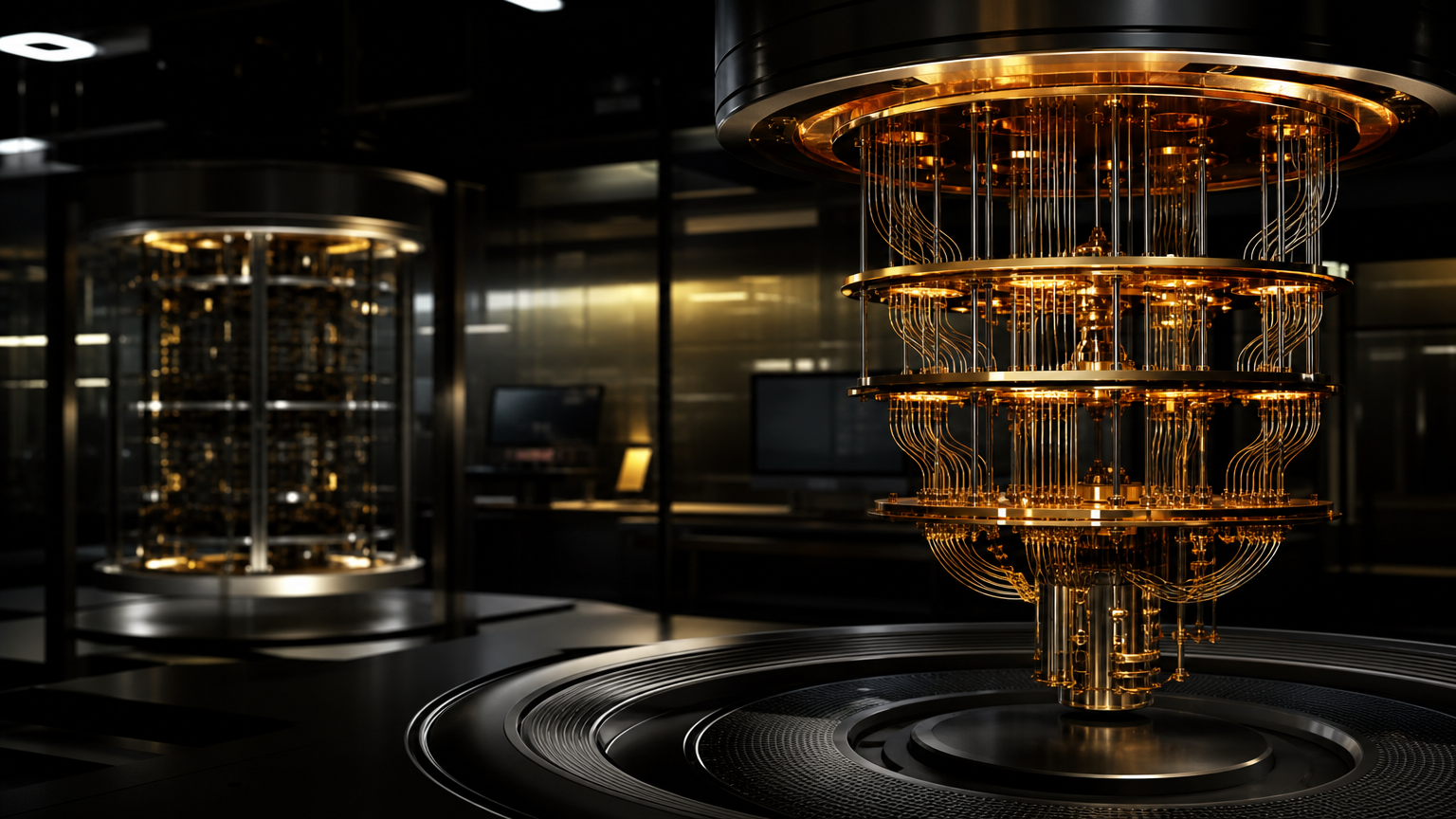
Two breakthroughs, one message
The working headline is the story: Mythos 5 and Google Just Broke Quantum Computing. Not in the sense that a useful universal quantum computer suddenly arrived, and not in the sense that encryption, chemistry or optimization were solved overnight. The shift is subtler and arguably more important: two of the field’s most stubborn cost centers were hit at once.
On the software side, Anthropic reported that Claude Mythos 5 designed more efficient quantum circuits from plain-language task descriptions, with an automated evaluator checking correctness and scoring resource use . On the hardware and error-correction side, Google Quantum AI reported that “magic state cultivation” worked on its Willow processor, reducing errors by about 40 times compared with uncultivated states and producing T-states with 99.99% logical fidelity .
Those are very different achievements. Anthropic’s result is a circuit-design result, not a run on a quantum processor. Google’s result is a physical hardware demonstration, not a general-purpose quantum application. But taken together, they update the same roadmap: practical quantum computing depends on cutting the cost of the circuits we want to run and cutting the cost of the error-corrected operations needed to run them.
What Claude Mythos 5 actually did
Anthropic gave Claude Mythos 5 eight quantum-circuit design tasks drawn from areas including chemistry, optimization, physics simulation, number theory and numerical computation . The model did not merely answer a benchmark multiple-choice test. It worked in a loop: propose a Python implementation, send it to an independent evaluator, receive a correctness result and a resource score, then revise the design .
The evaluator mattered because quantum circuits can look clever while being useless if they compute the wrong reversible transformation. In Anthropic’s setup, the external software first checked whether a candidate was correct, then scored it using qubit counts and gate counts as proxies for scarce hardware and runtime resources . The arXiv paper describes this as an evolutionary framework in which large language models propose circuit designs and an independent evaluator verifies and scores them .
The headline result is strong but needs precise wording. The paper says that in seven of eight tasks, the discovered circuits significantly reduced both Toffoli-gate counts and qubit counts relative to the state of the art . In the eighth task, the system found a new reversible architecture for prime-field modular inversion, improving the trade-off between Toffoli gates and qubits rather than simply lowering both in a directly comparable way .
That distinction is important. “AI beat humans at quantum circuit design” is too broad; “Claude Mythos 5 found better evaluated circuit designs on a specific set of reversible quantum primitives” is closer to the evidence. The work shows AI as a search partner inside a formal scoring loop, not as a magical oracle.
Why gates and qubits are the right battlefield
Quantum computers are constrained by two linked shortages: they need enough qubits to hold information and enough reliable operations to finish before accumulated errors overwhelm the computation. Anthropic emphasizes Toffoli gates because they are expensive operations in fault-tolerant quantum algorithms and are often used as a runtime proxy . It emphasizes qubits because future error-corrected machines will have to spend many physical qubits to protect each logical qubit.
That makes a circuit with fewer gates and fewer qubits more than an academic improvement. It can lower the size of the machine required for a useful task, reduce runtime and reduce exposure to accumulated failure. Anthropic frames the work against the history of FeMoco simulation, where estimates for a key chemistry calculation fell dramatically over years of human algorithmic improvements . The point is not that Claude solved FeMoco, but that circuit redesign has historically moved quantum practicality by huge factors.
One reported example is especially revealing: elliptic-curve point addition. Anthropic says Claude’s design emerged from a 53-hour run and produced a new reversible approach to modular inversion, a costly arithmetic step in elliptic-curve calculations . Independent summaries of the paper note that one comparison used roughly 12% more qubits but about 17 times fewer gates, illustrating that the best quantum design is often a negotiated trade-off rather than a single number .
Google attacks the “magic” bottleneck
Google’s result hits a different bottleneck: fault-tolerant quantum computers need special resource states, often called magic states, to execute non-Clifford operations required for universal computation . These states are powerful but costly. Google notes that some estimates have put magic-state production as high as 95% of a quantum computer’s capacity, leaving relatively little hardware for the actual computation .
Magic state cultivation is a filtering strategy. A noisy state is injected into a small region of the chip, the system performs coordinated measurements to check for errors, and flawed attempts are rejected . The goal is to grow or “cultivate” a cleaner resource state in a way that could reduce the overhead compared with traditional approaches.
Google says the protocol ran on its Willow superconducting processor and achieved about a 40-fold reduction in errors relative to uncultivated states . It also reports T-states with a record logical fidelity of 99.99% . Quantum Computing Report, summarizing the Science milestone, describes the work as the first physical hardware implementation of magic state cultivation and notes that the result produced T-states with 99.99(1)% logical fidelity, corresponding to an error rate at or below 0.0001 .
The caveat: neither result is “quantum computing solved”
The honest reading is more exciting than the hype. Anthropic did not demonstrate a new quantum computer; it demonstrated an AI-assisted method for designing cheaper circuits that future fault-tolerant quantum computers may run . Google did not demonstrate a useful commercial quantum application; it demonstrated a hardware error-correction ingredient that must still scale .
Google itself says larger-scale demonstrations are still needed before magic state cultivation becomes realistic for practical quantum computing . The Google result also concerns one crucial operation pipeline, not the entire stack of logical qubits, real-time decoding, scheduling, memory, compiler support and application-level algorithms needed for a useful machine.
Likewise, Anthropic’s evaluator-guided loop works best where correctness can be checked and resource use can be scored objectively. That is a powerful class of problems, but not every scientific discovery can be reduced to a clean evaluator. The lesson is not that AI replaces quantum theorists; it is that AI can explore design spaces quickly when the problem can be encoded, tested and scored.
Why the combination matters
The striking part is that these breakthroughs meet in the middle. Anthropic is shrinking the circuits. Google is improving the expensive fault-tolerant resources needed to execute difficult circuits. If both trends continue, they multiply rather than merely add.
Imagine a future quantum chemistry workload. A better algorithm may cut the number of expensive gates. A better magic-state factory may lower the cost of supplying those gates. Better error correction may reduce physical-qubit overhead. Better compilers may adapt the algorithm to the hardware. The useful machine arrives not from one miracle, but from stacked reductions across the pipeline.
That is why the October 2026 news feels like a firmware update for the entire field. Claude Mythos 5 suggests that AI systems can become active co-designers of quantum algorithms. Google’s Willow demonstration suggests that a key theoretical error-correction idea can survive contact with real superconducting hardware. Neither is the finish line. Both make the map shorter.
The new race: evaluators, hardware and proof
The next phase will be about verification. For Anthropic, the important questions are whether other groups reproduce the circuit improvements, whether the designs integrate into larger algorithms, and whether the evaluator-guided process generalizes beyond the eight selected tasks. For Google, the questions are scale, yield, integration and whether magic state cultivation remains attractive when embedded in a full fault-tolerant architecture.
The deeper trend is clear: quantum computing is becoming a co-design problem across AI, algorithms, error correction and devices. Mythos 5 pushes on the abstract circuit layer. Google pushes on the physical resource-state layer. The field needs both.
So did Mythos 5 and Google “break” quantum computing? In the productive sense, yes. They broke two assumptions: that quantum circuit design must move only at human research speed, and that magic-state production must remain an overwhelming bottleneck. What remains is the harder part: turning these breakthroughs into a scalable, useful, fault-tolerant quantum computer.
Sources from the last 72 hours
- [1]Designing more efficient quantum circuits with ClaudeOct 16, 2026, 2:00 AM
- [2]Bringing the magic: Google breaks open a bottleneck in quantum computingOct 15, 2026, 2:00 PM
- [3]Anthropic says Claude Mythos 5 reduced gate and qubit counts in seven of eight tasksOct 17, 2026, 2:00 AM
- [4]Google Quantum AI Demonstrates Magic State Cultivation on Willow Processor in Science MilestoneOct 15, 2026, 2:00 PM
- [5]Discovering state-of-the-art quantum circuits with large language modelsOct 15, 2026, 7:59 PM
AI-generated article based on recent web research, then preserved as a dated editorial snapshot.
Comments
Be the first to comment.