
Daily Podcast full article
No One Realizes What OpenAI Just Created
OpenAI’s 722-paper math release is not simply a viral “AI solved mathematics” moment. The current story is more interesting: a private model generated a research-scale proof corpus, the catalogue has already been corrected to 719 manuscripts, roughly 42% of top-line results are Lean-formalized, and the human mathematics community is now being funded to inspect, translate and decide what counts as knowledge.
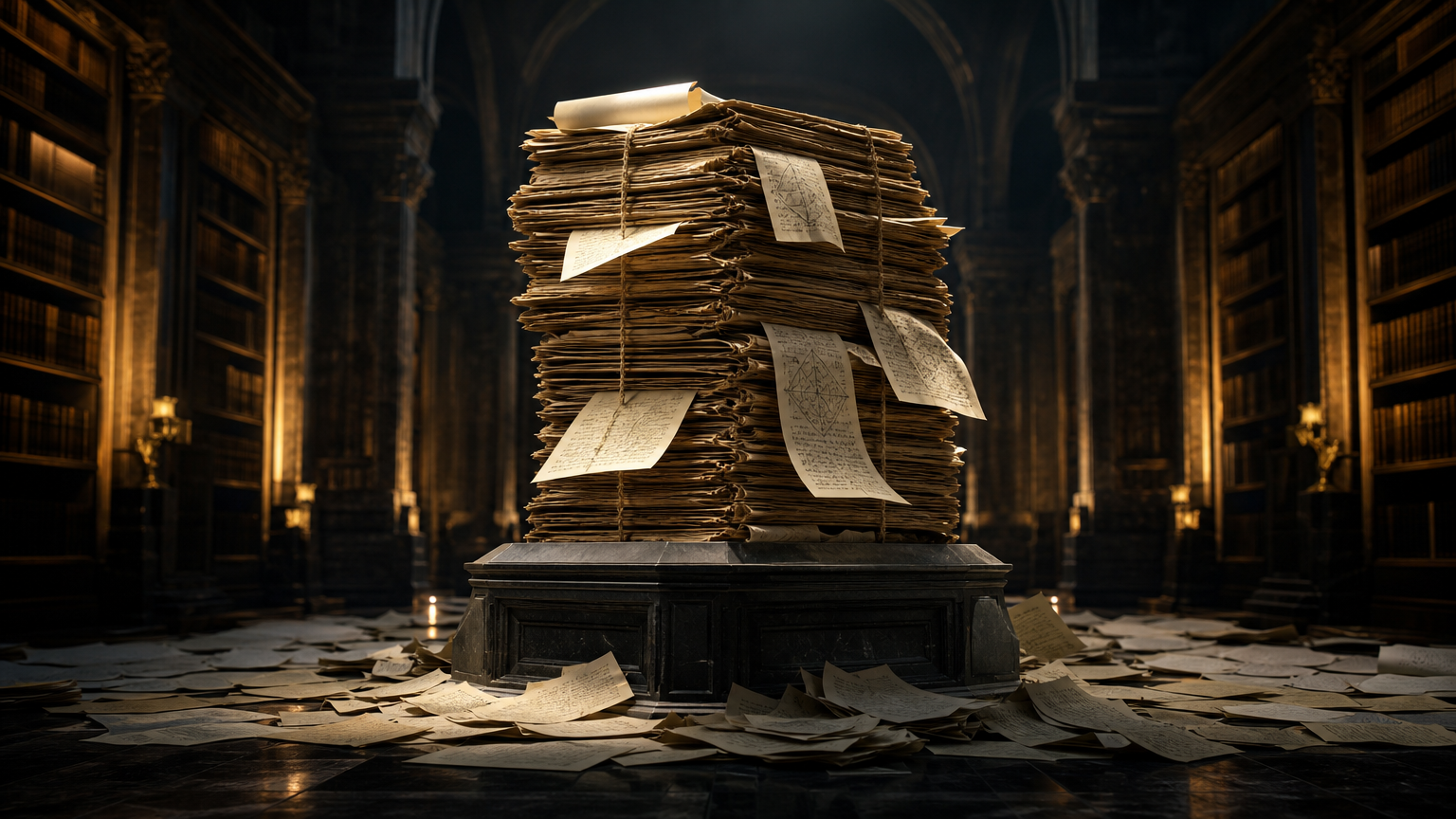
The headline number is already outdated
The working headline is No One Realizes What OpenAI Just Created — and the reason it matters is that the creation is not just a pile of PDFs. It is a new research workflow: an AI system produces candidate mathematics at industrial scale; a public repository exposes the outputs; formal proof tools check part of the corpus; and human mathematicians become the bottleneck between machine output and accepted knowledge.
OpenAI’s October 6 release was described as 722 AI-written mathematical manuscripts from an unreleased internal model, grouped into 372 result families and drawn from an evaluation involving about 4,000 problems . But the live count has already changed: after three withdrawals, the catalogue is now reported as 719 manuscripts, while the 372-family structure remains the organizing frame . That distinction matters. “722” is the historical shock number; “719, under active correction” is the more accurate current state.
The correction was not cosmetic. A sign error in one manuscript reportedly invalidated an argument and affected two dependent papers, leading OpenAI to withdraw three manuscripts and revise 14 others with proof repairs, clearer hypotheses or corrected statements . In ordinary academic publishing, three withdrawals from a first release would be damaging. In this case, it also demonstrates why the release should be treated as a corpus under verification, not as a finished encyclopedia of solved problems.
What OpenAI actually created
The most important object here is not a single theorem. It is a proof-production pipeline.
According to current reporting on the repository, the model was posed thousands of open research problems, produced candidate results, and the public release gathered the surviving outputs into families across mathematical disciplines . OpenAI has not publicly released the model itself, so outside researchers cannot yet reproduce the generation process, inspect the prompting strategy in full, or test whether the system can reliably do the same thing on a new set of problems. The public artefact is therefore a record of outputs, not an open model launch.
That difference is central to understanding the moment. If the manuscripts are mostly right, OpenAI has shown that AI can generate research-level mathematical work faster than existing institutions can absorb it. If many are wrong, OpenAI has still shown something disruptive: current AI systems can flood expert communities with plausible, technically dense work that must be checked before it can be trusted. Either outcome changes the economics of expertise.
The current repository status also reveals a split between formal and informal proof. About 42% of top-line results are reported to have Lean machine-checked formalizations . Lean matters because it forces a proof into a form that a computer kernel can verify step by step. But it is not a magic stamp of mathematical significance. A Lean-checked proof can verify a particular formal statement while leaving open questions about exposition, novelty, dependence on assumptions, or whether the formalized claim is exactly the headline claim mathematicians care about.
The unformalized majority is the real stress test. OpenAI’s own materials, as summarized in current coverage, acknowledge that unformalized results may contain issues . That is the gap between “AI produced a manuscript” and “mathematics has absorbed a theorem.”
The latest development: paying humans to understand the machine
The most important update in the last 72 hours is not another proof. It is money for interpretation.
On October 15, OpenAI and Anthropic backed a $15 million Simons Foundation initiative, with OpenAI contributing $5 million, to help mathematicians analyze AI-generated discoveries . The initiative is aimed at workshops, conferences, grants and standards for evaluating AI proofs, and OpenAI has pledged access to models and computing resources for researchers supported by the foundation .
A separate October 16 report framed the same program as an effort to put independent checking and shared methods beside model access, emphasizing that the Simons Foundation will manage an open call and support evaluation of AI-assisted results . That governance point is important. If AI labs produce the outputs, fund the checking and control the models, the mathematics community has to ask who sets the standards for acceptance. A foundation-managed program does not remove every conflict, but it creates a more credible layer between the vendor and the verdict.
This is the part many headlines miss. OpenAI did not merely publish manuscripts and walk away. It has now helped finance the human process required to turn AI output into mathematical understanding. That is an admission, whether explicit or not, that generation is no longer the only scarce resource. Verification, prioritization and explanation may now be equally scarce.
Why this is not “AI solved math”
The release should not be read as 719 or 722 confirmed breakthroughs. It is a large collection of proposed results at different stages of verification. Some have machine-checkable Lean proofs; others do not . Some were already withdrawn or revised within a day . The model remains unreleased, and the community has not had time to assess priority, elegance, correctness or importance at the level mathematics normally requires.
That caution does not make the event small. It makes it more serious.
A chatbot solving a contest problem is impressive. A private frontier system generating hundreds of research manuscripts is a different category of claim. It creates a new asymmetry: producing mathematical text may become cheap, while confirming that the text is true, novel and meaningful remains expensive. One recent analysis described OpenAI’s release as giving mathematicians a body of work to assess, with about 42% of top-line results formalized when checked, and connected the October 15 funding pledge to the cost of understanding AI-assisted mathematics .
That is the real story. AI may be moving mathematics from a discovery-limited regime to an absorption-limited regime. In the old regime, the hard part was finding a proof. In the new regime, the hard part may be deciding which machine-produced proof deserves months of human attention.
The bottleneck has moved
For decades, proof assistants like Lean were seen as specialized tools for formal verification. OpenAI’s release suggests they may become the auditing layer for AI-generated research. But even that layer is not enough by itself. Formal verification can check logical validity; it cannot automatically decide whether a theorem is valuable, whether a proof gives insight, or whether a field should reorganize around a new technique.
That is why the Simons initiative matters. The announced funding is not just charity for overwhelmed mathematicians. It is infrastructure for a new scientific workflow: AI proposes, proof assistants verify where possible, and humans curate, explain and decide what enters the shared body of knowledge .
The criticism of the release also fits this pattern. Mathematicians objected not only to possible errors, but to the burden imposed by a mass dump of technical claims . A community built around slow peer review, seminars and careful exposition is being asked to process machine-scale output. The mismatch is institutional, not merely technical.
What to watch next
The next phase will not be decided by the launch headline. It will be decided by slower signals.
First, watch the formalization percentage. If the Lean-checked share rises substantially from about 42%, confidence in the corpus will improve . Second, watch the withdrawal and revision history. A few early corrections are normal for an experimental release; a sustained pattern of deep failures would be more damaging. Third, watch whether independent mathematicians publish expository versions, simplified proofs or new follow-on results. That is how machine output becomes human mathematics.
Finally, watch governance. The $15 million Simons effort suggests that the field is moving toward shared standards for AI-assisted proof, but those standards are not settled yet . The question is no longer whether AI can write impressive mathematics. The question is who gets to certify it, explain it and decide what it means.
That is what OpenAI just created: not the end of mathematics, but a prototype of mathematics after proof generation becomes abundant.
Sources from the last 72 hours
- [1]OpenAI put 722 AI-written math papers on GitHub. One sign error took three of them down the next dayOct 16, 2026, 2:00 AM
- [2]OpenAI donates $5 million to help mathematicians ‘understand’ AI after backlashOct 15, 2026, 7:02 PM
- [3]Simons Foundation starts a $15M programme for mathematics and AIOct 16, 2026, 2:00 AM
- [4]The mathematicians’ problem is becoming OpenAI’s problemOct 17, 2026, 2:00 AM
AI-generated article based on recent web research, then preserved as a dated editorial snapshot.
Comments
Be the first to comment.