
Daily Podcast full article
OpenAI confirms humanoid robot project
Sam Altman has confirmed that OpenAI intends to build a humanoid robot, turning the company’s “physical AI” ambitions into a concrete hardware direction. The confirmation does not come with a product, price, launch date or production plan, but it reframes OpenAI’s next frontier: not only smarter models on screens, but AI systems that can perceive, move and act in human spaces.
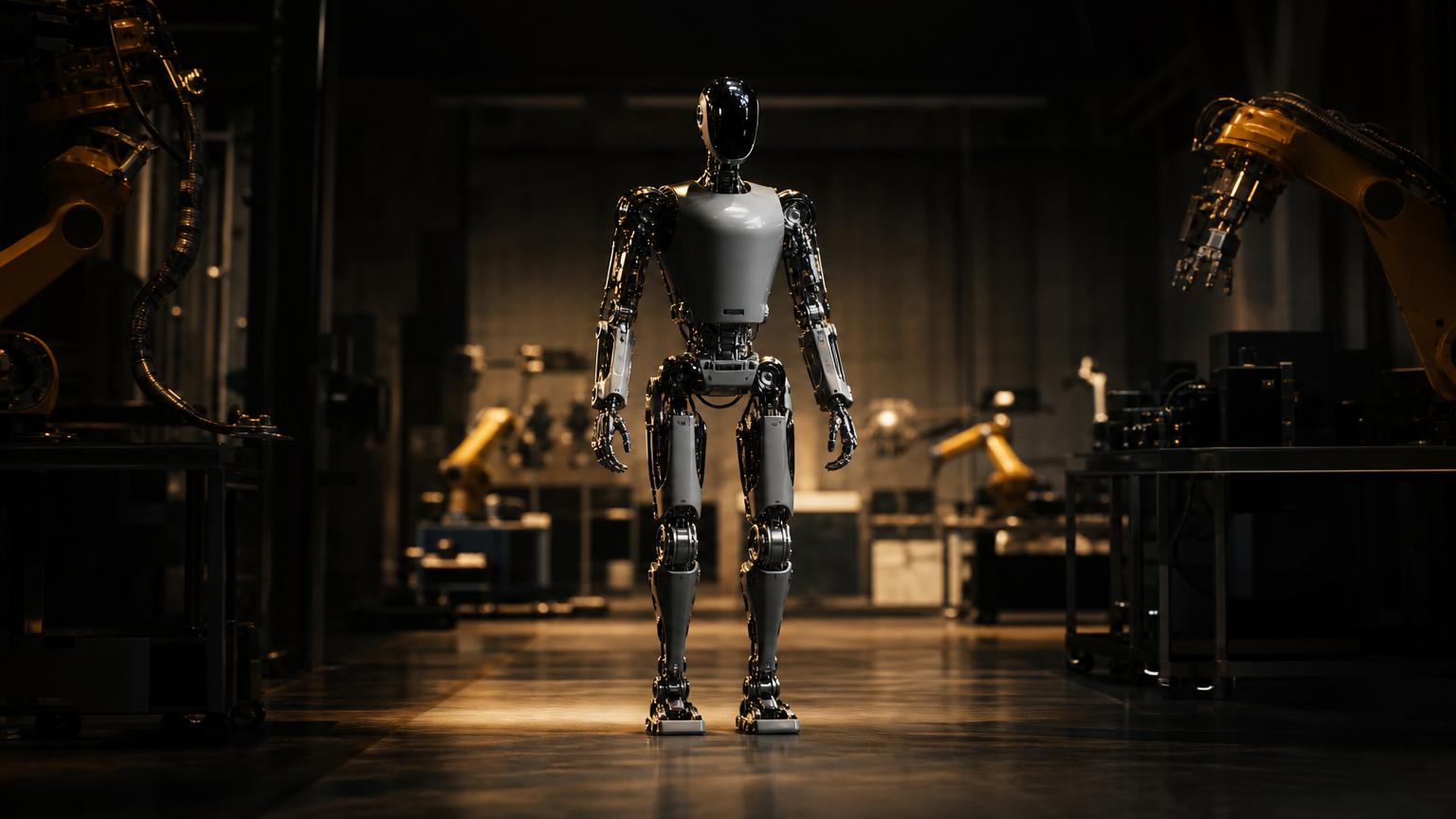
OpenAI steps beyond the chatbot
OpenAI’s robotics plan is no longer just an inference drawn from hiring pages or partnership history. CEO Sam Altman has now said the company will build a humanoid robot, with the project framed around a simple idea: the world is built for people, so a general robot meant to work in that world may need a human-like form . In the exchange reported by Engadget, Altman’s answer to whether OpenAI would actually build one was short and direct: “We will” .
That is a meaningful shift for a company still best known for software: ChatGPT, frontier models, coding agents, image and video tools, and the cloud infrastructure needed to run them. A humanoid robot is a different kind of bet. It requires sensors, actuators, batteries, thermal systems, safety testing, manufacturing, repair networks and real-world data pipelines. It also exposes the company to physical risks that do not exist when an AI answer stays inside an app.
For now, the announcement should be read as a strategic confirmation, not a product launch. OpenAI has not disclosed the robot’s design, price, release date, subscription model, manufacturing partner or privacy framework . That silence matters. A machine with cameras, microphones and mobility inside a workplace or home would raise questions that are much more concrete than the usual debate over chatbot data retention.
Why a humanoid shape?
Altman’s argument for a humanoid robot is not that two arms and two legs are inherently magical. It is that doors, keyboards, tools, kitchens, offices and work sites were designed around human bodies . A robot that can operate in those environments without requiring the world to be rebuilt may benefit from matching the rough proportions and movement patterns of a person.
That does not mean every OpenAI robot would be humanoid. Reporting around the remarks indicates the company is also thinking about other robot forms for specialized uses, while the humanoid path is aimed at general-purpose interaction with human spaces . The distinction is important. A wheeled platform may be better in a warehouse aisle; a fixed arm may be better on a factory line. A humanoid is the more ambitious option when the goal is flexibility across existing human environments.
The consumer fantasy is obvious: a physical ChatGPT that can carry groceries, load a dishwasher, help an elderly person, or fetch a tool from another room. But OpenAI’s near-term objective appears more practical. One robotics job posting cited in recent coverage describes a short-term goal of building general-purpose robots that help skilled workers construct infrastructure, while the longer-term goal is a personal robot that can help with a wider range of tasks .
That staged approach is revealing. OpenAI is not presenting the first version as a domestic companion. It is starting closer to skilled labor, infrastructure and controlled work environments, where tasks can be constrained and the business case may be easier to justify.
The “brain” is the hard part
Altman’s most important point may be that the robot’s body is not the central challenge. He said the details of what the robot looks like are less important than figuring out the “brain that makes the robot work” . That phrase captures why robotics is such a hard extension of generative AI.
A useful humanoid cannot merely recognize objects or produce plans in language. It must link perception, reasoning and motion in real time. If it is asked to pick up a mug, it needs to identify the mug, locate the handle, estimate weight and orientation, choose a grip, apply the right force, lift without spilling and recover if the mug slips. Each step depends on feedback from the physical world.
Recent summaries of the story emphasize the same point: the “brain” includes perception, planning, control and the ability to correct actions when the world does not behave like a clean simulation . That is where embodied AI differs from a chatbot. A text model can be wrong and revise its answer; a robot can drop a glass, hit a doorframe or injure someone.
OpenAI’s current robotics hiring points in that direction. Coverage of the company’s careers page says roles span motion control, state estimation, actuator control, whole-robot behavior and the machine-learning infrastructure needed to train physical AI systems . Another current summary says OpenAI lists 27 robotics openings, a sign that the effort reaches across software, controls, hardware and manufacturing rather than remaining a small research experiment .
Hardware is still unavoidable
Altman’s focus on intelligence should not be mistaken for a claim that hardware is easy. Job descriptions cited in the reporting point to custom electromechanical actuators that combine motors, transmissions, sensing and thermal systems, as well as manufacturing and supply-chain roles needed to produce hardware at scale . In other words, OpenAI may see the “brain” as the differentiator, but it still has to build or coordinate a body that can survive the real world.
This is where OpenAI enters a field with experienced competitors. Tesla has spent years iterating on Optimus, while XPENG has shown its IRON humanoid walking off a production line after assembly, according to the same reporting . Those projects demonstrate the scale of the problem: a robot’s apparent intelligence is limited by motor reliability, balance, grip strength, battery life, sensor placement and thousands of mechanical decisions.
OpenAI also has its own history in robotics. The company’s Dactyl work trained a robotic hand in simulation to manipulate real objects, and later applied the method to a Rubik’s Cube task . The lesson remains central: simulation can accelerate learning, but physics has the final vote. The gap between a model that “knows” what should happen and a machine that can make it happen is the gap OpenAI now has to cross.
A 2027 demo is not a launch
The clearest timeline now being discussed is a possible 2027 demonstration. Altman told Fortune, as cited in the recent coverage, that he thinks OpenAI will have a “cool demo” in 2027, while also saying robots walking the streets are still several years beyond that . That is a demo target, not a commercial release.
Current coverage underscores that OpenAI has not said what the demo will show, what the machine will look like, or when outsiders might use it . That distinction should temper expectations. Robotics demos can be impressive inside constrained settings while still being far from robust deployment. A humanoid that can perform one chore under supervision is not the same as a safe, affordable, general-purpose assistant.
The unanswered questions are now the story. Will OpenAI manufacture robots itself or partner with an established hardware company? Will it sell hardware, rent it, or attach it to a services subscription? How will it handle privacy if cameras and microphones move through homes or job sites? What safety framework will govern a model that can take physical action? None of those details has been announced .
Why this matters
OpenAI’s confirmation changes the competitive map because it signals that one of the world’s leading AI model companies wants a place in embodied intelligence, not just cloud software. If the company can combine frontier models with reliable robotic control, it could push the humanoid sector from scripted demonstrations toward more adaptable machines.
But the risk is just as clear. Robotics compresses all the hardest AI problems into the physical world: perception, planning, uncertainty, safety, latency, cost and trust. OpenAI has confirmed the direction. It has not yet proved the product. ChatGPT may be looking for a physical avatar, but the body will need more than a clever brain before it can safely walk into everyday life.
Sources from the last 72 hours
- [1]OpenAI says it will build a humanoid robot, demo planned for 2027Oct 17, 2026, 5:46 AM
- [2]OpenAI Targets Humanoid Robots, With Intelligence as the Hard PartOct 18, 2026, 3:11 AM
- [3]OpenAI CEO says humanoid robot's brain is the real challengeOct 18, 2026, 3:01 AM
- [4]OpenAI Is Building A Humanoid Robot, But The Body Isn't The Real ChallengeOct 18, 2026, 2:45 AM
AI-generated article based on recent web research, then preserved as a dated editorial snapshot.
Comments
Be the first to comment.