
Daily Podcast full article
SpaceX targets 456 Starship launches
SpaceX’s new Starship target is not merely “more launches.” It is a request to turn Starbase into a near-daily orbital transport hub, with as many as 456 annual launches and 912 landings under FAA review. The number would transform launch economics if achieved, but it also puts reusability, manufacturing, pad operations, environmental scrutiny and public tolerance on the same critical path.
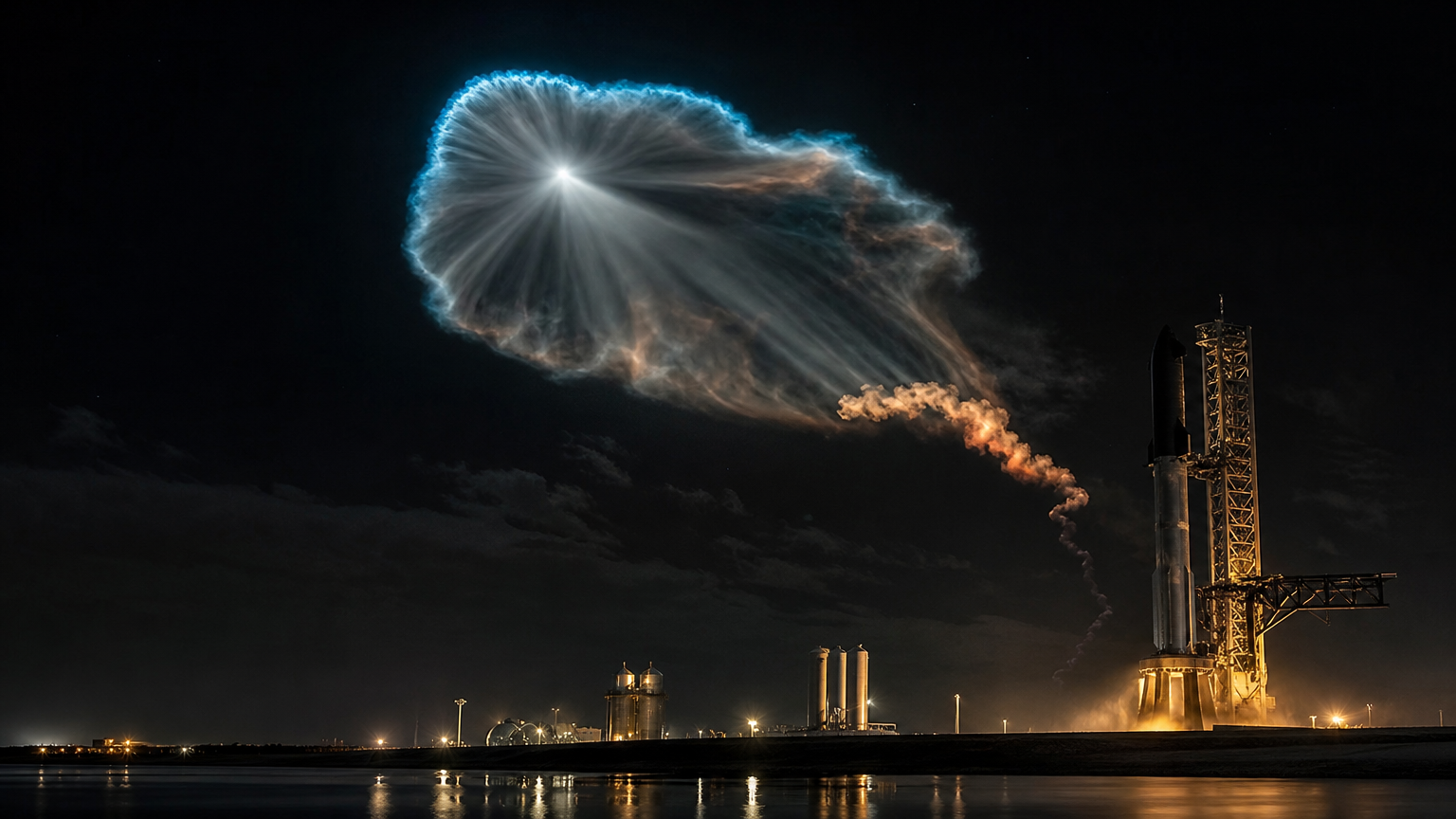
The number that changes the debate
SpaceX’s latest Starship ambition is now attached to a concrete regulatory number: 456 launches per year from Starbase, Texas . That works out to roughly 1.25 launches every day, a cadence closer to airline scheduling than to the traditional rhythm of orbital rocketry . The request is not an approval, and it is not a flight manifest. It is a ceiling SpaceX wants regulators to study as the company tries to move Starship from a test vehicle toward an industrial transportation system.
The Federal Aviation Administration review described in the fresh coverage is built around two phases. Phase 1 would allow up to 100 annual Starship-Super Heavy launches and 200 landings, while Phase 2 would raise the studied maximum to 456 launches and 912 landings per year at Boca Chica, reflecting the return of both the Super Heavy booster and the Starship upper stage . The same reporting notes that SpaceX’s current authorization is 25 launches annually, so the requested upper bound is not a marginal expansion but an 18-fold jump .
That distinction matters. SpaceX is not only asking whether one more test can fly. It is asking regulators, local communities and the market to imagine Starship as infrastructure: a vehicle that can be built, launched, recovered, checked, refueled and launched again at a tempo no orbital system has yet sustained.
What 456 launches would require
The 456-launch figure is a reusability claim as much as a regulatory one. To fly that often, SpaceX would need the Starship stack to behave less like a bespoke rocket and more like a heavy industrial machine with predictable refurbishment intervals. The FAA-linked outline cited by Leo.space says the phased approach assumes the vehicle matures and reliability improves, with Starship and Super Heavy designed for minimal post-flight refurbishment . That is the heart of the business case.
At 456 flights per year, the constraint would not be only the rocket. It would be engines, heat-shield tiles, methane and oxygen supply, launch tower operations, tank farms, inspection teams, transport logistics, road closures, airspace coordination, marine hazard zones and the political patience of South Texas. Fast Company’s recent analysis frames the target as a major escalation with consequences for people on the ground as well as for SpaceX’s ambitions in orbit . That is why the FAA process is not a paperwork footnote; it is the gate through which the entire cadence must pass.
The landing number is especially revealing. SpaceX’s request includes 912 annual landings because each fully reusable Starship mission implies two returning vehicles: the booster and the ship . If that becomes routine, SpaceX would not just be launching more mass. It would be normalizing the controlled return of enormous stages to the same coastal launch ecosystem hundreds of times a year.
Why SpaceX wants the tempo
The strategic logic is clear. Starship is supposed to lower the cost of moving mass to orbit, and the cost curve only bends if the same hardware flies repeatedly and if the factory can feed the launch site at scale. The latest Motley Fool/AOL report frames the request as part of SpaceX’s broader bid for space dominance and emphasizes that the company currently has permission for far fewer annual Starship flights . The gap between 25 and 456 is the gap between a development program and an operating network.
Starlink is the most obvious near-term beneficiary. A high-cadence Starship could deploy larger batches of satellites, refresh constellations faster and support more bandwidth-heavy services. But the implications extend beyond Starlink. A vehicle flying hundreds of times a year could change pricing expectations for commercial satellites, national-security payloads, station resupply, lunar logistics and in-space infrastructure. Competitors would not only need rockets; they would need factories, pads, recovery systems and regulatory capacity able to match the tempo.
That is the hidden competitive advantage in the number. If regulators approve only a fraction of the request and SpaceX still proves it can increase cadence safely, the company’s lead widens. If the full 456-launch vision is eventually realized, the market may stop comparing Starship with individual rockets and start comparing it with ports, rail networks or cloud data centers: capital-intensive systems whose power comes from throughput.
The NASA jellyfish as a useful contrast
The same news cycle offered a smaller but telling reminder of why SpaceX’s operational cadence matters. A NASA-backed SpaceX Falcon 9 launch created a giant glowing “jellyfish” across the sky when sunlight illuminated the rocket’s expanding exhaust plume at high altitude while observers below remained in darkness . ScienceDaily, citing NASA material, reported that the October 13 launch sent a Dragon spacecraft toward the International Space Station with research and equipment, including investigations connected to artificial retinas, heart tissue models, glass formation in microgravity and brain organoids relevant to neurological disease research .
NASA’s follow-up station blog said the CRS-35 Dragon was docked at the ISS and that crews had begun unloading and activating new experiments after the cargo-packed spacecraft arrived . That is the less viral but more important part of the story: the jellyfish image sells the spectacle, while the docking and unpacking show commercial launch services acting as routine public infrastructure .
This is the bridge between Falcon 9 today and Starship tomorrow. Falcon 9 has made NASA cargo flights familiar enough that a spectacular plume can become the headline even as the mission itself proceeds as expected. SpaceX’s Starship proposal asks whether that kind of normalization can be scaled to a much larger, fully reusable system. The visual poetry of a jellyfish plume is easy to share; the industrial reality behind 456 annual Starship flights is much harder to build.
The unresolved questions
The current state of the subject is therefore simple but consequential: SpaceX is seeking a studied pathway to 456 Starship launches and 912 landings per year from Starbase, and the proposal is moving through environmental and regulatory review rather than standing as an approved operating schedule . The company’s ambition is visible, but the permissions, infrastructure and proof of reliability are not yet in place.
Several questions now define the story. Can Starship reach aircraft-like reuse without months of inspection? Can the pad infrastructure survive repeated acoustic, thermal and mechanical stress? Can propellant production and storage keep up? Can public agencies review environmental, airspace and safety impacts at the same speed SpaceX wants to launch? And can nearby communities tolerate a launch site that behaves less like a test range and more like a spaceport with rush hour?
SpaceX has often turned impossible-sounding cadence goals into engineering pressure. But 456 Starship launches per year is not just another stretch target. It is a proposal to industrialize orbital access at a scale that would redraw the economics of spaceflight, strengthen Starlink, pressure rivals and force regulators to define what “routine” means when the vehicle is the largest rocket system ever flown. Houston may indeed need a cron job for liftoff; first, the FAA, the hardware and South Texas all have to say whether the schedule can run.
Sources from the last 72 hours
- [1]SpaceX Bids for Space Dominance, Plans 456 Starship Launches Per YearOct 18, 2026, 12:26 PM
- [2]SpaceX seeks FAA approval for 456 Starship launches per year from StarbaseOct 15, 2026, 9:30 PM
- [3]SpaceX wants to launch 456 Starships a year. That's great news for Musk and bad news for the rest of usOct 16, 2026, 2:00 AM
- [4]NASA’s SpaceX launch lights up the sky with a giant glowing jellyfishOct 17, 2026, 2:00 AM
- [5]Crew Unpacks Dragon and Begins Activating New Science ExperimentsOct 16, 2026, 7:15 PM
AI-generated article based on recent web research, then preserved as a dated editorial snapshot.
Comments
Be the first to comment.