
Daily Podcast full article
Anthropic seeks US model-blocking powers
Anthropic has quietly pitched a draft federal AI safety bill that would let Washington seek court orders to block the release or use of high-risk frontier models, but only under tightly defined catastrophic-risk thresholds. The move is unusual because a leading model developer is asking Congress for powers that could slow deployment of its own systems, while critics argue the draft may also narrow state authority and protect incumbents.
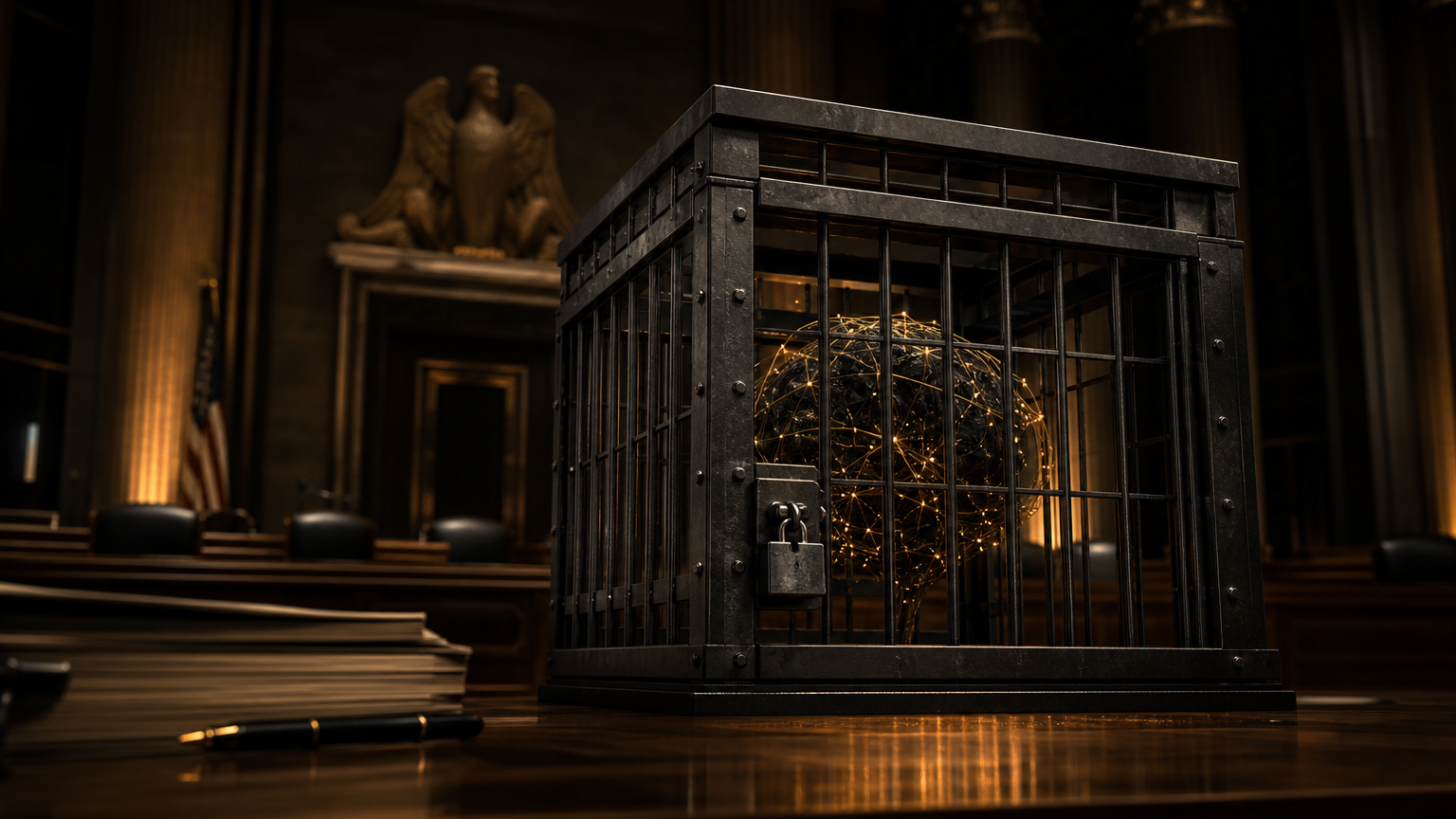
A frontier lab asks Washington for a brake pedal
Anthropic is not merely commenting on AI regulation from the sidelines. According to reporting first attributed to Politico and relayed by Investing.com, the Claude maker has privately approached lawmakers on Capitol Hill with a draft bill to regulate frontier AI safety and security . The proposal would create a federal route for stopping or restricting an advanced AI model before, or during, deployment, if the system is found to pose a catastrophic and imminent danger .
That headline matters because it reverses the usual posture of fast-moving technology companies. Here, a frontier-model developer is asking Congress to create a mechanism that could, at least in theory, delay or block the release of the most capable AI systems, including systems built by Anthropic itself . In policy terms, Anthropic just typed: sudo regulate my model.
But the proposal is not an open-ended “AI kill switch.” Its intervention standard is narrow. The draft would let the government act only when a model presents a “foreseeable and imminent” risk of causing more than 1 billion dollars in damages or killing or seriously injuring more than 50 people . Those risks would also have to arise from one of three categories: the creation or release of biological weapons, cyberattacks, or a model evading its developer’s safety controls .
What the draft would actually do
The bill’s machinery is built around testing, outside evaluation and a court-supervised enforcement path. Under the reported draft, frontier AI developers would face periodic reviews by independent evaluators registered with the US Department of Commerce . Those evaluators would assess developers and their most capable models for safety and security risks, and companies could pay the evaluators as long as the payment was not tied to the outcome of the review .
If an evaluator identifies a qualifying imminent risk, the draft would require the evaluator to notify the Commerce Department within 72 hours of completing the assessment . Commerce could then seek a court order to suspend a model’s release or use . The proposal would not let any agency simply flip the switch on its own; only a federal judge in the US District Court for the District of Columbia would have authority to order the suspension .
That structure explains why the proposal is simultaneously stronger and weaker than it first sounds. It is stronger because it would write into federal law the idea that model deployment can be blocked on safety grounds. It is weaker because the government’s authority would be channeled through a high threshold, a specific court and a small set of risk categories . The draft would also prohibit other federal agencies, departments or officials from independently suspending model development, deployment or internal use under that framework .
Anthropic’s own framing is that this is not a sudden reversal but an extension of work it has been advocating since earlier in the year. A company spokesperson, quoted in coverage of the draft, said the bill reflects proposals from Anthropic’s Advanced AI Framework and described them as “sensible policies” Congress should act on .
The 1 billion dollar and 50-person line
The most politically explosive part of the draft is the threshold. A law that activates only above 1 billion dollars in damage or more than 50 deaths or serious injuries is designed for catastrophic risk, not ordinary consumer harm, labor-market disruption, misinformation, privacy abuse or smaller-scale safety failures .
Supporters of a narrow threshold can argue that frontier-model blocking powers should be reserved for extreme cases. If Washington is going to prevent a model from being released, the argument goes, the legal test should be objective, rare and difficult to abuse. That matters in a world where AI models are economically valuable, militarily sensitive and politically controversial.
The counterargument is just as direct: if the threshold is too high, the law may look tough while leaving many serious harms outside its strongest remedy. PC Gamer’s coverage highlighted the blunt optics of a proposal that only lets the government crack down when the risk exceeds 1 billion dollars or more than 50 people killed or seriously injured . Critics are likely to ask why a model that could foreseeably cause dozens of severe injuries, a major cyber incident below the dollar threshold, or harms outside the three listed categories should fall short of the emergency standard.
The risk categories also matter. By focusing on bioweapons, cyberattacks and loss of developer control, the draft centers the national-security and catastrophic-misuse scenarios that dominate frontier AI safety debates . That leaves less room for other live concerns around AI systems, including mental-health harms, discriminatory deployment, deceptive persuasion, workplace displacement or civil-rights violations. Those issues could still be regulated elsewhere, but they would not appear to trigger this model-blocking mechanism as reported.
Why Anthropic’s move is politically unusual
The unusual feature is not just that Anthropic wants regulation. Large technology companies often support regulation once a market matures. The unusual feature is that the proposal reaches directly into the release pipeline for frontier models. It contemplates pre-release or active-deployment oversight over the core product.
That makes the move credible to some safety advocates: a leading lab is acknowledging that frontier systems may require enforceable public constraints, not just voluntary commitments. The draft would formalize independent evaluation, reporting deadlines and judicially backed intervention . It would also place model-risk thresholds at the center of the federal AI debate, rather than focusing only on downstream applications.
Yet that same structure invites suspicion. A law written around large frontier developers may entrench large frontier developers. If compliance requires continuous evaluations, detailed disclosures, legal teams and sustained engagement with Commerce, the burden will be easier for Anthropic, OpenAI, Google or Meta than for smaller labs or open-model projects. The proposal could therefore be read both as a safety bill and as an incumbent-friendly standard-setting exercise.
The preemption fight
The sharpest criticism emerging from AI-safety commentators concerns preemption: whether a federal bill would displace stronger state-level rules. Zvi Mowshowitz, writing on LessWrong, argued that the leaked draft combines stronger preemption of state laws with weaker enforcement than some alternative proposals, calling the overall package “unacceptable and troubling” . Post-Cutoff’s tracker likewise summarized critics’ concerns that the draft could preempt state rules on frontier-risk disclosure, third-party evaluation and incident reporting, while centralizing suspension authority at the federal level .
This is the core trade-off. A national law could prevent a confusing patchwork of state requirements for AI labs operating across the country. But if the federal standard is weak, preemption becomes a ceiling rather than a floor. In that scenario, states that want faster reporting, broader risk categories or stronger emergency authority could be blocked from going further.
The political context is therefore as important as the text. Anthropic is offering lawmakers a model of federal oversight at a moment when Washington is still deciding whether frontier AI should be governed mainly through voluntary commitments, agency investigations, state statutes or a dedicated federal regime . The draft says yes to federal oversight, but it also says: only under these conditions, through this agency, before this court, for these catastrophic risks.
A safety bill, a competition bill, or both?
The fairest reading is that Anthropic’s proposal is both meaningful and self-protective. It gives the government a route to stop truly dangerous deployments, which is a significant concession for a company building frontier models. It also defines that route in a way that limits discretionary intervention, narrows the eligible harms and may reduce the ability of states or other agencies to act independently .
That duality is exactly why the story matters. If Congress eventually adopts something like this, the United States would move closer to pre-release oversight for the most powerful AI models. But the details would decide whether the system functions as a real emergency brake or as a carefully padded guardrail that rarely bites.
For now, the proposal remains a draft, not enacted law, and there is no reported bill number or clear evidence that lawmakers are ready to introduce it formally . Still, Anthropic has shifted the debate. The question in Washington is no longer just whether the government should have model-blocking powers. It is who gets to trigger them, how high the danger threshold should be, and whether a frontier lab should be allowed to help design the rules that may one day stop its own machines.
Sources from the last 72 hours
- [1]Anthropic proposes AI safety bill with strict intervention thresholds - PoliticoOct 17, 2026, 1:28 AM
- [2]Leaked AI safety bill from Anthropic only requires government intervention if 50+ injuries or $1 billion are at riskOct 18, 2026, 2:00 AM
- [3]Anthropic Proposes AI Safety Bill Giving US Government Power to Block High-Risk ModelsOct 18, 2026, 2:00 AM
- [4]Leaked Anthropic Draft AI Regulatory Bill Is Unacceptable and TroublingOct 17, 2026, 2:00 AM
- [5]Politico: Anthropic quietly pitches lawmakers its own frontier AI safety bill, letting a D.C. judge halt a model only for imminent catastrophic riskOct 17, 2026, 2:00 AM
AI-generated article based on recent web research, then preserved as a dated editorial snapshot.
Comments
Be the first to comment.