
Daily Podcast full article
Musk pledges $10.5B in SpaceX shares
Elon Musk says he will give one SpaceX share to every child in the United States in 2027, a promise now valued at a little over $10.5 billion. The headline number is huge, but the live story is less about a completed gift than about execution: eligibility, custody, tax treatment, voting rights and timing remain unresolved.
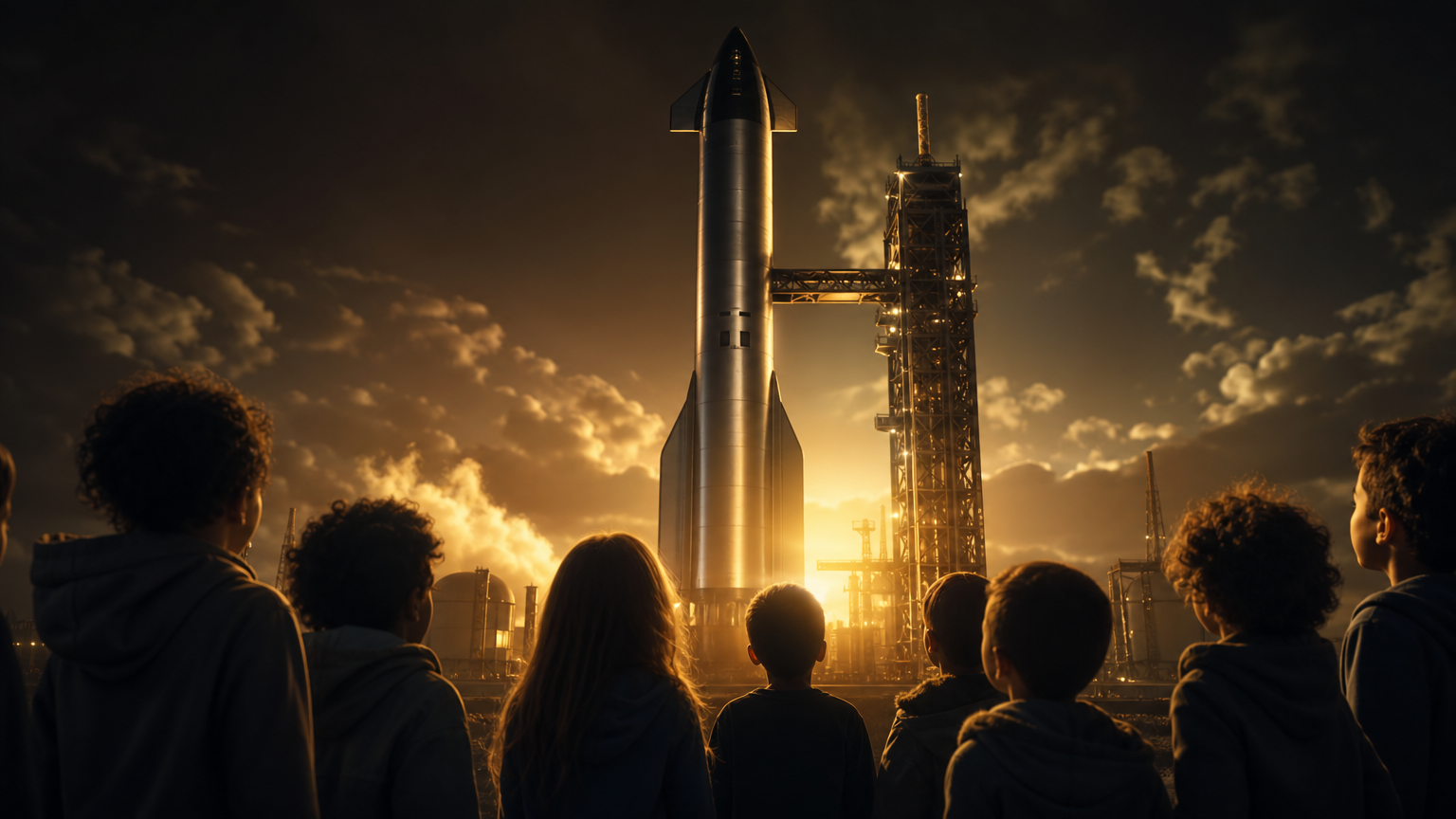
A blockbuster pledge, not yet a blueprint
Elon Musk has put a remarkable promise into the public domain: next year, he says, he will give one of his SpaceX shares to every child in America . The pledge, made on X early Monday, immediately turned into a financial and political Rorschach test. Supporters framed it as mass participation in the space economy. Skeptics saw a viral announcement with few operational details. Both reactions are reasonable, because the pledge is enormous in scale but still thin on mechanics.
The latest reporting is consistent on the core facts. Musk said the gift would happen in 2027 and described it as the first of several such distributions . He has not specified whether “kid” means every person under 18, only U.S. citizens, all children resident in the United States, or a narrower category . He also has not explained how the shares would be delivered, who would act as custodian for minors, whether parents would need to opt in, or what restrictions would apply once a child receives the stock .
That gap matters. A social media pledge can set the news agenda in minutes, but distributing equity to tens of millions of minors is an administrative project. It would touch securities rules, brokerage infrastructure, guardianship law, tax reporting, anti-fraud controls and possibly the government-backed account system created for children. Until those pieces are specified, this remains a promise with a headline valuation rather than a finished philanthropic program.
The $10.5 billion math
The valuation is straightforward. Axios reported that the United States has just over 72 million people under 18, and that SpaceX closed Friday at $146.03 a share . One share for each child at that price implies a market value a little above $10.5 billion . AP likewise reported that SpaceX shares closed Friday at $146.03 and that the company is due to report quarterly earnings Tuesday .
CBS reported that SpaceX shares were trading higher Monday morning, up 2.7% to $149.49, which shows why the exact value of the pledge will move with the stock price . If the share price rises before distribution, the market value of the gift rises. If it falls, the pledge shrinks in dollar terms while remaining the same in share count. That distinction is important: Musk promised shares, not a fixed cash amount.
The share count also changes the way the public should read the headline. TechCrunch reported that Musk owns around 849 million Class A common shares of SpaceX and more than 5.5 billion Class B supervoting shares . The Next Web, citing an August SEC filing, put Musk’s total holdings at 6.42 billion SpaceX shares when trusts, restricted stock and options are included, and calculated that a 72 million-share giveaway would represent about 1.1% of that total . In other words, the pledge is one of the largest technology-linked personal gifts ever proposed, but it would not come close to exhausting Musk’s SpaceX position.
The timing is not accidental
The pledge arrived just after Anthropic announced plans to commit 5% of its shares to a new public benefit fund . Musk responded by arguing that shares should be given directly to the public, and then said he would do that through SpaceX stock . That sequence is part of the story. This was not merely a stand-alone act of charity; it was also a public contrast with a rival AI company’s model for distributing future corporate value.
That rivalry helps explain the message. Anthropic’s plan is institutional: a fund, governed over time, intended to support public-benefit goals. Musk’s proposed version is populist and direct: give a share to every child and let families feel a personal link to the company. The simplicity is powerful. A child does not need to understand orbital launch cadence, Starlink economics or AI infrastructure to understand the sentence: you own one share of SpaceX.
But simplicity can hide complexity. If every child becomes a shareholder, even with only one share, the company and transfer agents must manage a vast new retail base. Questions follow. Will the shares carry voting rights? Will they be placed in restricted accounts? Can they be sold immediately, or only when the recipient reaches adulthood? If a child is undocumented, abroad with U.S. citizenship, in foster care, or without a standard bank or brokerage account, how would delivery work? None of those answers has been supplied yet .
A public-attachment strategy for the space age
The most interesting interpretation is that the pledge is philanthropy and brand architecture at the same time. SpaceX is not just a rocket company in the public imagination; it is a symbol of reusable launch, satellite internet, Mars ambition and private-sector space power. Giving children shares would create millions of young symbolic stakeholders in that project.
That could matter commercially and politically. A child with a SpaceX share becomes a future adult who has a personal memory of receiving a slice of a space company. Parents may follow SpaceX more closely. Schools may use the share as a hook for lessons about markets, engineering or orbital infrastructure. Lawmakers may hear from constituents who now see company performance as part of family wealth, even if the stake is modest.
There is also a market-structure angle. If tens of millions of shares are placed into accounts for minors and subject to restrictions, those shares may become relatively sticky. They may not trade often. That could reduce available float at the margin, though the effect would depend entirely on the final design. A true gift with immediate transferability would behave differently from a custodial grant locked until adulthood.
Why the unanswered details matter
Large pledges by billionaires often encounter a credibility test: is the donor transferring value, or announcing an intention that may later be revised? In this case, the test will be easy to measure. By the end of 2027, either qualifying children will have SpaceX shares in identifiable accounts, or they will not.
The legal and tax structure could decide how inclusive the program becomes. If the gift goes through existing child investment accounts, participation might be easier for some families and harder for others. If it requires parents to submit documentation, some eligible children may be missed. If it is automatic, the system would need reliable identity matching at national scale. If stock is donated to a central trust instead of individual accounts, the political meaning would change because children would be beneficiaries rather than direct shareholders.
The pledge also raises a governance question. Musk has been reported to hold vast supervoting power through SpaceX share classes . If the donated shares are ordinary shares without meaningful voting influence, the gift would be financial and symbolic rather than democratic. That would not make it worthless; one share of a major technology and space company is still a real asset. But it would limit claims that the plan broadly redistributes corporate power.
Bottom line
Musk’s promise is big enough to deserve attention and incomplete enough to deserve caution. Based on current share prices and the number of U.S. children, the proposed distribution is worth a little over $10.5 billion . It could make millions of minors small SpaceX shareholders and deepen public attachment to the commercial space economy. Yet as of the latest reporting, there is no published operational plan for eligibility, delivery, restrictions, taxes or custody .
For now, the story is best read as a pledge with extraordinary scale and unresolved plumbing. If Musk follows through in 2027, the program could become a defining example of tech-era mass share philanthropy. If the details never arrive, it will remain another spectacular Musk announcement: easy to understand, hard to execute and designed to make the future feel personal.
Sources from the last 72 hours
- [1]Musk pledges 1 SpaceX share for every child in AmericaOct 19, 2026, 11:43 AM
- [2]Elon Musk says he plans to gift a SpaceX share to every child in the U.S.Oct 19, 2026, 5:51 PM
- [3]Musk pledges to give ‘every kid in America’ one of his SpaceX sharesOct 19, 2026, 2:42 PM
- [4]Elon Musk Says He’ll Give Every Child In America One SpaceX Share Next YearOct 19, 2026, 11:04 AM
- [5]Musk says he will give a SpaceX share to every child in America next yearOct 19, 2026, 2:18 PM
- [6]Musk pledges to give a share of his SpaceX company to ‘every kid in America’Oct 19, 2026, 1:50 PM
AI-generated article based on recent web research, then preserved as a dated editorial snapshot.
Comments
Be the first to comment.