
Daily Podcast full article
Omron buys OnLogic for $675M to push AI onto the factory floor
Omron’s planned $675 million acquisition of OnLogic is less about buying another hardware supplier and more about owning a missing layer in industrial AI: rugged edge computing that can sit beside machines, process production data locally, and connect intelligence directly to factory control.
The deal: Omron adds rugged compute to its automation stack
Omron has agreed to acquire U.S. industrial computer maker OnLogic and its parent company, Interlogic, in a transaction valued at $675 million, a move designed to strengthen Omron’s industrial computing capabilities and accelerate its push into physical AI for manufacturing . The deal is expected to close in early 2027, subject to regulatory approval, and is framed by Omron as a way to combine its sensing, control, motion, robotics and safety technologies with OnLogic’s configurable industrial computers built for demanding operating environments .
That combination matters because modern factories are generating more data at the machine level than traditional automation architectures were designed to absorb. Cameras, sensors, robots, drives and inspection systems can all produce streams of operational information. But if that data must travel to a distant cloud or central data center before a decision is made, latency, reliability and cybersecurity concerns can limit what manufacturers are willing to automate. OnLogic’s core proposition is compute closer to the work: rugged industrial PCs and edge systems intended to operate where ordinary office or data-center hardware would struggle .
RobotToday summarized the week’s broader physical-AI capital activity by noting that Omron agreed to buy industrial-PC maker OnLogic for about $675 million, with the enterprise value also described as roughly 104.6 billion yen and closing expected around January 2027 . In other words, this is not a vague partnership or pilot. It is a large, cash-priced industrial acquisition aimed at giving Omron tighter control over the hardware layer that industrial AI needs before it can become production-grade.
Why OnLogic is strategically useful
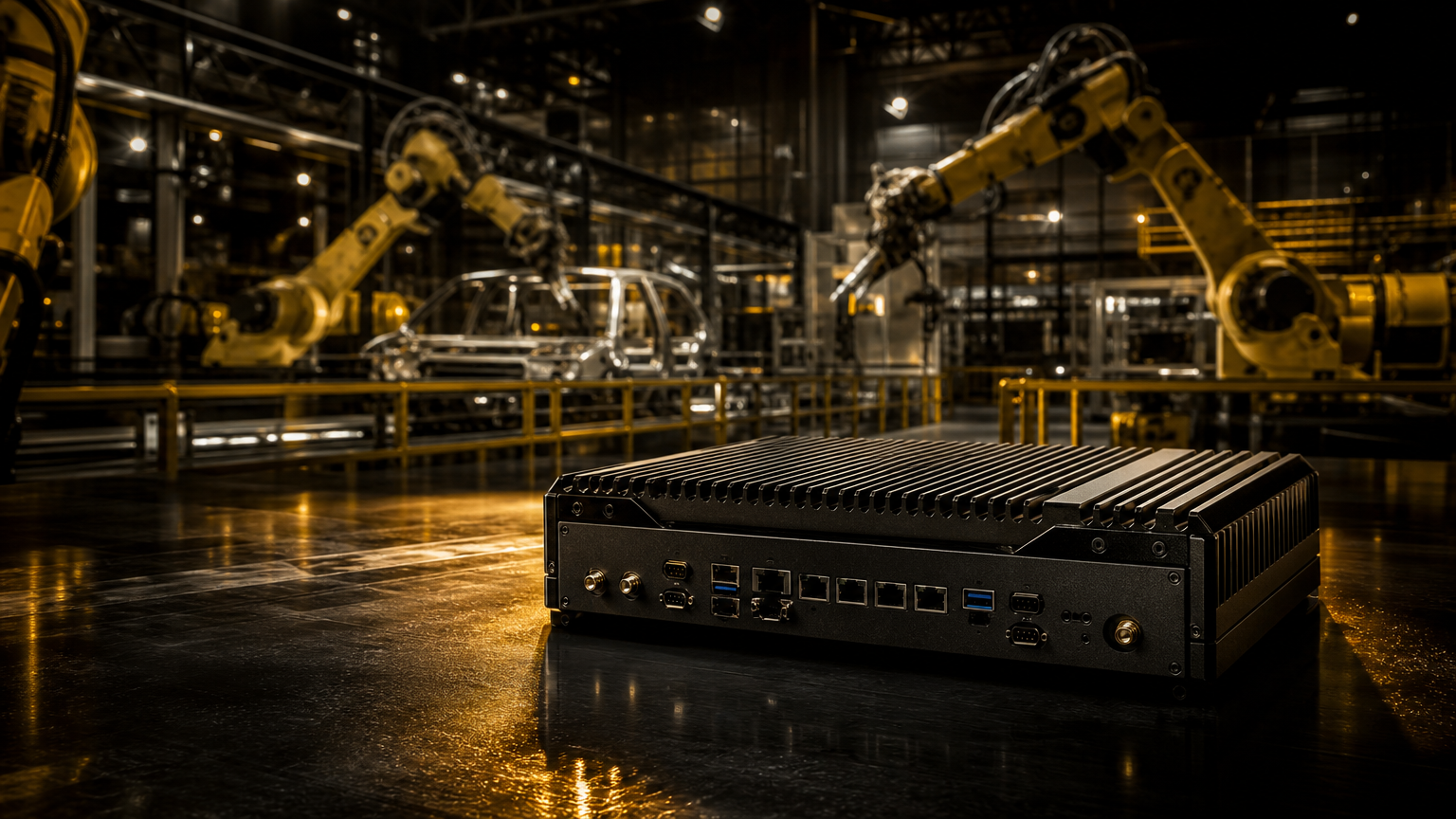
OnLogic sits in a category that often looks less glamorous than robots or generative AI models but is essential to both. Its machines are designed for factory floors and other harsh environments where heat, dust, vibration, awkward installation spaces and long service lives are real engineering constraints . That makes the company relevant to machine vision, inspection, data acquisition, industrial IoT, edge inference and automation control workloads.
Omron already sells much of the equipment that acts on the physical world: sensors, controllers, motion systems, safety products and robots. What OnLogic brings is a computing layer that can sit next to those systems and turn raw production signals into decisions. Metrology and Quality News described the intended combination as one that links Omron’s automation expertise with OnLogic’s industrial computers to enable manufacturers to process larger volumes of machine and sensor data closer to production .
That is the industrial AI thesis in practical terms. The factory does not need AI only as a dashboard or a chatbot. It needs systems that can detect a defect, adjust a process, coordinate a robot, trigger a safety response or improve throughput without waiting for a distant server. For that, compute has to be physically close, electrically reliable, thermally robust and easy enough to configure for many types of equipment.
The Industrial Stack made the broader point clearly: industrial AI is becoming a stack, not merely a model, and Omron’s move signals that automation vendors are moving deeper into industrial edge computing . The model matters, but the deployment environment matters just as much. If the AI system cannot survive the line, talk to the controller, integrate with sensors and respond in time, it is not yet useful industrial AI.
Edge AI is moving from optional to central
The acquisition also shows how AI spending is spreading beyond cloud training clusters. Cloud infrastructure remains critical for training large models and running centralized workloads, but factories need inference and decision-making near machines. In manufacturing, seconds can be too slow; sometimes milliseconds matter. Network outages, bandwidth limits and data-governance rules can also make cloud-only architectures impractical.
That is where rugged edge hardware becomes strategic. A production line can use cameras and optical measurement systems to detect defects, industrial PCs to process those images locally, and automation controls to adjust the process or route a part for inspection. Metrology and Quality News highlighted this manufacturing relevance, including intelligent inspection, adaptive process control and data-driven quality management as applications that could benefit from closer links between computing and production systems .
This is not only a technology argument; it is also a margin and integration argument. Automation vendors that own both controls and compute can package solutions more tightly, reduce integration friction and capture more value from digital transformation projects. A plant manager does not want a science project assembled from incompatible components. The buyer wants a reliable system that is supportable, maintainable and safe. By acquiring OnLogic, Omron can attempt to make the industrial AI stack more vertically integrated.
OnLogic remains independent, at least by design
A notable part of the announced structure is continuity. After completion, OnLogic is expected to keep operating as an independent business within the Omron Group, retaining its headquarters in South Burlington, Vermont, along with its global offices, brand identity, direct-sales model and management team . That detail is important because OnLogic’s value is not only its hardware catalog; it is also its customer relationships, configuration model and credibility with engineers who specify industrial PCs for difficult applications.
Keeping the OnLogic brand may help Omron avoid the common post-acquisition mistake of absorbing a specialized company so deeply that its distinct go-to-market model weakens. For OnLogic customers, the immediate message is stability: same brand, same management, broader resources. For Omron, the benefit is strategic optionality. It can preserve OnLogic’s direct customer access while looking for ways to bundle or integrate products with its own automation portfolio.
The Industrial Stack argued that the deal blurs a line that has traditionally separated the control layer from higher-performance computing . That is a useful way to read the acquisition. If physical AI becomes a durable category, the boundary between industrial PCs, machine controllers, vision systems and robots will become less rigid. The factory system will increasingly be judged by how well sensing, computing and action work together.
What Omron is really buying
The simple headline is that Omron is buying a rugged-PC company for $675 million. The deeper story is that Omron is buying a position in the infrastructure of machine intelligence. Industrial AI is not just software installed on a server. It is a chain: sensors collect data, computers interpret it, controllers and robots act, and quality systems verify the result. Weakness in any link makes the whole promise less convincing.
OnLogic fills one of those links. Its industrial computers provide the local processing layer that can support AI inference, machine vision and factory analytics at the edge. Omron’s existing portfolio provides many of the devices that sense and act. Together, the companies want to build physical-AI platforms that connect data processing with machine operation .
There are still unanswered questions. Regulatory approval is pending, closing is expected in early 2027 rather than complete today, and the real test will be whether Omron can turn the acquisition into integrated products customers actually deploy at scale . Industrial customers move carefully because downtime is expensive and safety requirements are strict. The acquisition gives Omron capability, but execution will decide whether it becomes a competitive advantage.
The bigger signal for industrial AI
The deal is a marker for where the next stage of AI investment may go. The first wave was dominated by cloud models, GPUs and data centers. The next industrial wave may be about putting enough intelligence near physical equipment to make machines more adaptive, more autonomous and more measurable. That requires rugged compute, deterministic control, trustworthy data and strong integration.
Omron’s bet is that owning more of that stack will matter. By acquiring OnLogic, it gains industrial PCs built for demanding environments, a North American base, and a platform for developing AI-enabled manufacturing systems. For factories, the intelligence upgrade will not arrive as a single magic model. It will arrive as a tighter connection between sensors, computers, controllers and machines. Omron is paying $675 million to make sure it owns more of that connection .
Sources from the last 72 hours
- [1]Omron to Acquire OnLogic for $675 Million to Advance Industrial AIOct 19, 2026, 2:00 AM
- [2]RobotToday Weekly October 12 – 16, 2026Oct 17, 2026, 2:00 AM
- [3]The industrial AI stack is filling inOct 18, 2026, 2:00 AM
AI-generated article based on recent web research, then preserved as a dated editorial snapshot.
Comments
Be the first to comment.