
Daily Podcast full article
SpaceX launched 80% of 2026 rideshare missions
SpaceX’s 2026 rideshare cadence is no longer just a launch-industry statistic: it is a measure of market power, satellite dependence and strategic vulnerability. Fresh reporting shows the company has carried roughly 80% of all mass sent to orbit this year, while its next Falcon 9 rideshare, Bandwagon-5, lines up 32 payloads from Cape Canaveral and the Starlink dispute in Europe turns launch dominance into a geopolitical issue.
The 80% number is the story
SpaceX’s grip on orbital access in 2026 is best captured by one blunt figure: about 80% of all mass sent to orbit this year has flown on SpaceX vehicles, according to a fresh market report citing launch-tracking data . The same report puts SpaceX’s 2026 total near 1,950 tonnes to orbit so far, out of about 2,396 tonnes worldwide across 236 successful launches . That is why the company’s rideshare missions matter beyond the smallsat niche. They are not side business; they are a visible expression of a launch system that has turned high flight cadence, reusable boosters and internal demand from Starlink into a structural advantage.
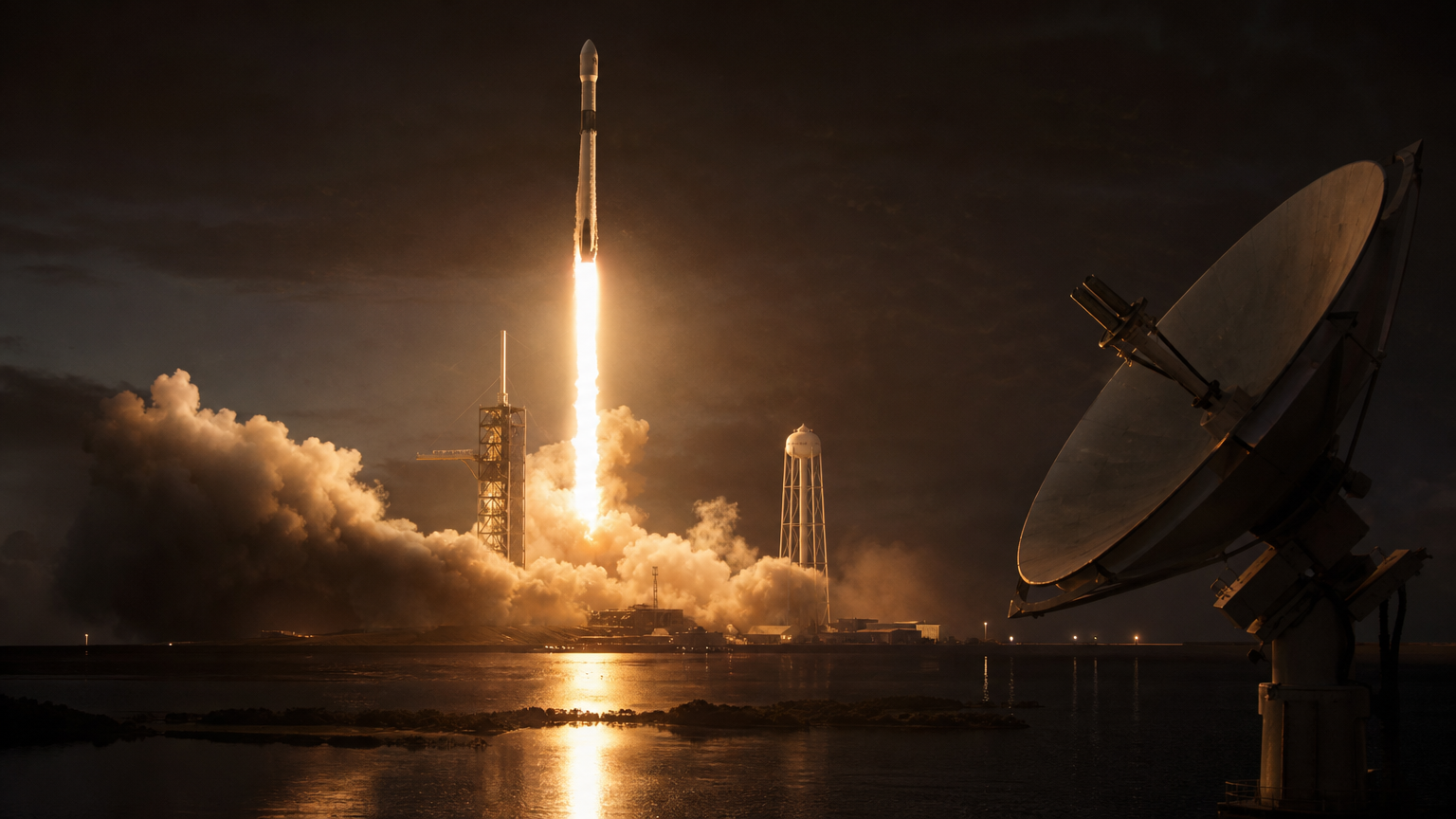
The headline can be read as a rideshare story because rideshare is where SpaceX’s dominance becomes most tangible for smaller customers. A startup, university, imaging operator, navigation company or communications provider does not need to buy an entire rocket; it can buy a slot on a Falcon 9 mission whose economics are supported by repeatable hardware, packed manifests and a launch calendar few rivals can match. SpaceX’s Bandwagon-5 mission, scheduled from Cape Canaveral before dawn on October 19, illustrates that system in miniature: a single Falcon 9 is set to carry 32 payloads, including SpaceX’s own Starfall reentry capsule and 31 customer payloads .
That concentration is impressive, but it is also uncomfortable. A market where one launch provider carries four-fifths of orbital mass gives customers lower costs and more frequent opportunities, while simultaneously creating dependence on one company’s priorities, pad availability, pricing choices and regulatory exposure. Falcon 9 has become the rail network of low Earth orbit: efficient, heavily used, and increasingly hard to route around.
Bandwagon-5 shows how the model works
Bandwagon-5 is a dedicated rideshare mission, not a single-purpose satellite launch. Spaceflight Now reported that the Falcon 9 was scheduled to lift off from Space Launch Complex 40 at Cape Canaveral Space Force Station during a one-hour window opening at 6:30 a.m. EDT, or 10:30 UTC, on October 19 . Space Coast Daily also reported that the mission would send more than 30 payloads to low Earth orbit and would be Brevard County’s 60th orbital launch of 2026 .
The payload mix explains why rideshare has become so central to the space economy. Beyond Starfall, Exolaunch manifested 20 of the remaining 31 payloads, including spacecraft from HawkEye 360, Iceye and Xona Space Systems . In practical terms, that means one launch campaign can serve radio-frequency monitoring, Earth observation, navigation and technology-demonstration customers at the same time. Instead of waiting for a bespoke rocket, these operators ride a standardized transport service to orbit.
The rocket itself is part of the argument. The Bandwagon-5 booster, B1085, was slated for its 19th flight, with a planned landing on the drone ship A Shortfall of Gravitas about nine minutes after liftoff . Reuse is not just an engineering flex; it is the mechanism that makes a high-frequency rideshare business credible. Every recovered and reflown booster helps convert launch from a rare event into an industrial service.
Weather was the main operational question in the final hours before the window. The 45th Weather Squadron forecast a 55% chance of acceptable conditions, with gusty winds and recovery-zone weather listed as concerns . That detail matters because SpaceX’s advantage is built not merely on rockets but on schedule execution. When customers buy into a rideshare campaign, they are buying a place in a launch flow that has to absorb weather, range constraints, booster turnaround and deployment sequencing.
Starfall adds a return-to-Earth twist
Bandwagon-5 is also notable because of Starfall, SpaceX’s uncrewed reentry capsule. Spaceflight Now reported that this would be the second launch of Starfall, a capsule SpaceX introduced in June with relatively limited public detail . The Federal Aviation Administration material cited in the report describes Starfall as about 0.75 meters tall, 3.1 meters in diameter, roughly 2,100 kilograms in mass, and capable of supporting up to 1,000 kilograms of payload mass .
That changes the rideshare conversation. Traditional smallsat rideshare is about getting hardware to orbit cheaply. Starfall points toward a second market: getting valuable material back from orbit. Microgravity research, in-space manufacturing and pharmaceutical experiments all become more commercially relevant when customers can plan not only a launch slot but a return path. Varda Space Industries’ W-Series 7 reentry capsule is also on Bandwagon-5, carrying a pharmaceutical experiment involving the cancer drug Protac . In other words, this Falcon 9 mission is not just deploying satellites; it is testing the economics of orbital round trips.
If SpaceX can fold reentry services into the same operating logic as launch, it could extend its advantage from access to orbit into access from orbit. That would make Falcon rideshares part of a larger logistics chain: deploy, operate, manufacture or experiment, then return.
The Starlink dispute turns market share into statecraft
SpaceX’s launch dominance cannot be separated from Starlink. Starlink creates huge internal demand for launches, while Falcon launches expand and maintain the satellite network. That vertical integration is part of why the company can sustain a cadence other providers struggle to match.
But the same integration now sits at the center of a policy fight. The Financial Times reported that the US government warned Europe of “devastating” retaliation if Brussels moved ahead with plans that would restrict American companies such as SpaceX from parts of the European market . The dispute concerns proposed European rules around satellite-to-smartphone spectrum, which could reserve some access for European operators and limit US and Chinese companies, including Starlink .
This is why the 80% figure is strategically charged. For Washington, Starlink is not merely a consumer broadband product; it is communications infrastructure with defense, emergency-response and Ukraine-war relevance. For European policymakers, dependence on a US-controlled satellite network raises sovereignty questions, especially when the same company dominates the launch capacity needed to deploy rival constellations. A regulator can say it is protecting European autonomy, but a launch market this concentrated makes autonomy expensive and slow.
Why rivals and governments still care
SpaceX’s dominance does not mean competitors are irrelevant. It means they are more strategically important than their current market shares suggest. If one company carries most orbital mass, then alternative launch providers become insurance policies against congestion, political conflict, technical grounding or commercial repricing. Europe’s Ariane program, national security launch procurement, emerging reusable vehicles and small-launch startups all look different in this context. They may be less efficient today, but they preserve optionality.
The Bandwagon-5 manifest also shows why customers keep choosing SpaceX. The combination of price, payload integration, cadence and flight heritage is difficult to beat. For many satellite operators, ideological concerns about concentration are secondary to getting hardware to orbit on time. That is the orbital Konami code SpaceX appears to have found: launch often, reuse aggressively, fill spare capacity, feed Starlink, and make the next mission easier to sell.
The risk is that the same code locks the market around one player. In 2026, SpaceX’s rideshare machine is not just transporting payloads. It is shaping which companies can reach orbit, how quickly sovereign alternatives can emerge, and how much leverage the United States carries in disputes over satellite connectivity. Bandwagon-5 is one Falcon 9 mission. The larger story is that the road to orbit increasingly runs through SpaceX.
Sources from the last 72 hours
- [1]Elon Musk’s SpaceX Now Controls 80% of the Race to OrbitOct 19, 2026, 12:51 AM
- [2]Live coverage: SpaceX to launch Starfall reentry capsule, 31 customer payloads on Bandwagon-5 rideshare missionOct 18, 2026, 6:32 PM
- [3]SpaceX Falcon 9 Set to Launch Bandwagon-5 Mission From Cape Canaveral Monday MorningOct 18, 2026, 2:00 AM
- [4]US threatens Europe over Starlink restrictionsOct 18, 2026, 6:00 PM
AI-generated article based on recent web research, then preserved as a dated editorial snapshot.
Comments
Be the first to comment.