
Daily Podcast full article
Starship targets orbital refueling in 2027
SpaceX’s most important Starship test is no longer just reaching orbit. The next gate is ship-to-ship cryogenic propellant transfer, now shown on NASA-linked timelines for early 2027, with February a plausible but not formally fixed opening inside the first quarter.
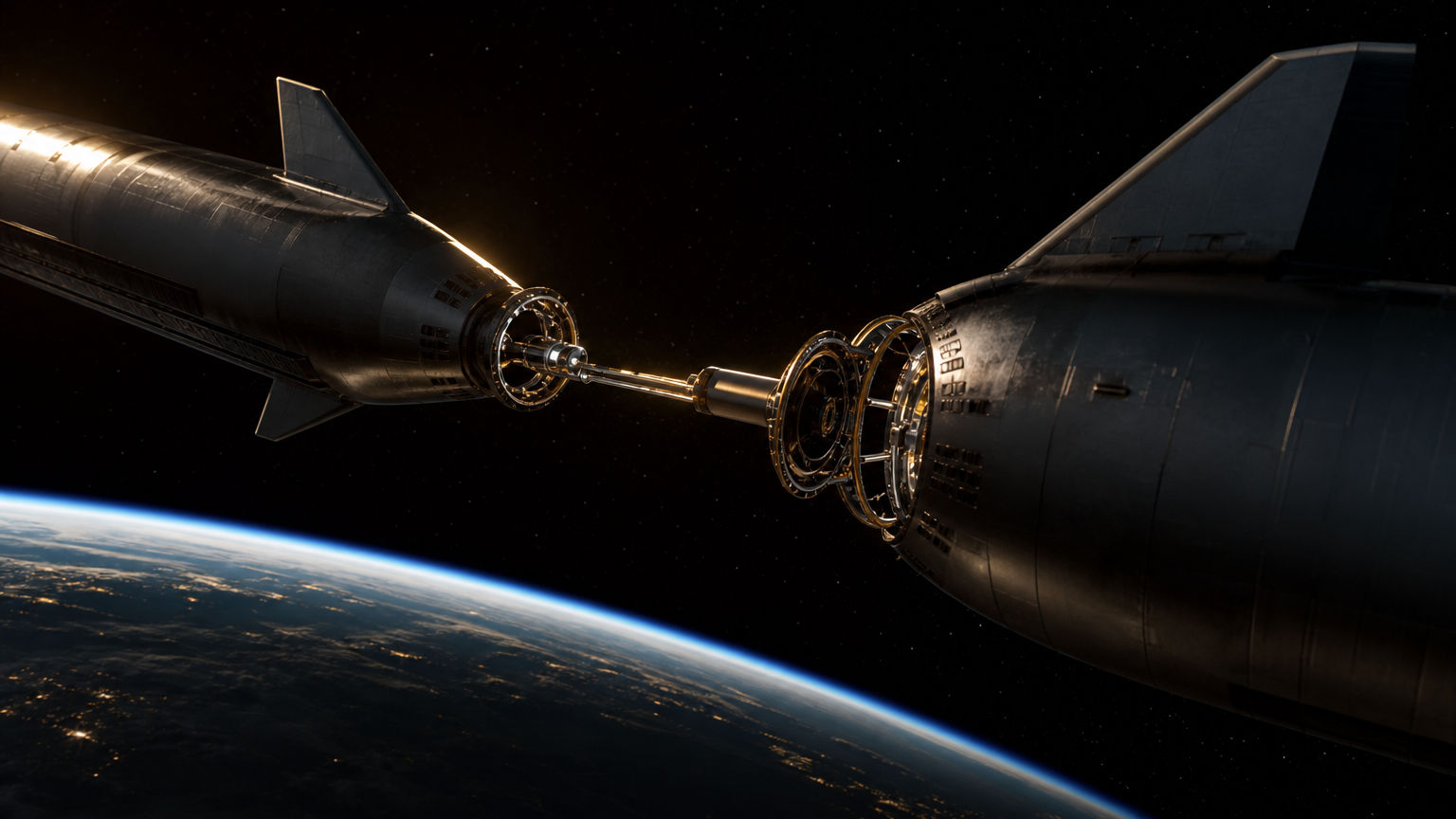
The headline check: this is the orbital-refueling story
The working headline is the story: Starship targets orbital refueling in 2027. The current signal around SpaceX’s lunar and Mars architecture is that the first large-scale Starship propellant-transfer demonstration has moved into early 2027 planning, not as a side note but as the central operational test that decides whether the vehicle can become more than a very large launcher .
NASA-linked Artemis Human Landing System material circulating over the weekend places a Starship “Prop Transfer Demo” in Q1 2027, alongside other Starship HLS milestones such as Cabin One operations testing, continued V3 flight testing, and preparations for an uncrewed lunar demonstration later in 2027 . Italian technology outlet Hardware Upgrade, summarizing the same NASA HLS update, reports that the first demonstration of propellant transfer between two Starships in orbit is planned for Q1 2027 and that a tanker-version Starship appears later in the 2027 sequence . A widely shared spaceflight timeline post published on October 18 also reads the NASA slides as putting the “prop demo” in Q1 2027, while noting a first Cape flight and Cabin One completion in late 2026 .
Why this test matters more than another launch
Starship can reach low Earth orbit and still be unable to do the jobs SpaceX advertises most aggressively. The architecture for the Moon and Mars depends on launching a Starship that has burned most of its own propellant just to get upstairs, then replenishing it from other Starships or a depot before it leaves Earth orbit. Without that second act, the system remains payload-limited for deep-space missions.
That is why orbital refueling is the “side quest” that locks or unlocks Mars. A fully fueled Starship cannot simply depart Earth’s surface, carry a major payload, and arrive at the Moon or Mars with the required margins in one launch. The vehicle needs a campaign: launch, rendezvous, dock or connect, transfer super-cold methane and oxygen, manage boiloff, separate safely, and repeat at high cadence. The 2027 demonstration is expected to test that chain at least in its first integrated form .
This is not ordinary spacecraft refueling. The propellants are cryogenic; the tanks are enormous; the vehicles are massive; and the operation must happen in microgravity with fluids that do not behave like fuel in a car tank. Even a “demo” can expose hard questions: how to settle propellant, how to limit losses, how to chill transfer lines, how to measure what moved, and how to avoid creating a brittle, one-off stunt instead of a repeatable lunar logistics system.
The current timeline: Q1, with February possible but not guaranteed
The most careful wording is that SpaceX is targeting the first half of 2027, with the latest public timeline pointing to Q1 2027 for the first Starship propellant-transfer demonstration . That makes February plausible inside the window, and social-spaceflight trackers are already describing it as “likely around February,” but NASA’s visible milestone chart is broader than a single launch date .
Hardware Upgrade’s October 18 report says NASA’s updated Artemis material places the two-Starship orbital transfer demo in Q1 2027, while Q2 2027 is reserved for additional Starship HLS hardware work such as landing-leg and airlock-related demonstrations . The same report places a first tanker flight in Q3 2027, connected to the uncrewed lunar demonstration campaign, which shows why the Q1 transfer demo is not an isolated experiment but the first domino in a more complicated refueling sequence .
The practical reading: February is an “as early as” possibility, not a commitment. Q1 runs through March 31, 2027, and the milestone could still slide while remaining inside NASA’s early-2027 planning language. That distinction matters because Starship timelines have repeatedly compressed ambition into optimistic charts before hardware, licensing, pad readiness, and flight results forced the calendar to move.
The docking problem before the fueling problem
The phrase “orbital refueling” can make the challenge sound like plumbing. It is also guidance, navigation, control, rendezvous, docking or berthing, structural dynamics, pressure management, software verification, and abort planning. Two Starships have to find each other in orbit, approach without damaging either vehicle, establish a transfer interface, and remain stable long enough to move cryogenic propellant.
NASA’s HLS presentation, as summarized by Digg, also places Artemis III in 2027 as a low Earth orbit demonstration involving Orion and one or both commercial lander test articles, with Artemis IV becoming the first crewed lunar landing attempt in early 2028 . That broader Artemis reshuffling reduces the immediate pressure to land astronauts on the Moon in 2027, but it increases attention on the precursor demonstrations. If Starship cannot refuel reliably, the later landing architecture has no operational foundation.
Community discussion around the newly circulated slides reflects that tension: enthusiasts see the Q1 target as a major sign of confidence, while skeptics note that a large launch cadence, pad availability, vehicle reuse, boiloff control, and long-duration orbital operations all still have to mature together . That skepticism is not anti-SpaceX; it is the engineering reality of turning a spectacular rocket into a transportation system.
What success would prove
A successful 2027 orbital refueling demo would not mean Mars is suddenly open. It would prove something narrower but essential: that two Starship-class vehicles can execute the first version of a transfer operation in orbit and that the hardware, software, and procedures are converging. If the demonstration includes meaningful quantities of liquid oxygen and methane, clean separation, and reliable post-transfer data, it would validate one of the hardest assumptions behind SpaceX’s lunar and Mars architecture.
It would also give NASA a firmer basis for judging Starship HLS. The agency’s roadmap still points to uncrewed lunar landing demonstrations before crewed landings, and the same current reporting places SpaceX’s uncrewed lunar demo in late 2027 planning . For Artemis, refueling is not a luxury feature; it is the bridge between launching a giant stainless-steel stage and having a lunar lander that can actually reach, descend to, and depart the Moon.
For Mars, the stakes are even larger. The Mars version of the architecture would require not just one successful transfer, but many launches, rapid pad turnaround, reliable tanker ships, long-duration propellant storage, and mission operations robust enough to work across planetary windows. A 2027 demo would be the first serious proof that SpaceX can start building that chain.
The bottom line
As of the latest weekend reporting and NASA-linked timeline circulation, the story is not that SpaceX has solved orbital refueling. The story is that the first serious Starship-to-Starship cryogenic transfer demonstration is now being targeted for early 2027, with February possible inside the Q1 window but not yet a fixed public date .
If it works, Starship moves from “big rocket that can reach orbit” toward “transport architecture that can be refilled and sent somewhere useful.” If it slips, the Moon and Mars schedules slip with it. Mars remains locked until SpaceX completes this orbital side quest.
Sources from the last 72 hours
- [1]La NASA annuncia alcuni aggiornamenti per le missioni Artemis III e successive, in attesa della conferenza del 23 ottobreOct 18, 2026, 11:50 PM
- [2]Per the IAC 2026 HLS Presentation, the prop transfer demo is NET Q1 2027. Artemis III is Q3 2027.Oct 18, 2026, 12:59 PM
- [3]NASA plans Artemis III docking demonstration in low Earth orbit for 2027Oct 18, 2026, 4:10 PM
- [4]Update on the HLS provider timelines from NASAOct 18, 2026, 5:23 AM
AI-generated article based on recent web research, then preserved as a dated editorial snapshot.
Comments
Be the first to comment.