
Daily Podcast full article
Tesla’s Insane Roadster Flying Tech Exposed!
Tesla’s redesigned Roadster has finally left the ground in public, but the most important takeaway is not that Tesla has suddenly built a practical flying car. The current evidence points to a spectacular prototype using suction, cold-gas thrusters and carefully staged closed-course maneuvers, while production, road legality, final pricing and independent performance verification remain open questions.
The Roadster spectacle was real, but narrow
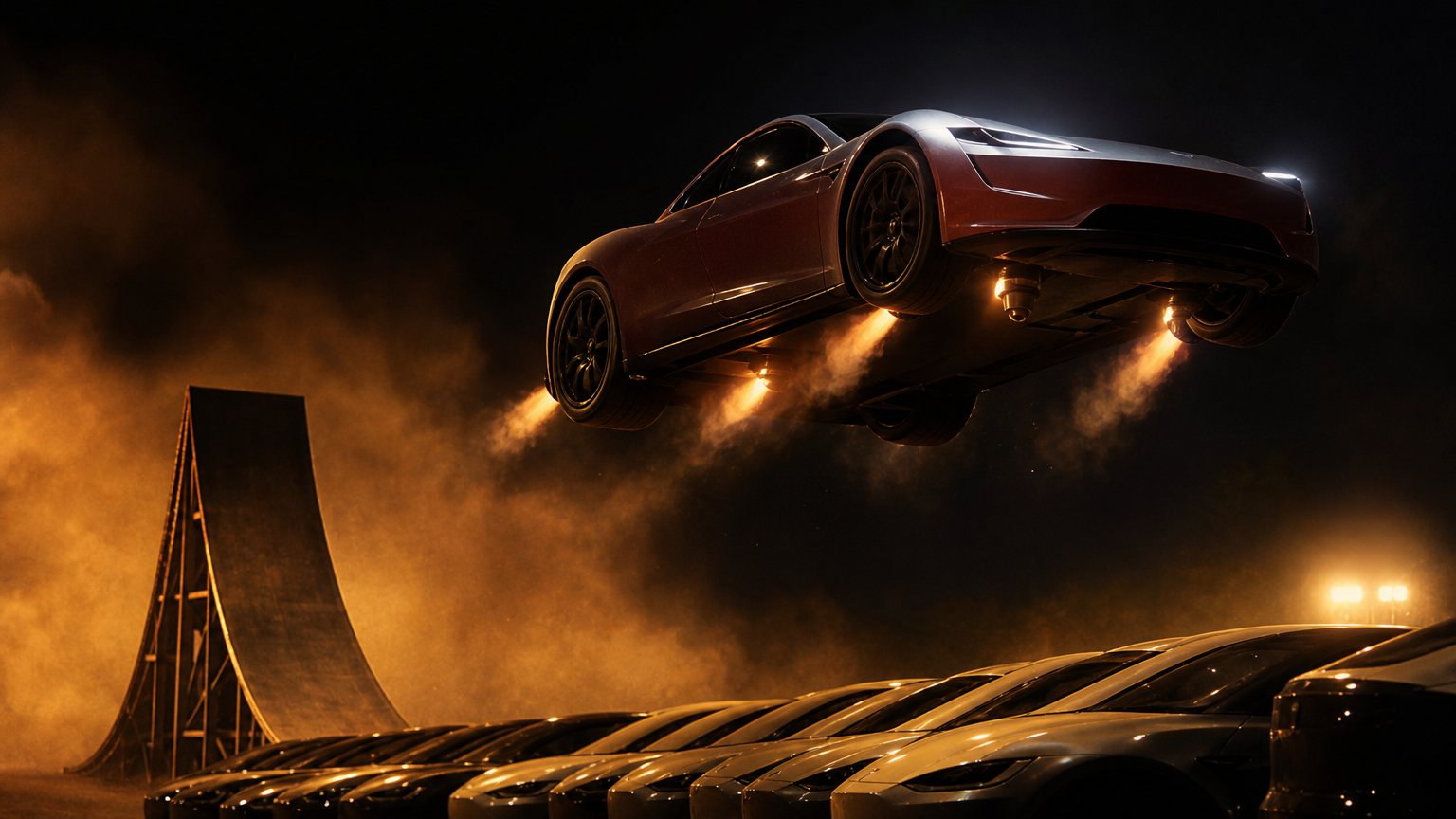
Tesla’s new Roadster reveal has shifted from years of promise to something much more dramatic: a car-shaped prototype that climbed, inverted, jumped and corrected itself in mid-air. At SpaceX’s McGregor, Texas test facility near Waco, the Roadster drove along a curved ramp, hung upside down with the help of a fan-based suction system, then separated from the structure and used bursts from cold-gas thrusters to rotate and land on its wheels . A second stunt sent the car over a lineup of Tesla vehicles, with the Roadster again rotating in the air before coming down under control .
That is the key distinction. Tesla demonstrated short, controlled airborne maneuvers on a closed test site, not sustained aircraft-like flight. The latest reporting describes the display as brief hops and attitude control, while noting that Tesla has not provided independent data showing how long, how far or under what conditions the Roadster can remain airborne . In plain terms, the Roadster appears capable of leaving the ground for seconds; it has not been shown cruising through the sky like an aircraft.
Two systems, not one magic trick
The McGregor demo combined two different engineering ideas that can be easy to confuse. The first is underbody suction. Reports describe fans and sealing surfaces beneath the Roadster that create enough low pressure to hold the car against a surface, including while inverted . That system explains the curved-ramp portion of the stunt: the car did not simply rely on tires gripping an upside-down road. It was being pulled toward the ramp surface.
The second system is the headline-grabber: cold-gas thrusters developed with SpaceX influence. These thrusters release compressed gas to generate force, rather than burning fuel like a conventional rocket engine. Space.com reported Tesla’s explanation that the vehicle uses main rear thrusters and attitude-control thrusters to manage orientation in the air . Fortune reported that Tesla engineering vice president Lars Moravy said the thrusters use about 600 liters of rechargeable compressed air, while other technical summaries distinguish between a 200-liter pressure vessel for the two-seat Thrust configuration and an additional 400-liter vessel for the single-seat flight version .
That architecture matters because it changes what the Roadster is. The base spectacle is not just a very fast electric sports car. It is a battery-electric vehicle plus pressure vessels, valves, nozzles, fans, seals, active aerodynamics and software that must coordinate all of it quickly enough to avoid a violent landing.
What Tesla says it will sell
Current reporting points to three Roadster versions: Performance, Thrust and Rocket. The Performance version is described as the road-ready two-seat model with active aerodynamics and fan suction. The Thrust version adds rear cold-gas thrusters for extreme acceleration. The Rocket version is the most radical: an invitation-only, single-seat configuration with perimeter thrusters and brief flight capability .
Tesla’s own Roadster page, as recorded by The File, says the invite-only version is “air-ready,” seats one person, and is not approved for public road use . That caveat is not small print in spirit. It means the most viral version of the Roadster is not being presented as a normal street car. Even the less extreme Thrust trim raises practical questions, because cold-gas propulsion behind a road vehicle would introduce unusual risks around blast, noise, debris, proximity to other vehicles and misuse.
The reservation picture is also unusual. Fortune reported that Tesla is asking for a $50,000 reservation payment for Performance and $250,000 for Thrust, while the Rocket version is invite-only and has no publicly disclosed reservation fee . Final prices have not been announced . In other words, Tesla is taking large deposits before publishing full production specifications, final pricing or delivery terms.
The performance claims are still claims
Tesla’s acceleration numbers are spectacular, but they remain company claims. The File recorded Tesla’s post claiming 0–60 mph in 0.81 seconds, and 0.67 seconds with rollout, while emphasizing that those figures were not independent tests . Fortune reported that Tesla claims a top speed above 230 mph and a range above 300 miles for the redesigned Roadster .
Those figures are especially notable because they mark a different Roadster from the one Tesla unveiled in 2017. The earlier pitch promised a four-seat electric supercar with 620 miles of range and production in 2020; the current version seats no more than two in road-going form, drops the range claim to more than 300 miles, and targets production in 2028 . The new Roadster may be more extreme, but it is also a different product proposition.
The same caution applies to the “flying” label. A closed-course prototype can demonstrate a maneuver long before regulators, insurers, suppliers and manufacturing engineers agree on what customers can actually receive. The demonstration was visually persuasive; it was not certification.
Regulation may be the hardest landing
One of the most important post-reveal developments is the regulatory ambiguity. Fortune reported that the Federal Aviation Administration told other outlets the Roadster does not meet its definition of an aircraft, meaning the FAA would not need to certify it as airworthy . That does not automatically make the Rocket version road legal. Tesla’s own page says the Rocket version is not approved for public road use .
In the United States, vehicle safety falls mainly under the National Highway Traffic Safety Administration framework. TSN reported NHTSA’s position that manufacturers must ensure vehicles comply with applicable Federal Motor Vehicle Safety Standards and that drivers must obey local traffic laws . That leaves Tesla with a complicated path: the company must satisfy road-vehicle rules for the car, while the airborne function may sit in a gray zone that current regulations were not built to address.
Outside the United States, the puzzle could be even harder. The National noted that licensing, airspace, insurance and liability rules would vary by region, and quoted industry concern over whether owners would need aviation-style credentials or special coverage . Even if Tesla can technically build the Rocket version, selling it globally as an owner-operated object is another matter.
What is exposed now
The exposed reality is both impressive and limited. Tesla has shown a Roadster prototype that can use suction to invert, thrusters to jump and rotate, and software to control a landing. It has also revived a long-delayed halo car with a new 2028 production target after missing the original 2020 ambition .
But the gaps are just as important as the spectacle. There is no independently certified acceleration test, no final price, no confirmed customer delivery date, no public certification path for the Rocket version, and no clear answer on how the most extreme features would be used safely near people, traffic or property. Tesla has made the Roadster astonishing again. It has not yet made the flying Roadster a verified consumer product.
For now, the best reading is this: Tesla’s insane Roadster flying tech has been exposed as a real prototype stunt built from suction and compressed-gas thrust, not as a proven everyday flying car. The 2028 target gives Tesla time to turn theater into engineering, but it also gives skeptics two more years to ask the same hard question: what exactly will customers be allowed to buy, drive and, if Tesla gets its way, briefly fly?
Sources from the last 72 hours
- [1]SpaceX thrusters just made a Tesla Roadster 'fly' (and Elon Musk's car is still out there in space)Oct 16, 2026, 7:38 PM
- [2]Tesla is taking $250,000 deposits for a Roadster with SpaceX thrusters. The FAA says it isn’t an aircraftOct 17, 2026, 12:01 PM
- [3]Tesla shows a Roadster it says can flyOct 18, 2026, 1:30 PM
- [4]Tesla’s Roadster demo paired suction with brief thruster-powered hopsOct 17, 2026, 2:00 AM
- [5]Tesla Roadster Explained: Thrusters, Delays, 2028Oct 18, 2026, 2:00 AM
- [6]Up in the air: Tesla's 'flying' Roadster raises more questions than answersOct 17, 2026, 2:00 AM
AI-generated article based on recent web research, then preserved as a dated editorial snapshot.
Comments
Be the first to comment.