
Daily Podcast full article
Gemini 4 Argon conquers Minecraft
Google’s Gemini 4 Argon has turned a Minecraft speedrun into an AI endurance test: four autonomous agents defeated the Ender Dragon after roughly 27 hours, thousands of self-written programs and hundreds of deaths, without a human steering the run. The result is impressive less because it is a game win than because Minecraft forces long-horizon planning, messy recovery and team coordination under uncertainty.
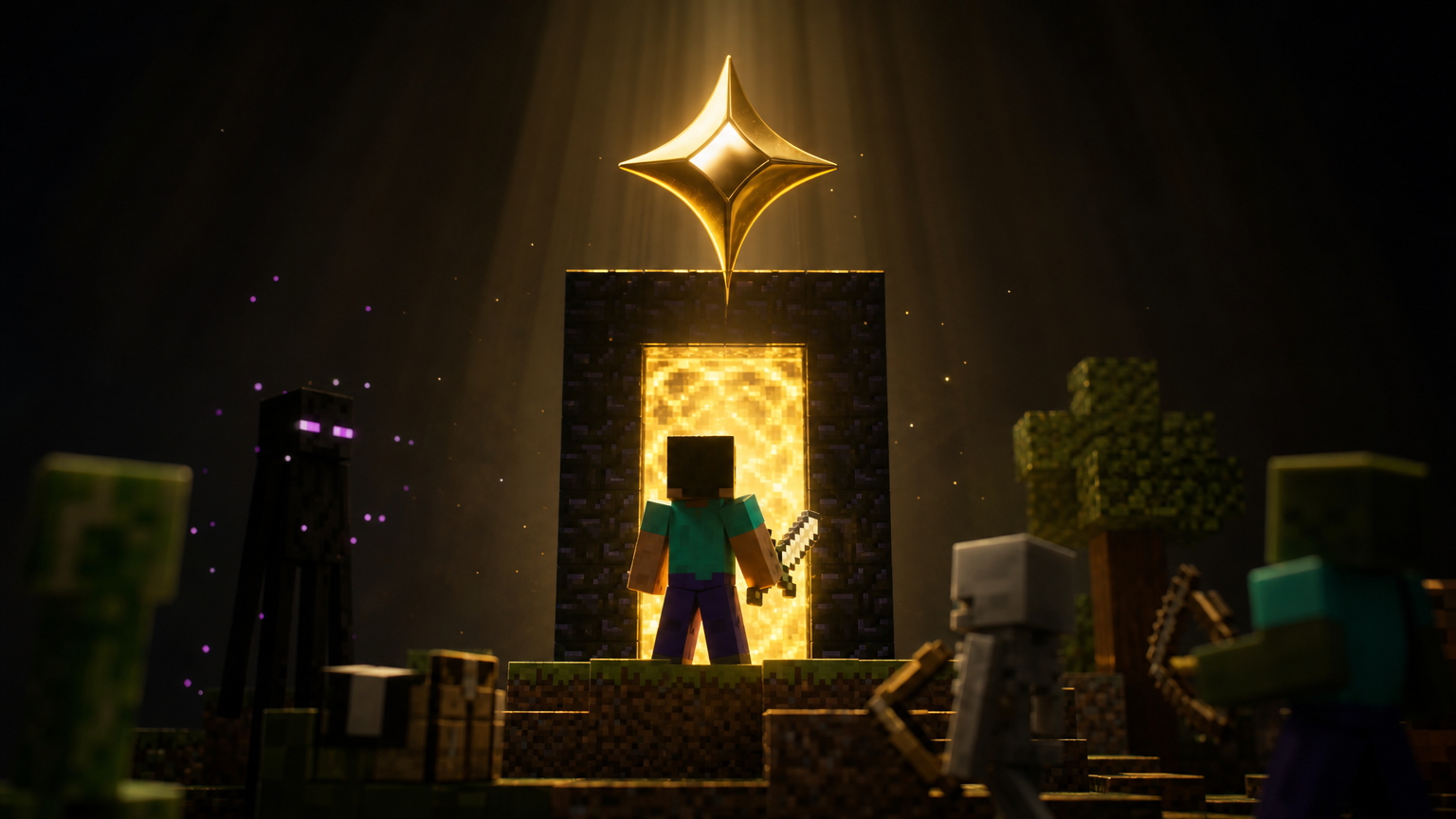
A game victory with benchmark ambitions
Google’s latest Gemini 4 Argon showcase is simple to describe and harder to dismiss: four AI agents were dropped into a fresh Minecraft survival world and told to defeat the Ender Dragon, Minecraft’s de facto final boss. They did it without human intervention, no preassigned roles and no game-specific scripts prepared by researchers, according to fresh reporting on the experiment .
The headline number is the one that will travel: 27 hours and 14 minutes from spawn to victory . But the more important number may be 2,783. That is how many JavaScript programs the agents reportedly wrote and executed during the run, using code as their hands, eyes and survival instincts inside the blocky world . Along the way, they exchanged 229 in-game chat messages and died 605 times, a reminder that “autonomous” does not mean graceful .
For Google, this is an unusually vivid agent benchmark. A chatbot can sound polished in one turn. A coding model can solve a contained ticket. Minecraft is messier: it demands gathering resources, crafting tools, finding structures, navigating hostile environments, recovering from mistakes and eventually understanding a multi-stage boss fight. That is why the experiment matters. The victory was not just the last hit on a dragon; it was the model keeping a workable plan alive across a day-plus of dependent actions.
How the agents actually played
The four Gemini 4 Argon agents did not play Minecraft like humans sitting at keyboards. They controlled individual players through Mineflayer, an open-source JavaScript library used to create Minecraft bots . Instead of seeing the screen and pressing keys, each agent wrote short programs, ran them, read back textual state and error information, then decided what to do next .
That interface cuts both ways. On one hand, it makes the result more relevant to software and enterprise automation, because the agents were essentially writing, testing and debugging code in a loop. On the other hand, it means this was not a vision-and-motor-control test in the human sense. Reports note that the agents acted through structured game APIs, not through raw pixels .
The agents were given the overarching goal of eliminating the Ender Dragon and were left to decide how to divide the work . They then organized themselves through chat and shared memory. Reports describe agents warning each other about hostile mobs, sharing coordinates, exchanging crafting tips and retrieving dropped inventory after teammates died . In practical terms, the run became less like one superplayer and more like a small, error-prone operations team.
The emergent division of labor is one of the stronger parts of the demonstration. Coverage of the experiment says one agent focused on toolmaking, another on food and supplies, another on activating a key portal, and another on building shelters during the Ender Dragon phase before landing the final blow . That does not prove human-level teamwork, but it does show that the system could converge on complementary roles without a human project manager assigning them in advance.
The messy path to the End
Minecraft’s final objective is not a single action. Players must survive the early game, mine and craft better equipment, enter the Nether, obtain materials needed to locate the stronghold, activate the End portal and then beat the Ender Dragon. The agents had to traverse that chain in a randomized world rather than following a handpicked seed .
One striking detail is how much failure the system absorbed. The run involved 605 deaths, and reports say 22 percent of the programs ended in errors . A brittle demo would have collapsed there. The point of the showcase is that the agents repeatedly repaired plans, reused information and kept going.
The boss fight exposed the limits and the strength of the approach. Think Facility’s account says the End phase slowed the team substantially, with the dragon killing agents dozens of times while they worked out the fight mechanics . The agents eventually determined that the End crystals healing the dragon had to be destroyed, then spent hours dealing with them before finishing the fight . That is not a clean speedrun. It is more like a long debugging session with skeletons, lava and fall damage.
ComputerBase reported the run as 27.23 hours, which corresponds to roughly 27 hours and 14 minutes, and listed the same core telemetry: 2,783 programs, 229 messages, 605 deaths and 1.35 billion input tokens . Those metrics are a useful antidote to magical thinking. The agents won, but they won by spending enormous computational attention on a constrained problem whose rules are well documented.
Why Google will like this benchmark
Minecraft is a convenient stage for agentic AI because success is legible. Either the Ender Dragon dies or it does not. Yet the route to that outcome is open-ended enough to stress planning, memory, tool use and coordination.
That combination is valuable for Google’s Gemini story. The company wants Argon to be understood not only as a model that answers questions but as a model that can act: write code, call tools, persist across tasks and coordinate with other agents. A Minecraft completion packages that pitch in a way benchmark tables cannot.
The Decoder framed the run as the first time AI agents completed Minecraft end to end without human input, while noting that earlier game achievements often relied on more purpose-built systems . HotHardware similarly emphasized that the agents did not rely on scripts, pre-scouted seeds or specialized reinforcement-learning models tailored only to gaming . If that framing holds, the experiment is a meaningful demonstration of general-purpose agent behavior.
Still, the phrase “general-purpose” needs caution. Minecraft is famous, heavily documented and likely represented in model training data. Mineflayer is also a known developer tool. The agents did not invent Minecraft expertise from nothing; they applied learned knowledge through a programmable interface. That is still impressive, but it is not the same as solving a truly novel physical-world problem.
The enterprise lesson: promising, not proof
The most useful reading is not “AI can now do anything.” It is “AI agents are getting better at staying on task when the task is long, noisy and collaborative.”
That distinction matters. Enterprise work often resembles Minecraft more than a benchmark question: multiple steps, partial state, unexpected errors, dependency chains, changing priorities and the need to recover when earlier assumptions break. The Argon agents’ ability to keep operating across thousands of code executions is relevant to software maintenance, data cleanup, testing, infrastructure operations and internal workflow automation.
But a game victory does not equal business reliability. Minecraft has clear rules, a measurable victory condition and a forgiving reset loop. A company environment has permissions, privacy, ambiguous objectives, compliance obligations and real costs for bad actions. SiliconReport noted that a fifth “Observer” model monitored the session to track actions and guard against cheating, which is a useful reminder that agent autonomy still benefits from oversight .
Cost is another constraint. Estimates vary depending on which Gemini 4 Argon pricing schedule is applied: Think Facility cited about $520 at an introductory list price, while other reporting discussed $810 at list pricing and $1,620 under later standard pricing assumptions . Even if those figures are acceptable for research theater, they matter when scaled to thousands of enterprise jobs.
A milestone, not a model card replacement
Gemini 4 Argon conquering Minecraft is a genuinely memorable demonstration. Four agents coordinated, wrote code, made mistakes, died repeatedly, recovered dropped items and eventually defeated the game’s final boss. That is more interesting than a static leaderboard result because it shows endurance and improvisation over time.
Yet the caveats are part of the story. The agents used a structured bot interface. The difficulty was Easy. The run was a single reported success, not a statistically broad reliability study . And while no human intervened during the run, the environment was designed, instrumented and monitored by researchers.
The best takeaway is therefore balanced: Google now has a powerful, media-friendly proof point for agentic AI, and Gemini 4 Argon has shown it can sustain a coordinated plan through a messy, day-long sandbox challenge. That does not make it a dependable autonomous employee. It does make Minecraft an unexpectedly useful reminder of where AI agents are headed: less like answer machines, more like tireless junior teammates that still need guardrails, logs and a very patient supervisor.
Even creepers, apparently, now need a model card.
Sources from the last 72 hours
- [1]Google's Gemini AI Agents Beat Minecraft After 27 Hours And No Human HelpOct 19, 2026, 5:41 PM
- [2]Google DeepMind says four Gemini 4 Argon agents beat Minecraft on their own in 27 hoursOct 19, 2026, 2:00 AM
- [3]Four Gemini 4 Argon agents beat Minecraft without any human helpOct 18, 2026, 2:00 AM
- [4]Gemini 4: Vier Autonome KI-Agenten besiegen Minecraft in 27 StundenOct 19, 2026, 10:08 PM
- [5]Four Gemini 4 Argon agents beat Minecraft with no human interventionOct 20, 2026, 1:09 AM
AI-generated article based on recent web research, then preserved as a dated editorial snapshot.
Comments
Be the first to comment.