
Daily Podcast full article
Nvidia lands $35B China orders as China’s AI giants rush for RTX PRO 5500
ByteDance, Alibaba and Tencent have reportedly placed orders worth more than $35 billion for Nvidia’s RTX PRO 5500 graphics cards, a workstation-class product that has become one of the most powerful Nvidia options still available to Chinese buyers under U.S. export controls. The scale of the shopping list is striking; the bigger question is whether Nvidia can actually deliver it.
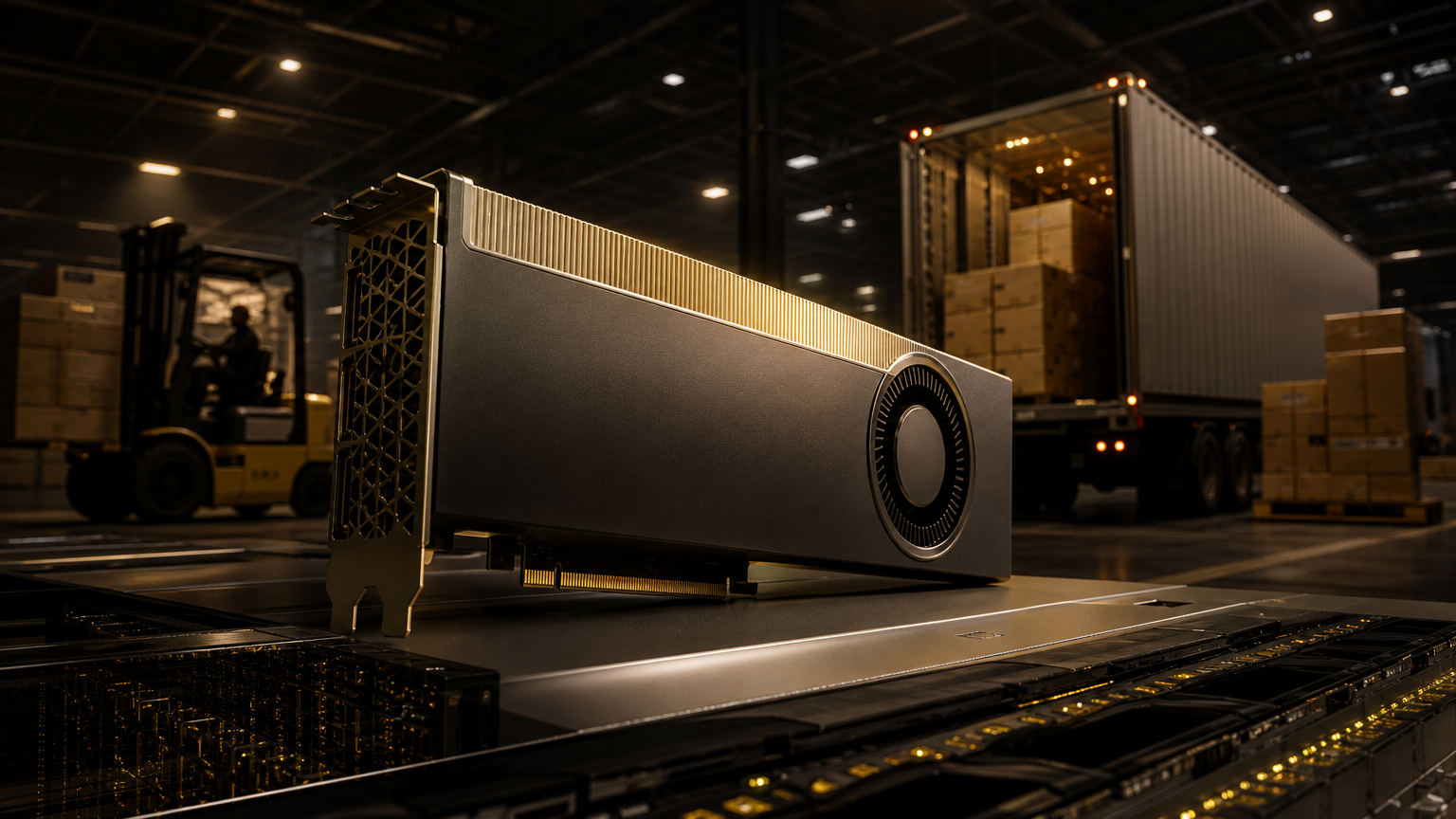
A $35 billion order book built around the chips China can still buy
Nvidia’s China business has not disappeared; it has been rerouted. ByteDance, Alibaba and Tencent have ordered more than 3 million of Nvidia’s new RTX PRO 5500 graphics cards, with a collective sticker price of more than $35 billion, according to Reuters reporting cited by multiple outlets on October 20, 2026 . The reported orders are not for Nvidia’s most advanced data-center accelerators, but for a workstation-class GPU that sits in the narrow space between strong AI utility and export-rule compliance .
That distinction matters. The RTX PRO 5500 is designed for powerful professional computers rather than the large data-center clusters typically associated with Nvidia’s top AI processors . Yet for Chinese cloud and internet groups facing tight access to the highest-end U.S. AI chips, “not the best” may still be good enough if it is available, scalable and compatible with existing AI software stacks.
The number is large even by the standards of the AI infrastructure boom. Reuters reported that the three companies’ orders are for cards priced at about $11,400 each, putting the potential combined value above $35 billion . The Next Web, summarizing the same report, said the order covers more than 3 million RTX PRO 5500 cards and noted that Nvidia has warned customers it cannot guarantee fulfillment .
The headline, in other words, is not only that China’s largest internet platforms still want Nvidia hardware. It is that they appear willing to commit giant sums to a less powerful, export-compliant part because the AI compute shortage has become strategic.
Export controls are redirecting demand, not eliminating it
The reported buying spree lands directly in the middle of Washington’s export-control strategy. Nvidia’s Blackwell-based B300 data-center chip is not allowed to be sold to Chinese buyers under U.S. rules, while exports of its Hopper-based H200 are reviewed case by case and subject to licensing conditions . That leaves Chinese buyers hunting for alternatives that are weaker than flagship AI accelerators but still strong enough for meaningful production workloads.
The RTX PRO 5500 appears to fit that role. Reuters described it as among the most powerful Nvidia chips still available to Chinese buyers, even though it is not built for the most demanding AI training clusters . Tom’s Hardware characterized it as an export-compliant workstation GPU and said it carries 84GB of GDDR7 memory, making it attractive for AI applications even if it is below Nvidia’s main data-center line .
This is the central policy wrinkle. Export controls are intended to slow China’s access to the most advanced AI computing systems. But the latest orders suggest that when top-tier accelerators are blocked, demand does not vanish. It migrates down the product stack, concentrates around compliant parts and intensifies competition for anything that can run modern inference at scale.
The reported use case reinforces that point. Chinese companies are seeking to use the RTX PRO 5500 primarily for AI inference, meaning the running of trained models to generate outputs such as chatbot responses, Reuters reported . Inference generally requires less compute than model training, which makes it a natural workload for hardware that may not be optimal for frontier training clusters but can still serve huge volumes of user requests.
The supply problem may be bigger than the order
The most revealing part of the story is not the dollar figure; it is the gap between demand and supply. Nvidia has told customers and partners it cannot guarantee that it can fill the orders because demand from Chinese technology companies far exceeds planned production, Reuters reported . One source told Reuters that partners might receive only 5% to 10% of the requested quantities, while another said Nvidia had indicated it could produce no more than 3 million RTX PRO 5500 cards globally in 2027 .
That creates a striking mismatch. The three named companies alone reportedly want more than 3 million units . Total orders from Chinese customers have exceeded 6 million units, according to Reuters sources cited by both The Next Web and Seoul Economic Daily . If Nvidia’s 2027 global output for the card is capped near 3 million units, even perfect allocation to China would not satisfy the reported demand; in practice, Nvidia also has customers and production priorities elsewhere.
Seoul Economic Daily reported the same pressure point bluntly: including the 3 million units tied to ByteDance, Alibaba and Tencent, Chinese RTX PRO 5500 orders have surpassed 6 million units, while Nvidia’s 2027 output may reach at most about 3 million units . The publication also said Nvidia may deliver only about 5% to 10% of ordered volumes to customers, reflecting the same supply warnings found in Reuters-based coverage .
That makes the order book partly a claim on future capacity rather than a simple revenue event. A $35 billion sticker value does not automatically translate into delivered sales. It signals willingness to buy, urgency to secure allocation and the possibility of constrained deliveries.
Why ByteDance, Alibaba and Tencent need the cards
The three buyers named in the report are not marginal AI experimenters. ByteDance runs massive recommendation and content systems, Alibaba operates one of China’s most important cloud platforms, and Tencent combines social, gaming, cloud and enterprise AI demand. Each has incentives to expand inference capacity as generative AI moves from research labs into search, commerce, advertising, coding, customer support and consumer apps.
That is why inference matters. Training a frontier model is capital-intensive and politically sensitive, but serving trained models to hundreds of millions of users is a separate bottleneck. Once AI features are embedded in everyday products, the limiting factor becomes affordable, available, reliable compute.
The RTX PRO 5500 may be a compromise, but compromise chips can become strategic when there are no unconstrained alternatives. The Next Web noted that Nvidia expects early samples in December and commercial deliveries beginning in the first quarter of 2027, according to Reuters sources . If that timetable holds, these cards would arrive just as Chinese platforms continue trying to turn AI models into live services.
Nvidia remains central, even when constrained
For Nvidia, the story cuts two ways. On one hand, it shows that U.S. export controls have seriously damaged its ability to sell top data-center AI accelerators into China. Nvidia CEO Jensen Huang has said restrictions reduced the company’s share of China’s AI data-center chip market from near monopoly to effectively nothing, according to the Reuters report .
On the other hand, the RTX PRO 5500 demand shows that Nvidia’s ecosystem still has enormous pull. Chinese companies are not merely switching away; they are trying to buy whatever Nvidia hardware remains legally reachable. Nvidia’s software ecosystem, developer familiarity and performance advantages continue to matter, especially for companies that must deploy AI services quickly.
The result is an awkward equilibrium. Washington restricts the most capable chips. Beijing encourages domestic alternatives. Chinese companies still prize Nvidia parts. Nvidia can see demand but cannot necessarily serve it. And global customers may now worry that every compliant chip suitable for AI inference will be contested by buyers with enormous budgets.
Global GPU allocation enters a new phase
The order raises a broader allocation question: if a workstation card can become the center of a multibillion-dollar AI procurement wave, what counts as scarce AI infrastructure now? The answer is no longer limited to flagship accelerators. Memory-rich workstation GPUs, export-compliant variants and any card that can efficiently support inference may become part of the same global scramble.
That matters for enterprises outside China as well. If Nvidia prioritizes its Rubin platform and other large-scale data-center products in 2027, as Reuters sources indicated, products like the RTX PRO 5500 may sit lower in the manufacturing queue . The more Chinese demand stacks up behind export-compliant GPUs, the more pressure there may be on prices, availability and lead times for other buyers.
The reported Tansun Technology filing adds a smaller but useful signal. Reuters said the Shenzhen-listed fintech and AI-computing services company agreed on October 13 to buy 20,000 RTX PRO 5500 cards from an unidentified counterparty and warned that shortages, industry demand and overseas technology controls could delay deliveries or reduce volumes . That warning captures the reality behind the splashy headline: orders are easier to place than to fulfill.
The bottom line
Nvidia has landed a reported $35 billion-plus China order wave from ByteDance, Alibaba and Tencent, but the story is less about a single sales win than about the shape of the AI compute market under constraint. Export controls have blocked China from Nvidia’s most advanced data-center chips, yet they have also made export-compliant alternatives more valuable. The RTX PRO 5500 is not the crown jewel of Nvidia’s AI portfolio, but it may be powerful enough, available enough and familiar enough to become a prized substitute.
The decisive question is fulfillment. If Nvidia can supply only a fraction of requested units, the orders become a map of unmet demand rather than a straightforward shipment schedule. Either way, the signal is clear: China’s biggest internet companies are still racing to secure Nvidia compute, and the global GPU shortage has moved from top-tier accelerators into every high-memory card that can keep AI services running.
Sources from the last 72 hours
- [1]Exclusive-ByteDance, Alibaba, Tencent place over $35 billion worth of Nvidia chip ordersOct 20, 2026, 11:03 AM
- [2]ByteDance, Alibaba and Tencent order $35bn of Nvidia chips, Reuters reportsOct 20, 2026, 1:32 PM
- [3]China’s tech giants drop $35 billion on export-compliant Nvidia RTX Pro 5500 workstation GPU orders to power AI ambitions, according to reports — ByteDance, Alibaba and Tencent order 3 million cards despite warnings that only 10% of orders are fulfillableOct 20, 2026, 2:00 AM
- [4]ByteDance, Alibaba, Tencent Order $35 Billion in Nvidia ChipsOct 20, 2026, 1:38 PM
AI-generated article based on recent web research, then preserved as a dated editorial snapshot.
Comments
Be the first to comment.