
Daily Podcast full article
Tesla’s Next-Gen 50,000-Ton Giga Press Makes New Cars 7X Faster!
Tesla’s reported 50,000-ton Giga Press is being framed as the muscle behind a radically faster Cybercab factory, but the current evidence points to a more nuanced story: Tesla has confirmed Cybercab production, keeps promoting “unboxed” assembly, and is expanding robotaxi operations, while the headline press specifications and true sustained output remain unverified.
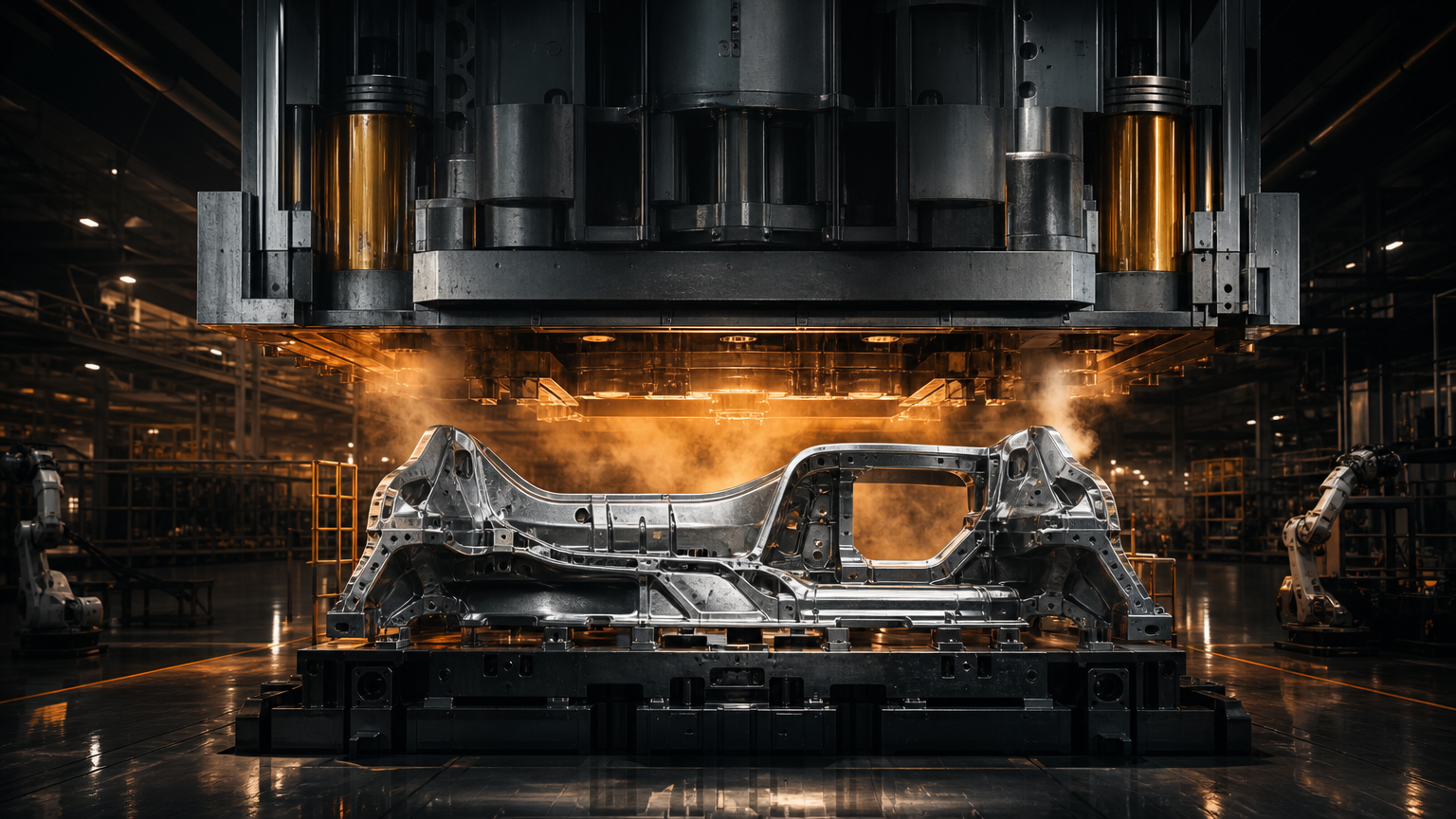
The headline is real; the proof is still catching up
Tesla’s Cybercab manufacturing story is now less about whether the company wants to reinvent car production and more about how much of the reinvention has been demonstrated at scale. The working headline remains the same: Tesla’s next-gen 50,000-ton Giga Press is supposed to make new cars dramatically faster. The current state, however, is that the 50,000-ton figure is still reported rather than fully specified by Tesla, while the broader manufacturing strategy around Cybercab has become more visible through Tesla’s own disclosures and recent reporting .
The central idea is simple but ambitious. Traditional cars are assembled from many stamped metal parts that must be aligned, welded, bonded, checked and moved through long serial lines. Tesla’s approach is to replace much of that complexity with large structural castings, modular subassemblies and a final joining process closer to a high-speed product line than a conventional body shop . That is where the “7X faster” promise comes from: fewer parts, fewer handling steps, more parallel work and less time spent correcting tolerance stack-up.
But there is an important distinction between a spectacular machine claim and a factory-proven production rate. A press stroke, a casting cycle, a completed underbody, a rolling chassis and a finished Cybercab are not the same metric . Tesla’s challenge is not simply to make a giant casting; it is to keep molten aluminum quality, cooling, inspection, module delivery, battery supply, software validation and fleet deployment moving at the same cadence.
What Tesla has actually confirmed
Tesla’s fresh proxy materials say the company began producing Cybercab at Gigafactory Texas in 2026 and expanded Robotaxi service into more U.S. cities . The same filing highlights Tesla’s shift away from linear assembly lines toward a “parallel modular construction” system, the unboxed process, which Tesla says is intended to reduce production time, factory footprint and cost .
That matters because the Giga Press is only one part of the Cybercab production thesis. If a giant casting cell produces front or rear structural sections quickly but the rest of the vehicle still moves through a traditional bottleneck, the headline speed advantage disappears. The unboxed process is designed to avoid that problem by building major vehicle modules separately and bringing them together near the end of the line .
Recent coverage of Tesla’s shareholder-meeting materials also says Tesla is pointing investors toward Cybercab as part of its late-2026 growth story. Not a Tesla App reported that Tesla’s current shareholder pitch says Cybercab has launched, with more than 300 units operating in Austin and rides expected to begin soon in Dallas . That is not the same as confirming the output of a 50,000-ton casting machine, but it does show that the vehicle program is no longer just a design study or a stage prototype.
Installed capacity is not sustained output
The most useful number in the current discussion is not the biggest tonnage claim. It is capacity. ElectronMotion’s Oct. 19 earnings preview says Cybercab production began at Gigafactory Texas in the second quarter and that Tesla listed installed Cybercab capacity at more than 125,000 vehicles per year . If that figure is accurate, it implies Tesla has installed enough equipment for a serious production program, not merely a handful of engineering builds.
Still, capacity is not output. Installed annual capacity assumes equipment availability, staffing, parts flow, uptime, quality yield and logistics all behave as intended. Early ramps rarely do. The same preview correctly framed the coming Q3 call as a moment to listen for how quickly Cybercabs are actually joining the fleet, not simply how large the theoretical factory could become .
That distinction is especially important for a vehicle like Cybercab. Tesla is not producing a conventional consumer car that can sit at dealerships until buyers arrive. It is producing a purpose-built robotaxi whose commercial value depends on autonomy readiness, city approvals, charging and cleaning infrastructure, remote support, insurance, maintenance and enough passenger demand to keep the fleet utilized.
The 50,000-ton question
The subject claim says Tesla’s next-gen press reaches 50,000 tons. The current public record supports caution. HelloBro’s fresh backgrounder says reports have linked Giga Texas to a 50,000-ton press, but Tesla has not publicly confirmed the full specifications of that exact machine . That is the sentence every reader should keep in mind.
Could Tesla want a press dramatically larger than the 6,000- to 9,000-ton class associated with earlier large castings? Yes, the logic is clear. Larger castings could consolidate more parts, reduce assembly variation and support an unboxed line that finishes vehicles faster. But without Tesla releasing machine specifications, cycle times, casting dimensions, scrap rates and first-pass yield, the 50,000-ton number remains a reported industrial ambition rather than an audited production fact .
The same applies to viral claims that a car can be built every few seconds. A single automated sub-process may operate on a seconds-scale rhythm, but total vehicle throughput depends on the slowest constrained part of the system. If battery modules, interiors, electronics or quality gates fall behind, a fast casting cell cannot by itself create finished vehicles at headline speed.
The Austin fleet is the proving ground
Cybercab’s factory story now intersects directly with its service story. Not a Tesla App reported that Tesla’s late-2026 shareholder pitch cites more than 300 Cybercabs operating in Austin, while Silicon Hills summarized the same broader moment by noting that Tesla’s Robotaxi account said the Austin Cybercab fleet had grown from fewer than 40 vehicles to more than 300 in about a month . Silicon Hills also noted that Tesla has not disclosed how many vehicles operate at once or how many rides they complete .
That is the right lens for the Giga Press claim. A faster factory only matters if Tesla can place vehicles into service, keep them running and prove the fleet economics. For a robotaxi, repairability and uptime are part of manufacturing quality. Large castings can reduce the number of pieces in the structure, but damage to a multifunction casting may be more consequential than damage to a smaller replaceable part. Tesla’s manufacturing bet must therefore work not just at the end of the assembly line, but over thousands of fleet miles.
Regulation is another bottleneck outside the casting shop. Silicon Hills reported that federal safety regulators are reviewing allegations involving Tesla robotaxis in school zones and whether Cybercab meets vehicle safety standards, while noting that neither review had found wrongdoing . That does not negate Tesla’s manufacturing progress, but it shows why Cybercab scale cannot be measured by factory equipment alone.
Why the unboxed system matters more than the press alone
The most compelling part of Tesla’s plan is not just brute force. It is coordination. A huge Giga Press can reduce structural complexity, but the unboxed factory is what could turn that into faster finished vehicles. Tesla’s proxy says the company is developing parallel modular construction to reduce production time, footprint and cost . EVXL’s Oct. 19 coverage of the same proxy emphasized that Tesla is using Cybercab and related manufacturing progress as part of its case to shareholders ahead of the Dec. 3 meeting at Gigafactory Texas .
If the system works, the Cybercab line could become a template for lower-cost EV manufacturing: cast big structures, build modules in parallel, install components while access is open, then join the vehicle late. That can reduce station count, robot count, factory area and rework opportunities. It also fits Cybercab’s design brief: a simpler two-seat robotaxi optimized for efficiency, fleet operation and repeatable production.
If the system struggles, the same integration that saves steps could make defects more expensive. A single large casting carrying multiple structural functions must be dimensionally consistent and metallurgically sound. Porosity, incomplete fill, distortion or cooling variation can turn one bad casting into one very expensive rejected structure. At robotaxi scale, quality escapes would be especially damaging because every downtime hour reduces revenue.
Bottom line
Tesla’s reported 50,000-ton Giga Press remains one of the boldest claims around Cybercab manufacturing, but the current state of the story is not “mission accomplished.” Tesla has confirmed Cybercab production at Gigafactory Texas, is publicly tying the program to unboxed manufacturing, and is presenting Cybercab deployment as part of its late-2026 growth case . Recent reporting also points to more than 125,000 units of installed annual capacity and a rapidly larger Austin fleet .
The unresolved question is whether those pieces can operate together at sustained speed, quality and cost. Until Tesla confirms the press specifications and publishes or demonstrates repeatable production rates, the 50,000-ton Giga Press should be treated as a powerful symbol of Tesla’s manufacturing direction, not yet as proof that Cybercab production is seven times faster in real-world fleet terms.
Sources from the last 72 hours
- [1]Tesla’s Next-Gen 50,000-Ton Giga Press Makes New Cars 7X Faster!Oct 20, 2026, 5:32 PM
- [2]Tesla, Inc. 2026 Proxy StatementOct 20, 2026, 2:00 AM
- [3]Tesla Announces 2026 Shareholder Meeting for Dec. 3Oct 20, 2026, 6:00 AM
- [4]Tesla Q3 2026 Earnings Preview: What Analysts ExpectOct 19, 2026, 6:00 AM
- [5]Tesla's Giga Texas Meeting Lottery Gives Winners 17 Days to Get ThereOct 19, 2026, 6:43 PM
- [6]Silicon Hills News Daily Roundup — Sunday, Oct. 18, 2026Oct 18, 2026, 6:00 AM
AI-generated article based on recent web research, then preserved as a dated editorial snapshot.
Comments
Be the first to comment.