
Daily Podcast full article
DeepSeek barred from US agencies
Washington has ordered federal civilian agencies to remove DeepSeek-linked AI tools from government systems and stop buying them, turning the US-China AI rivalry from a chip-and-cloud fight into a direct test of model provenance, data exposure and software supply-chain control.
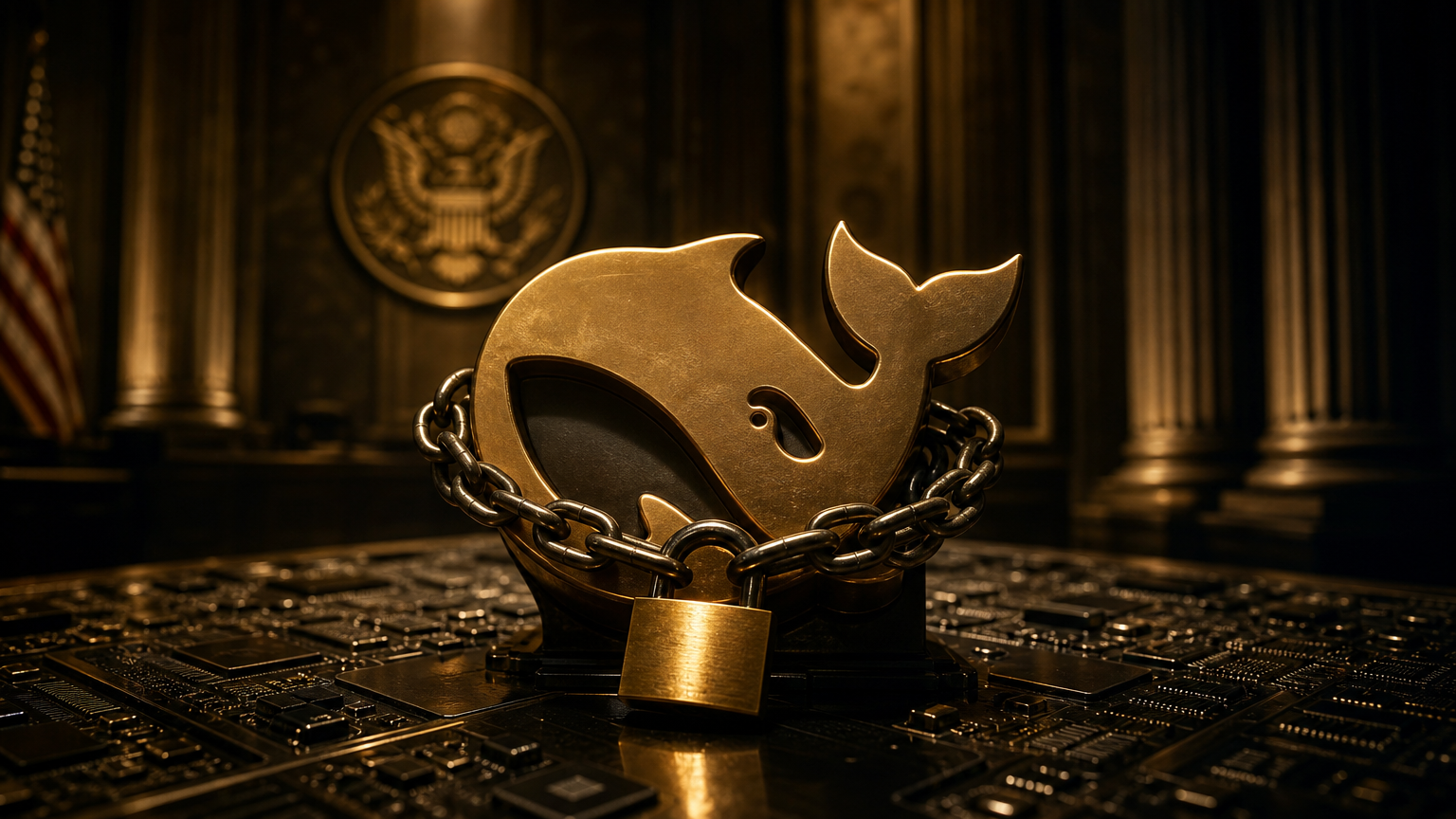
The ban moves AI policy down to the model layer
The US government has moved against DeepSeek inside federal civilian systems, ordering agencies to exclude information technology products and services developed by Hangzhou DeepSeek Artificial Intelligence Co., Ltd., its affiliates, and third-party products or services built using DeepSeek implementations from procurement and agency IT environments . The Department of Homeland Security notice, published in the Federal Register on October 20, 2026, says the Secretary acted under the Federal Acquisition Supply Chain Security Act of 2018 after reviewing a Federal Acquisition Security Council recommendation and supporting evidence .
That legal framing matters. This is not simply a warning to employees not to paste sensitive text into a foreign chatbot. It is a supply-chain exclusion and removal order aimed at the software, service and derivative-product layer around a named AI developer . In practice, federal civilian agencies must look not only for DeepSeek-branded apps, APIs or services, but also for products from affiliates and third-party tools developed using DeepSeek implementations .
The decision extends Washington’s technology restrictions from semiconductors, data centers and cloud infrastructure into the model stack itself. TechCrunch reported that the order requires federal civilian agencies to stop purchasing DeepSeek products and remove them from government IT systems over national security concerns tied to the Chinese startup’s operations in China . The Guardian likewise reported that the DHS notice covers products developed by DeepSeek and tools created using DeepSeek by third parties .
Why DHS says DeepSeek is different
The government’s stated concern is not only that DeepSeek is Chinese, but that its services could expose government users, vendors and agency data to a foreign legal and intelligence environment. The Guardian reported that the DHS order warns use of DeepSeek tools may transfer sensitive data to China, and that DeepSeek servers are located in China, where the legal system gives authorities broad power to access private company infrastructure . AP reported that the Federal Register notice alleges DeepSeek’s models present “multiple threat vectors,” including concerns about servers in China and potential access by Chinese authorities to sensitive US data .
That risk model fits the way modern AI is actually deployed. A model is not just a downloadable file or a chat window. It can be embedded in coding assistants, analytics products, workflow tools, search systems, help desks, procurement platforms and custom agency pilots. BleepingComputer reported that the DHS order covers DeepSeek products, affiliates and third-party products and services built using DeepSeek technology, and that covered agencies are told to remove those products immediately or seek an exception .
The breadth is the point. If an agency only blocks the DeepSeek website while leaving a vendor product that routes prompts to a DeepSeek implementation, the data-risk pathway may remain. If a contractor uses a DeepSeek-backed coding assistant while working on a federal system, the provenance and telemetry risks may be harder to see than a prohibited app icon on a government laptop. The order’s language therefore treats AI provenance as part of supply-chain security, not as a side issue for acceptable-use policies.
A compliance scramble for agencies
For federal IT teams, the immediate work is discovery. They must identify where DeepSeek technology may exist across approved-product lists, procurement marketplaces, SaaS subscriptions, developer tools, internal pilots and contractor workflows. The Federal Register notice says the order excludes DeepSeek-developed products and services from federal civilian procurements and removes DeepSeek, DeepSeek-affiliate products, and third-party products and services developed using DeepSeek implementations from civilian agency IT .
BleepingComputer reported that agencies can seek exceptions, with requests due within 60 days of the order’s issuance and reviewed by CISA, while agencies unable to comply because of internal capability limits can receive technical assistance . IT Pro reported that agencies using DeepSeek are warned to check whether they have already been compromised, monitor traffic into and out of agency systems, implement enhanced logging and controls, and flag anomalous activity .
That combination turns the ban into more than an uninstall order. It is an inventory project, a procurement audit, a network-monitoring exercise and a vendor-risk review. Agencies must determine what “developed using DeepSeek implementations” means in real deployments, then ask vendors to prove whether DeepSeek models, APIs, fine-tunes or inference services are anywhere in the product chain. The hardest cases may be products whose customer-facing brand is American or neutral, but whose AI component was trained, distilled, fine-tuned, hosted or benchmarked around DeepSeek technology.
Why enterprise AI vendors should pay attention
The federal order sends a signal beyond government. Any AI vendor selling into regulated sectors will now face sharper questions about training provenance, inference location, logging, subcontractors, model lineage and data retention. TechCrunch reported that the order goes beyond DeepSeek’s own products and covers third-party products and services built using DeepSeek technology, although agencies can request exceptions .
That creates a new commercial premium for documentation. Vendors that can produce a clear model bill of materials, describe where inference runs, identify upstream model dependencies, document fine-tuning data, and separate customer prompts from model improvement pipelines will be easier to approve. Vendors that cannot answer those questions may become procurement risks even if they never market themselves as DeepSeek resellers.
The order also illustrates a shift in how governments may regulate AI competition. Chip export controls focus on who can train frontier systems. Cloud and data-center rules focus on who can access compute. A model-level exclusion focuses on what software artifacts may touch official data, regardless of whether the model runs through a direct app, an API, an embedded tool or a contractor service. For agencies, that means AI security is no longer limited to blocking consumer chatbots. For vendors, it means AI supply-chain attestations are moving from nice-to-have paperwork to a condition of access.
Beijing pushes back
China responded sharply after the US move became public. AP reported that Foreign Ministry spokesperson Mao Ning said China would “resolutely safeguard the legitimate rights and interests of Chinese companies,” while China’s Ministry of Commerce expressed strong dissatisfaction and opposition and accused the US of using national security as a pretext to suppress China . TechCrunch also reported that Beijing opposed what it called the overstretching of national security and the politicization of technology and trade issues .
The dispute lands in a broader US-China AI contest. AP reported that Washington and Beijing have recently made some progress on AI governance discussions, including a US proposal for a notification system on national-security-related AI incidents, but remain at odds on many issues . The same AP report noted that AI is expected to be on the agenda when President Donald Trump and President Xi Jinping meet again in mid-November on the sidelines of the APEC summit in Shenzhen .
That diplomatic context makes the DeepSeek order more than a narrow cybersecurity action. It is a marker of distrust about model access, data flows and the role of national law in AI services. The US is effectively saying that, for civilian federal systems, certain AI products cannot be made safe enough if their ownership, infrastructure or legal exposure is considered unacceptable. China is answering that the US is expanding national-security logic to discriminate against Chinese technology firms.
What changes now
The near-term burden falls on agency CIOs, CISOs, procurement officers and contractors. They must remove covered tools, pause purchases, document exceptions, and prove that third-party products do not quietly depend on DeepSeek technology. The broader burden falls on the AI market, which must now treat model provenance as a compliance object.
The federal prompt has changed: not merely “do not share sensitive data,” but “show exactly which model is in the loop.” For DeepSeek, the US order closes the door across federal civilian agency systems. For everyone else selling AI into government, it opens a more difficult era in which model origin, data handling and deployment control are not marketing claims, but procurement evidence.
Sources from the last 72 hours
- [1]Notice of Order Regarding Exclusion and Removal of DeepSeek Products From Federal Civilian Executive Branch Information Technology Systems and ProcurementsOct 20, 2026, 2:00 AM
- [2]US orders federal agencies to remove China’s DeepSeek AI from their systemsOct 20, 2026, 3:07 PM
- [3]US bans use of China’s DeepSeek AI tools by government agenciesOct 20, 2026, 2:33 PM
- [4]DHS bans DeepSeek products across US federal civilian agenciesOct 20, 2026, 4:19 PM
- [5]US bans DeepSeek from federal civilian agenciesOct 20, 2026, 2:00 AM
- [6]China defends DeepSeek after US ban of its AI from government systemsOct 20, 2026, 11:36 AM
AI-generated article based on recent web research, then preserved as a dated editorial snapshot.
Comments
Be the first to comment.