
Daily Podcast full article
AI Factories That Use Less Power and Water, Built in Days | NVIDIA DSX
NVIDIA’s DSX POD turns the AI data center into a factory-built product: modular Vera Rubin infrastructure assembled, cabled, cooled, powered and validated before it reaches the site. The promise is not only a faster route to “first token,” but also a new operating model for AI factories constrained by electricity, water and construction complexity.
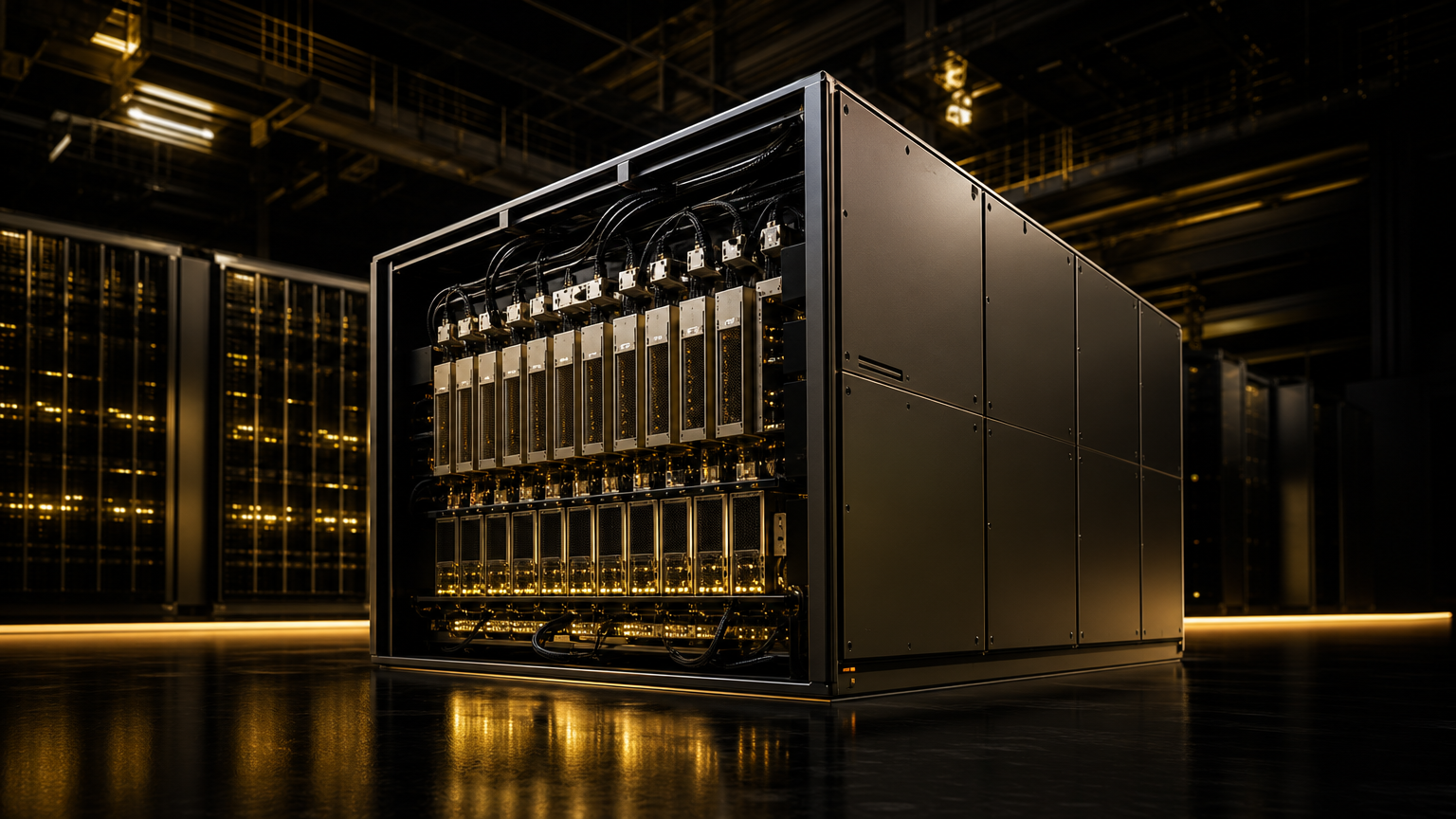
NVIDIA’s DSX moment is about infrastructure, not just chips
NVIDIA’s latest DSX announcement is best read as a shift in what the company wants the market to buy: not only GPUs, not only racks, but a repeatable architecture for entire AI factories. At GTC Berlin, NVIDIA introduced DSX POD as a reference design for complete Vera Rubin AI factories built by partners inside modular containers, integrated and validated before delivery . The headline claim is direct: once a site is prepared, these factory-built units can reduce deployment time from roughly six months to as little as 14 days .
That distinction matters. DSX POD is not described as a magic box that eliminates construction, permitting, utilities or grid interconnection. It is a way to move a large share of high-risk, repetitive integration work off the jobsite and into a controlled manufacturing environment. NVIDIA says partners complete rack-to-rack cabling, wiring, piping and functional validation before shipment, while site preparation can proceed separately . In practical terms, the bottleneck shifts from field assembly toward repeatable interfaces: power, cooling, networking, foundations and commissioning.
The broader DSX platform frames the AI factory as one coordinated system. NVIDIA’s technical blog says DSX brings compute, networking, storage, power, cooling, facility controls and software together at the data-center level, while DSX POD is the factory-built implementation of that broader design . That is the core of the story: the AI factory is being treated less like a bespoke data-center project and more like an industrial product line.
From site-built clusters to factory-validated pods
Traditional data-center projects are sequential. Select the site, design the power and cooling, install racks and cables, validate network and cluster behavior, then start bringing workloads online. NVIDIA’s argument is that AI infrastructure has become too dense and interdependent for that slow, mostly site-built model to scale cleanly. Rack-scale AI systems combine high-density compute, scale-up and scale-out networking, liquid cooling, power telemetry and management software; those systems must stay within mechanical, electrical, thermal and networking specifications through factory integration, transportation, installation and operation .
DSX POD attacks that problem by changing the validation boundary. Instead of shipping racks as independent pieces to be assembled into a cluster in the field, partners validate the installed compute environment as a deployment unit. NVIDIA says validation can include rack inventory, firmware and configuration baselines, power-on checks, fabric connectivity, sensor operation, cooling integrity and system-level functional tests before the container leaves the factory .
This matters because the most expensive delays in AI infrastructure often happen late: a cable mismatch, a thermal issue, a power-sequencing fault, a sensor problem or a network validation failure after everything is already on site. Factory validation does not remove all risk, but it moves more defects into a setting where tooling, documentation and repeatable procedures should be easier to control.
NVIDIA says the POD architecture is aligned with its Vera Rubin platform and rack-scale systems . Data Center Dynamics reported that Jensen Huang described one Vera Rubin DSX POD as beginning with Vera Rubin NVL72: seven liquid-cooled compute racks connected with 17 kilometers of Spectrum-X cables . The detail is useful because it shows why NVIDIA is talking about factories rather than rooms full of servers. At this density, the network, cooling loop, cabling plan and power design are no longer accessories; they are part of the product.
The power story: more tokens inside a fixed envelope
The power constraint is central. In many regions, the limiting factor for AI buildout is not demand for compute but the availability of megawatts, grid interconnections and electrical infrastructure. NVIDIA’s DSX efficiency pitch is therefore economic as much as environmental: if operators can produce more tokens inside the same power envelope, they can monetize constrained capacity sooner.
NVIDIA says DSX MaxLPS dynamically allocates power within an AI factory’s provisioned budget, helping operators generate the same number of tokens with up to 30% less power . The company also says operators can use that efficiency to support more GPU capacity and higher throughput within existing power budgets . Those are vendor claims, but they point to the operating model NVIDIA wants: power becomes a managed, software-controlled production input rather than a static facility limit.
The current partner list is also important. NVIDIA says CoreWeave, Firmus, Google Cloud, IREN, Lambda, Nebius, Nscale and Sharon AI are planning to use or explore DSX MaxLPS . In one reported proof of concept across NVIDIA HGX B200 systems, Lambda demonstrated 24% more cluster token throughput and 19% more GPU capacity within a fixed power budget . Nscale also evaluated DSX MaxLPS across four NVIDIA GB300 NVL72 racks in Iceland and reported 49% higher inference throughput and 37% more managed GPU capacity within the same 264-kilowatt provisioned budget .
Those numbers should be read carefully. They are not independent industry benchmarks for every workload, climate or data-center design. They are examples reported by NVIDIA and partners. Still, they clarify what DSX is trying to optimize: not peak chip performance in isolation, but productive AI output per available watt across the facility.
The water story: dry cooling where climate allows
The water claim is just as central, and more politically sensitive. AI data centers are facing scrutiny not only over electricity demand, but also over water consumption in regions already under pressure. NVIDIA says DSX reference designs connect liquid-cooled computing with dry-cooler-based heat rejection that avoids evaporation . In this design, cooling liquid absorbs heat from computing equipment and circulates in a closed loop, while outdoor dry coolers release heat into the air without evaporating water .
NVIDIA says Vera Rubin infrastructure supports 100% liquid cooling with coolant temperatures up to 45 degrees Celsius, enabling dry-cooler-based designs that can reduce facility cooling water consumption to near zero under suitable conditions . At 2-gigawatt scale, NVIDIA claims DSX could save 54 million liters of water per day compared with conventional cooling-tower-based systems, equivalent to the daily water use of 180,000 households .
The caveat is important. NVIDIA notes that local climate determines whether supplemental mechanical cooling is needed during the hottest periods . Data Center Dynamics likewise reported that some climates may require additional mechanical cooling in extreme heat . So “near-zero” cooling water is not a universal guarantee; it is a design target enabled by closed-loop liquid cooling, higher coolant temperatures and suitable heat-rejection conditions.
Why “built in days” still depends on the site
The most marketable phrase in the DSX POD story is the deployment window: from six months to as little as 14 days. But the condition is explicit. NVIDIA says the units connect to a prepared site’s power, cooling, networking and supporting infrastructure . Its technical blog is equally clear that DSX POD does not eliminate supporting facility infrastructure; at the site, teams still connect the container to prepared water and heat-rejection infrastructure, commission the complete loop and verify performance under operating conditions .
That makes DSX POD a schedule-compression strategy, not a replacement for project development. Permitting, grid capacity, land, civil works and upstream electrical gear still matter. What changes is the ability to parallelize. Site teams can prepare land, foundations, power and external connectivity while partners manufacture and integrate containers in the factory . After delivery, work focuses on placement, inter-container connections, hookup to external power, cooling and networking, transport-integrity checks and commissioning .
This is also why NVIDIA emphasizes partners. The company says Anduril, Armada, Bull, Crusoe, DayOne, Dell Technologies, Delta, Eaton, Foxconn, GIGABYTE, HPE, Lenovo, Pegatron, QCT, Schneider Electric, Vertiv and Wistron are working with it to deliver DSX POD AI factories worldwide in early 2027 . NVIDIA supplies the validated design foundation; the ecosystem supplies manufacturing, regional engineering, customization, deployment, service and support .
The real meaning of DSX POD
DSX POD is not merely a containerized data center. It is NVIDIA’s attempt to standardize the AI factory as a full-stack industrial system: compute, networking, storage, software, power, cooling, controls and construction logistics designed together. The benefit, if the model works, is faster time to first token, lower field-integration risk, better power utilization and reduced facility cooling water in climates suited to dry coolers.
The risk is that the claims sound simpler than the projects will be. A prepared site is still a serious undertaking. Grid interconnection remains hard. Water savings depend on climate and cooling design. Power-efficiency gains depend on workloads, policies and operational discipline. But the direction is clear: as AI infrastructure scales toward gigawatt-class buildouts, the competitive frontier is moving from individual accelerators to the factory that feeds, cools, connects and operates them.
In that sense, NVIDIA DSX POD is less a product announcement than a blueprint for the next phase of AI infrastructure: modular, partner-built, software-managed and designed from the beginning around the scarcest resources in the AI boom: time, power and water.
Sources from the last 72 hours
- [1]NVIDIA Introduces DSX POD AI Factories to Accelerate Europe’s Infrastructure DeploymentOct 21, 2026, 2:00 AM
- [2]Achieve Productive AI Capacity Faster and More Predictably with NVIDIA DSX PODOct 21, 2026, 2:00 AM
- [3]European Ecosystem Builds World’s Most Efficient AI Factories With NVIDIA DSXOct 21, 2026, 11:35 AM
- [4]Nvidia launches DSX POD, claims the Vera-Rubin reference architecture will make AI data centers more water and energy efficient - DCDOct 21, 2026, 2:00 AM
AI-generated article based on recent web research, then preserved as a dated editorial snapshot.
Comments
Be the first to comment.