
Daily Podcast full article
Nvidia cuts AI builds to 14 days
Nvidia’s new DSX POD is a factory-built, modular AI data center design that Nvidia says can take a prepared site from arrival to productive AI capacity in as little as 14 days, down from roughly six months. The launch at GTC Berlin is not just a hardware announcement: it is also a strategic push to make Nvidia the default infrastructure layer for enterprises, cloud builders and governments pursuing sovereign AI.
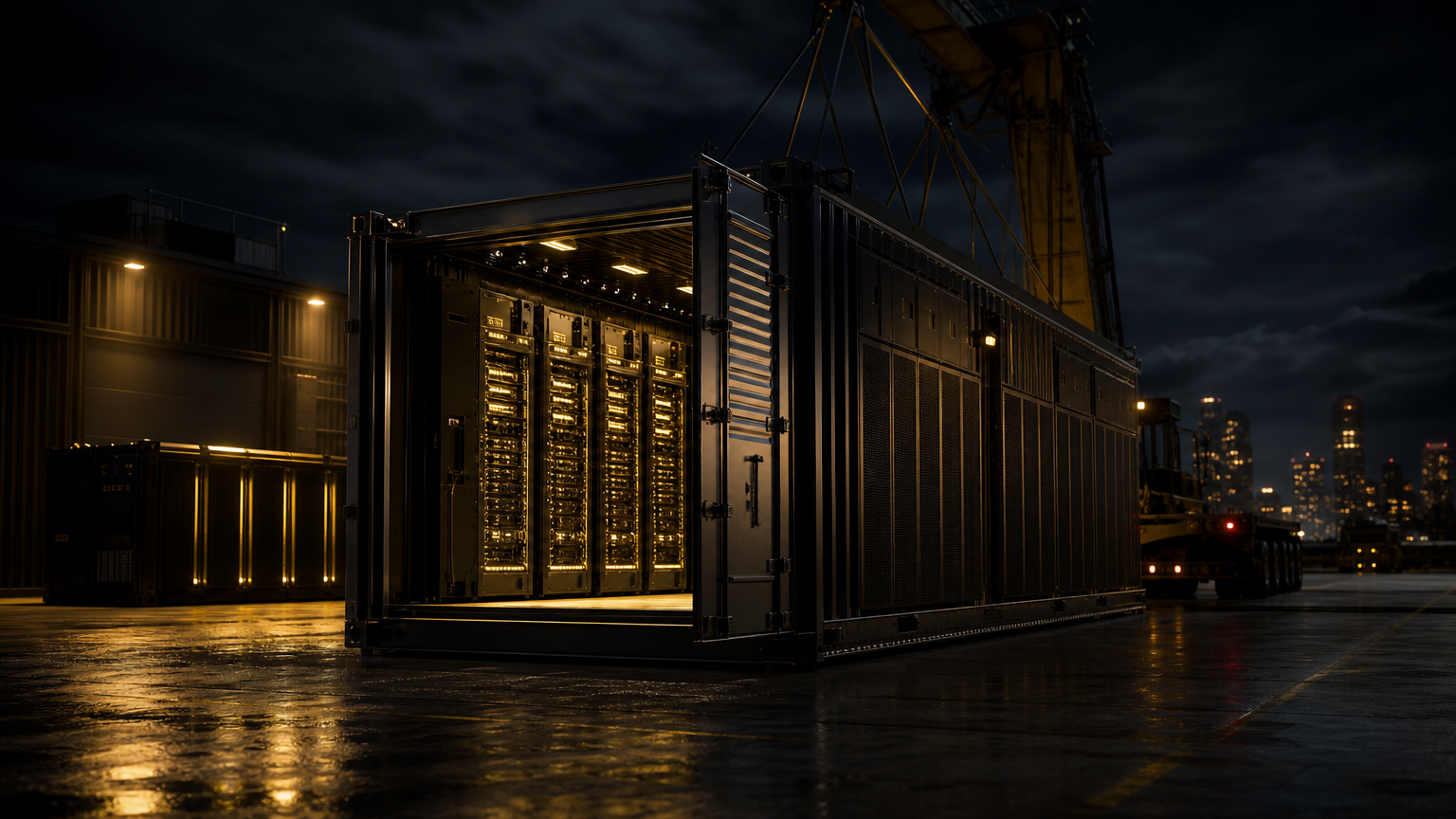
A shipping-container shortcut for AI infrastructure
Nvidia used GTC Berlin to introduce DSX POD, a reference design for complete Vera Rubin AI factories built by partners inside modular containers, integrated and validated before delivery . The headline claim is deliberately simple: at a prepared site, deployment time can fall from six months to as little as 14 days . For a market where every delay can mean idle GPUs, missed cloud revenue and slower model rollouts, Nvidia is selling time as the product.
The idea is to move as much work as possible out of the construction site and into the factory. DSX POD shifts the integration of computing, networking, cabling, rack-level power and liquid cooling to manufacturing facilities before the units are shipped . Nvidia’s technical blog describes the design as a standardized, factory-built implementation of the broader DSX AI Factory Platform, aligning compute, networking, storage, power, cooling, cabling, controls and validation around the Vera Rubin platform .
That framing matters. Nvidia is not simply placing servers in a metal box. It is trying to industrialize the buildout of AI factories, the company’s term for data centers optimized to turn power into AI tokens. The DSX POD reference design describes a complete system, not just a compute enclosure, and includes interfaces for scale-out networking, storage, service and management networks, liquid cooling, power delivery and transportation requirements .
What is inside DSX POD?
Nvidia’s announcement says DSX POD brings Vera Rubin systems together with the infrastructure needed to operate them in repeatable, factory-built, containerized designs that partners can manufacture and deliver at scale . Data Center Knowledge reported that the containerized module comes with seven Vera Rubin NVL72 racks, along with networking, cabling and cooling already installed . The goal is to make the module arrive much closer to a working AI factory than to a pile of equipment waiting for electricians, network engineers and cooling specialists.
The partner list is central to the plan. Nvidia says it is working with Anduril, Armada, Bull, Crusoe, DayOne, Dell Technologies, Delta, Eaton, Foxconn Ingrasys, GIGABYTE, HPE, Lenovo, Pegatron, Quanta Cloud Technology, Schneider Electric, Vertiv and Wistron to deliver DSX POD AI factories worldwide in early 2027 . That list shows the product is less a single box from Nvidia than an ecosystem blueprint that OEMs, ODMs, power specialists, cooling suppliers and site integrators can build around.
This is also why Nvidia calls DSX POD a reference design. The company provides the validated AI infrastructure foundation, while partners handle manufacturing, regional engineering, customization, delivery and support . In practical terms, Nvidia wants DSX POD to become a repeatable deployment unit for organizations that have land, power and a prepared site, but do not want to spend months assembling a rack-scale AI system in the field.
The 14-day promise comes with an important condition
The phrase “prepared site” is doing a lot of work. Nvidia’s own materials say DSX POD units arrive ready to connect to a site’s power, cooling, networking and other supporting infrastructure . Its technical blog is explicit that DSX POD changes where integration occurs but does not eliminate supporting facility infrastructure . Foundations, external connectivity, power availability and heat rejection still have to be in place.
That means DSX POD is not a magic button for building an AI data center from raw land in two weeks. It is a way to compress the phase between delivery and productive capacity once the site has already been prepared. The company’s deployment model assumes site teams can prepare land, foundations, power and external connectivity while partners manufacture and test the containers in parallel . After delivery, the remaining work focuses on placement, inter-container connections and hookups to external power, cooling and networking .
This is still a meaningful change. AI deployments often stall late in the process because physical integration is complex: racks must be cabled, cooling loops validated, firmware baselines checked, sensors tested, fabrics brought up and clusters commissioned. Nvidia’s argument is that the riskiest repeatable work should happen in a controlled factory environment rather than at a one-off job site . If that works, the difference is not just speed, but predictability.
Why Europe was the stage
The Berlin launch was also a geopolitical sales pitch. AP reported that Jensen Huang urged Europe’s AI sector to accelerate and tied the DSX POD announcement to the continent’s need for more computing capacity . AP also reported that Europe has about 5% of global AI computing capacity, compared with about 75% in the United States, making compute scarcity a key obstacle for European AI developers .
That context explains why Nvidia positioned DSX POD as infrastructure acceleration for Europe. Sovereign AI — the idea that countries should control their own AI infrastructure, data and models — has become one of Huang’s biggest themes. Axios described Huang’s current tour as a push to make Nvidia the indispensable backbone of the global AI economy, with governments and institutions becoming a major customer class for customized data centers and open models .
For Nvidia, the sovereign AI pitch expands the market beyond hyperscalers. If national governments, regional clouds, industrial groups and research institutions decide that they need domestic AI capacity, they become potential buyers of Nvidia-centered infrastructure. DSX POD fits that narrative because it promises a standardized way to deploy capacity without waiting for every project to become a bespoke construction effort.
Efficiency is part of the package
Nvidia also paired DSX POD with a broader DSX efficiency story. In a separate GTC Berlin announcement, the company said DSX reference designs use closed-loop liquid cooling and dry coolers to enable near-zero facility cooling water consumption, with potential savings of 54 million liters a day for a 2-gigawatt deployment compared with conventional cooling-tower systems . Nvidia also said DSX MaxLPS software can help operators generate the same number of tokens with up to 30% less power .
These claims address one of the biggest criticisms of the AI data center boom: that compute demand is colliding with limits in power grids, water availability and local permitting. The efficiency story does not erase those concerns, but it gives Nvidia and its partners a response. Dry-cooler-based heat rejection can reduce dependence on evaporative cooling, while power orchestration can help operators squeeze more output from a fixed power envelope .
The catch is that geography still matters. Nvidia notes that local climate determines whether supplemental mechanical cooling is needed during the hottest periods . A DSX POD deployed in northern Europe will not face the same thermal realities as one deployed in a hotter, drier region. The efficiency pitch is therefore strongest as a design direction, not as a universal guarantee.
The business logic: time to first token
Nvidia’s clearest business phrase is “time to first token.” The company says DSX POD can help customers begin generating production tokens and revenue sooner . That is a financial argument aimed at cloud providers, enterprises and governments alike. A large AI factory is expensive before it is useful; the sooner it runs production workloads, the sooner it can justify its capital cost.
It also helps Nvidia defend demand for its full stack. Axios noted that investors are scrutinizing whether AI infrastructure spending can remain self-sustaining, especially when Nvidia helps finance parts of the ecosystem buying its products . DSX POD gives Nvidia a practical answer: reduce build delays, standardize deployments and make each megawatt of installed capacity productive faster.
The result is a product that is part container, part reference architecture and part market strategy. If DSX POD works as advertised, Nvidia will not only sell more Vera Rubin systems. It will also shape how the next wave of AI factories is designed, financed, delivered and operated. The new loading screen for AI infrastructure may not truly have a skip button, but Nvidia is trying to make the wait much shorter.
Sources from the last 72 hours
- [1]NVIDIA Introduces DSX POD AI Factories to Accelerate Europe’s Infrastructure DeploymentOct 21, 2026, 2:00 AM
- [2]Achieve Productive AI Capacity Faster and More Predictably with NVIDIA DSX PODOct 21, 2026, 2:00 AM
- [3]Nvidia's Jensen Huang targets Europe with multibillion-dollar AI planOct 21, 2026, 3:10 PM
- [4]Nvidia Unveils DSX Pod for Faster AI Data Center BuildsOct 21, 2026, 2:00 AM
- [5]European Ecosystem Builds World’s Most Efficient AI Factories With NVIDIA DSXOct 21, 2026, 2:00 AM
- [6]Nvidia CEO encourages Europe’s lagging AI sector and offers tools to accelerate data center buildoutOct 21, 2026, 2:00 AM
AI-generated article based on recent web research, then preserved as a dated editorial snapshot.
Comments
Be the first to comment.