
Daily Podcast full article
Starship completed first revenue mission, plans historic double catch
SpaceX has turned Starship’s latest milestone into a commercial inflection point: Flight 14 carried 26 Starlink V3 satellites to orbit, and the next test is expected to attempt the first tower catch of both Super Heavy and the Starship upper stage.
A test vehicle becomes a revenue vehicle
SpaceX’s Starship program has crossed a line that matters as much to accountants as it does to engineers. In its third-quarter 2026 results, the company said Starship completed its first revenue-generating mission, delivering 26 Starlink V3 satellites to the broadband constellation and adding roughly ten times the downlink capacity of a typical Falcon 9 Starlink launch . That single sentence changes the framing of the world’s largest launch system: Starship is no longer only a prototype being iterated in public; it has begun doing the commercial work for which it was designed.
The flight in question was Starship Flight 14, launched on September 28, 2026, and described by SpaceX as its first orbital Starship flight and the first Starship mission to deliver meaningful payload to orbit . BASENOR’s October 20 summary, citing the same Q3 confirmation, identified the mission as carrying 26 Starlink V3 satellites and emphasized that SpaceX treated the flight as the moment Starship entered the commercial ledger rather than remaining only a development program . The payload matters because Starlink V3 is intended to be larger and more capable than the satellites Falcon 9 has been deploying, making Starship central to expanding the network at scale .
The mission was not a clean, finished-product demonstration. The Verge reported that a Raptor engine shut down prematurely during ascent, forcing mission control to adapt, and that SpaceX shortened a planned roughly 10-hour, six-orbit profile to about three hours and two Earth orbits . The Super Heavy booster splashed down in the Gulf of Mexico, while the Starship upper stage performed a deorbit burn and ended in a fiery vertical splashdown in the Pacific north of Hawaii; neither stage was recovered . In other words, Flight 14 was a commercial success, but not yet a reusability success.
Why 26 satellites matter
The number 26 sounds modest beside Starlink’s multi-thousand-satellite ambitions, but the payload was a demonstration of leverage. SpaceX said the batch represented approximately ten times the downlink capacity added by a Falcon 9 Starlink launch . BASENOR reported that each V3 satellite is designed for far greater throughput than earlier generations and that Flight 14’s batch was therefore less about satellite count than about network capacity per launch .
That is the practical reason Starship is so important to SpaceX’s business model. Falcon 9 made frequent, reusable orbital launch routine for one booster stage, but its upper stage remains expendable and its fairing volume limits how quickly SpaceX can deploy the largest Starlink spacecraft. Starship, by contrast, is being built around full and rapid reusability of both stages, large payload volume, and heavy lift. If the vehicle can repeatedly place high-capacity Starlink V3 satellites into orbit, each mission could do the network-building work of many smaller launches .
The financial context reinforces that point. SpaceX reported third-quarter revenue of $14.6 billion, up 161 percent year over year, with the Starship payload mission listed among the quarter’s operational highlights . That does not mean Starship suddenly became profitable on its own; the company did not break out Starship-specific revenue in the public highlights. But it does mean SpaceX is now presenting Starship as part of the operating system for revenue growth, not merely as an expense line attached to future Mars or Moon ambitions .
The next act: a double catch
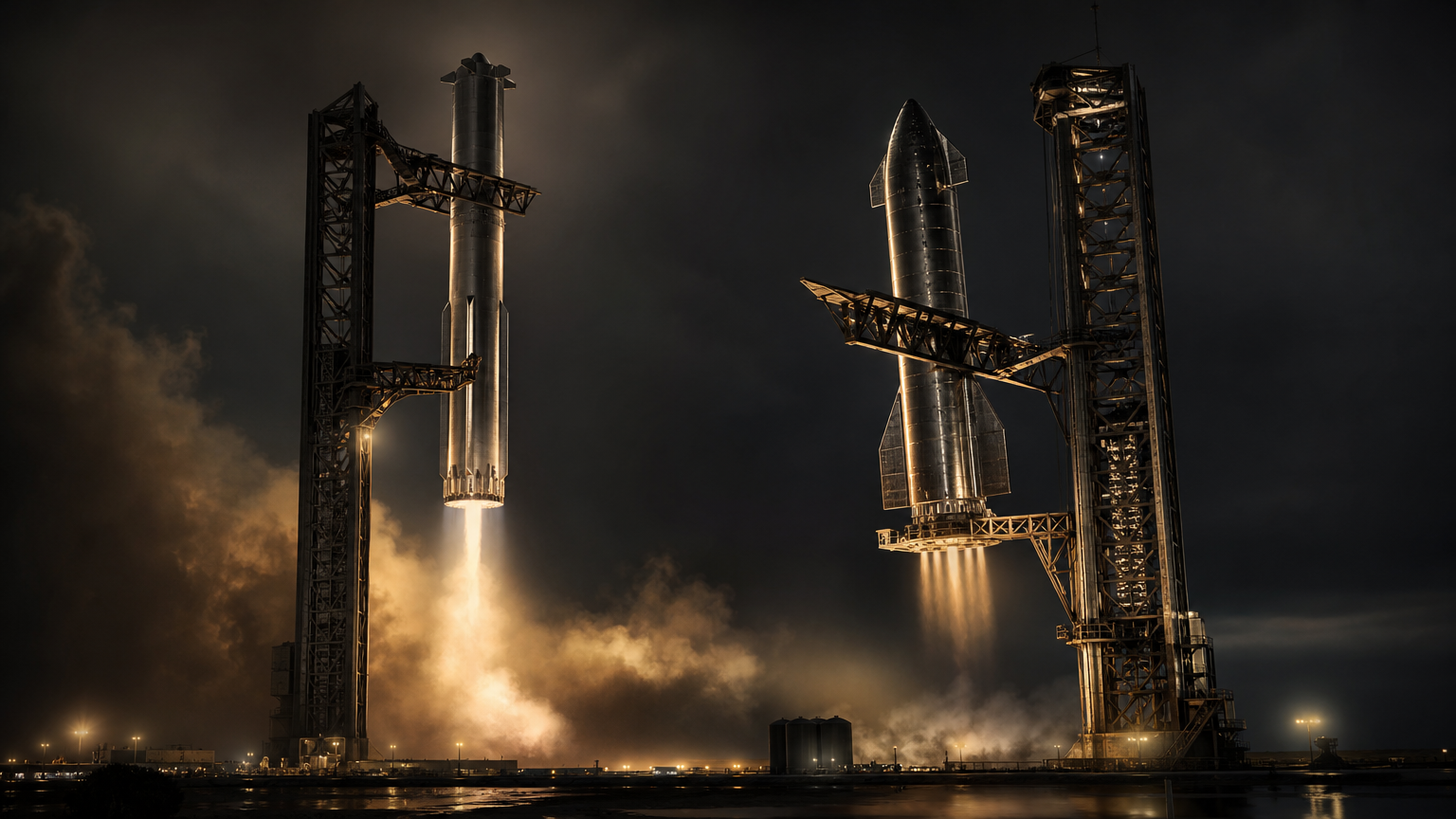
The next milestone is more dramatic: SpaceX plans to try catching both stages of Starship on the next test flight. Elon Musk said during the company’s October 20 earnings discussion that SpaceX would attempt to catch Starship and its booster next month, with the goal of recovering the full orbital launch system for the first time . Space.com likewise reported that the next flight, expected in November, is planned as a double catch attempt using the launch tower hardware .
This is the boss-level quick-time event for rockets: two giant vehicles returning from very different flight regimes, both needing precise guidance, propulsion, timing, and tower coordination. Super Heavy has returned from a lower-energy trajectory before, and Space.com reported that SpaceX has already achieved tower catches of the booster on three Starship test flights . The upper stage is the harder and newer challenge. It travels higher, faster, and farther before reentering, which means the thermal, guidance, structural, and propellant-management margins are different from the booster’s return profile .
The architecture is also unusual. Unlike Falcon 9, whose booster lands on legs either on land or on a droneship, Starship’s intended operational mode is to return to a tower equipped with mechanical arms often nicknamed “chopsticks” . The goal is to avoid landing legs, reduce mass, put the vehicle back near its launch mount, and accelerate inspection, refurbishment, and relaunch. A successful upper-stage catch would therefore be more than a spectacular visual; it would validate the missing half of SpaceX’s full-reusability concept .
Success would change the economics; failure would still teach
If the double catch works, SpaceX would have shown a path toward recovering the entire orbital launch vehicle, not just the first stage. Musk said success would mark the first time in history that an orbital launch vehicle had been fully recovered . That claim is significant because orbital launch energy has always made upper-stage reuse the hardest part of the reusability equation. Shuttle orbiters were reused, Falcon boosters are reused, and capsules return, but a fully reusable two-stage orbital rocket has remained the prize.
The operational payoff would be cadence. A caught Super Heavy and a caught Starship upper stage could, in principle, be inspected near the launch tower, serviced, restacked, and flown again faster than vehicles recovered at sea or expended after each mission. That is the economic link between Flight 14 and Flight 15: Starship has now demonstrated revenue payload delivery, and SpaceX is trying to pair that with the recovery method that could make such delivery much cheaper and more frequent .
Failure, however, would not necessarily mean strategic failure. Musk acknowledged that success is not guaranteed on early attempts, while saying he considered success on the next flight more likely than not and that SpaceX has a steady stream of Starship attempts planned through year-end and into 2027 . In a program built around rapid iteration, even a missed catch can produce valuable data about reentry heating, control authority, engine relight, propellant behavior, tower approach, abort logic, and structural loads.
The risk is not just the vehicle. A tower catch concentrates energy near expensive ground infrastructure. That is why SpaceX’s decision to move from ocean splashdowns toward tower recovery is a step-change in operational risk. The company is no longer only asking whether Starship can survive ascent, orbit, and reentry. It is asking whether it can make the last seconds of flight accurate enough to become routine.
A turning point, not a finish line
The current state of the story is therefore precise: Starship has completed its first revenue-generating mission by deploying 26 Starlink V3 satellites, and SpaceX now plans an unprecedented attempt to catch both Super Heavy and the Starship upper stage on the next flight . Flight 14 proved that Starship can contribute directly to Starlink deployment. Flight 15 is intended to test whether the same system can begin closing the loop on full recovery.
That pairing is why the moment matters. Payload delivery without reuse would make Starship powerful but expensive. Reuse without payload delivery would make it impressive but commercially incomplete. SpaceX is now trying to combine both. If it succeeds, the economics of building Starlink V3 and other large orbital infrastructure could shift sharply. If it fails, the data may still move the program closer to the same destination. Either way, Starship has entered a new phase: not merely reaching space, but learning how to come home and fly again.
Sources from the last 72 hours
- [1]SPACE EXPLORATION TECHNOLOGIES CORP (Form: 8-K, Received: 10/20/2026 16:01:41)Oct 20, 2026, 6:01 PM
- [2]SpaceX will attempt 1st-ever double Starship rocket catch on next test launch, a 'profound technology milestone,' Elon Musk saysOct 21, 2026, 12:29 AM
- [3]SpaceX Starship Flies First Revenue Mission, Deploys 26 Starlink V3 SatsOct 20, 2026, 2:00 AM
- [4]SpaceX will try catching Starship and its booster for first time, Musk saysOct 20, 2026, 11:02 PM
AI-generated article based on recent web research, then preserved as a dated editorial snapshot.
Comments
Be the first to comment.