
Daily Podcast full article
Tesla-SpaceX committees study $3.5T merger
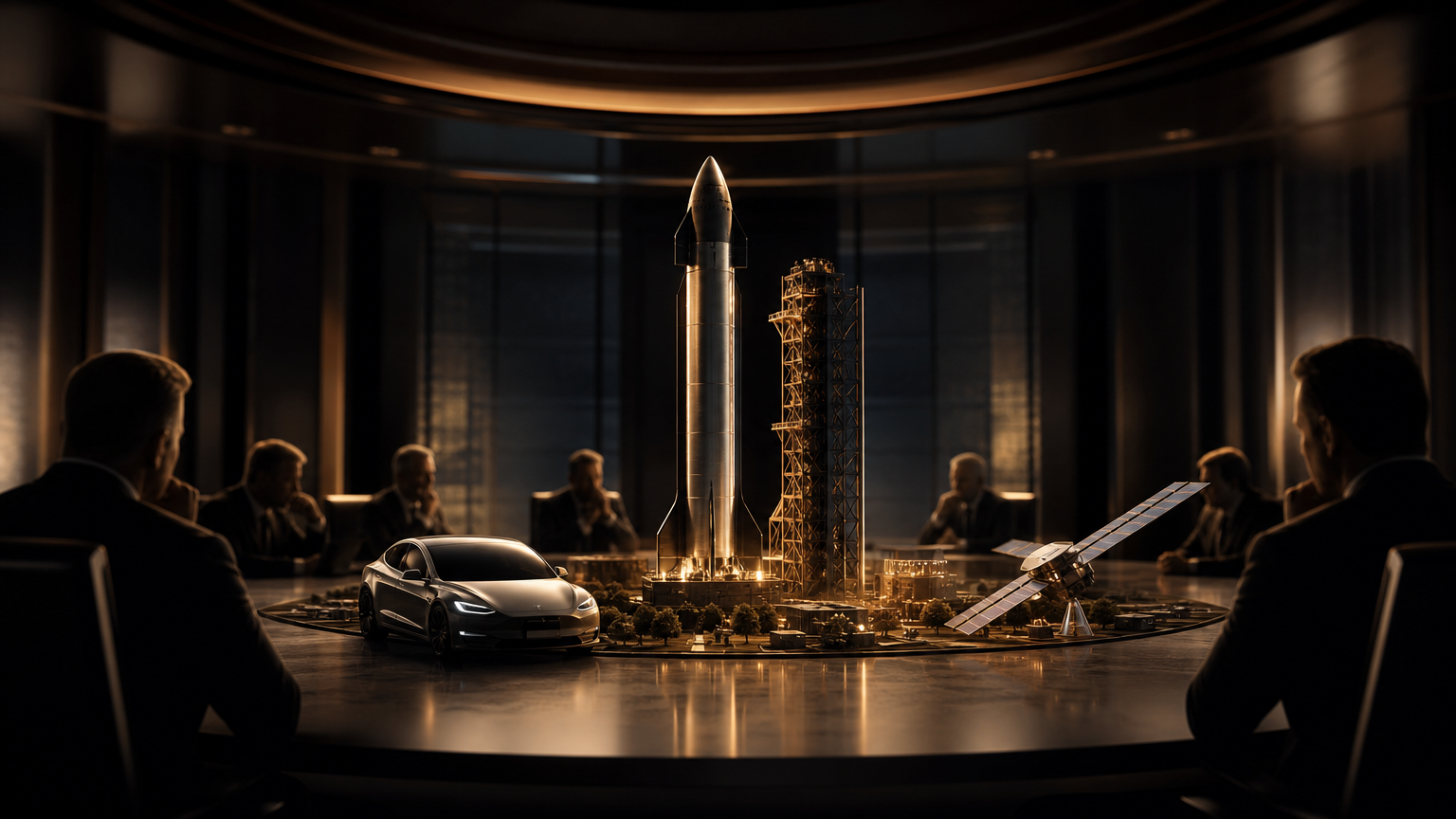
Tesla and SpaceX have moved the long-rumored combination of Elon Musk’s two most valuable companies from speculation to formal review, with independent board committees studying a deal that could approach 3.5 trillion dollars and reshape electric vehicles, space, satellites and AI infrastructure.
A formal review, not yet a deal
Tesla and SpaceX have each formed special committees of independent directors to evaluate a possible merger, according to Elon Musk’s comments during SpaceX’s third-quarter earnings call on Tuesday, October 20, 2026 . Musk, who is chief executive of both companies and a major shareholder in each, said he supports the idea but is not participating in the committee discussions because he is conflicted . That distinction matters: the current development is not an announced transaction, not a signed agreement and not a completed restructuring. It is a formal review of whether one should happen.
The scale explains the sudden market attention. Recent reporting put SpaceX’s market value at about 2 trillion dollars and Tesla’s at nearly 1.5 trillion dollars, implying a combined enterprise near 3.5 trillion dollars if a deal were pursued on those rough valuations . Bloomberg described the potential merger as a preliminary step toward what could rank as the largest corporate tie-up of all time . Even in an era of trillion-dollar technology companies, combining rockets, satellites, autonomous vehicles, humanoid robots, battery systems and AI compute would be an extraordinary corporate redesign.
Musk framed the idea as strategically logical but not inevitable. He said there was “a lot of merit” to combining the companies and pointed to possible cooperation in superintelligence software, chip design, robotics, connectivity and mass-to-orbit capabilities . At the same time, he cautioned that assuming a SpaceX-Tesla merger is certain would overstate the situation, and TechCrunch reported that the special committees had not reached agreement on transaction terms . Axios also noted Musk’s view that Tesla shareholder approval would be a high hurdle, with 50% of Tesla shareholders needing to approve any deal .
Why the merger idea is back now
The logic behind the review is less about cars meeting rockets than about both companies redefining themselves around AI infrastructure. Tesla is no longer valued by supporters merely as an automaker; its bull case rests heavily on self-driving software, robotaxis, Optimus humanoid robots, energy storage and manufacturing scale. SpaceX, meanwhile, is not only a launch provider; Starlink has made it a global connectivity platform, and its newer AI and compute ambitions increasingly overlap with Musk’s broader technology empire .
SpaceX’s latest results gave that narrative fresh momentum. The company reported quarterly profit of 4.4 billion dollars for the three months through September, reversing a year-earlier loss, while revenue rose 161% to 14.6 billion dollars . AP reported that SpaceX’s AI business became its largest by revenue in the third quarter, although Starlink remained the biggest profit generator . That mix helps explain why Musk is presenting a Tesla-SpaceX combination as a technology-platform question rather than a conventional industrial merger.
The specific areas Musk listed are revealing. AI software and chip design speak directly to the compute stack needed for autonomy, robotics and data-intensive services. Robotics connects Tesla’s Optimus ambitions with SpaceX’s manufacturing and launch operations. Connectivity links Starlink to vehicles, robots and remote energy assets. Mass-to-orbit capacity points toward SpaceX’s ability to deploy satellite constellations, and potentially orbital computing infrastructure, at a cost and cadence few competitors can match . In that frame, a merger would be less “EV company buys space company” than “Musk consolidates the infrastructure layer for physical AI.”
The governance problem is the story
The largest obstacle may not be industrial logic; it may be governance. Musk is on both sides of the prospective deal. He runs Tesla and SpaceX, owns large stakes in both, and would likely have strong preferences over valuation, voting power, leadership structure and strategic priorities. TechCrunch reported that Musk said he cannot be in the special committee discussions because he is a conflicted party . That is exactly why independent committees exist in transactions involving insiders, controlling shareholders or related parties.
Still, independence will be examined closely. TechCrunch reported that Tesla has seven independent board members under Nasdaq standards, including board chair Robyn Denholm, Ira Ehrenpreis, JB Straubel, Joe Gebbia, Jack Hartung, James Murdoch and Kathleen Wilson-Thompson . The same report said SpaceX lists six independent directors, including Ehrenpreis, Randy Glein, Donald Harrison, Steve Jurvetson, Luke Nosek and Roelof Botha, while Musk, Kimbal Musk, Gwynne Shotwell and Antonio Gracias are not considered independent . The presence of overlapping relationships across Musk-linked companies will likely make the process as important as the price.
That process must answer basic but difficult questions. Would SpaceX acquire Tesla, Tesla acquire SpaceX, or would both fold into a new holding company? Would Tesla shareholders receive SpaceX shares, cash, or stock in a combined entity? How would voting rights work? How would public Tesla investors be protected if SpaceX’s private-market valuation is contested? How would SpaceX shareholders evaluate exposure to Tesla’s more volatile public equity? None of those terms has been agreed, according to the latest reporting .
Strategic upside versus concentration risk
The upside case is straightforward. A combined Tesla-SpaceX could coordinate manufacturing, batteries, chip development, connectivity, launch capacity and AI software under one capital plan. Tesla’s factories and supply-chain expertise could help SpaceX scale hardware production. SpaceX’s Starlink network could support Tesla vehicles, robots and energy products. Joint chip and AI work could reduce duplication. In a world where autonomy, robotics and compute are capital-intensive, a 3.5 trillion-dollar platform could arguably move faster than two affiliated but legally separate companies.
The risk case is equally large. A merger would concentrate even more operational and governance dependence around Musk. Tesla already faces the complexity of selling vehicles, building batteries, scaling autonomy and commercializing robotics. SpaceX faces the separate demands of launch reliability, Starlink economics, Starship development and AI infrastructure. Bloomberg noted that a deal would unite Tesla’s EV, energy and robotics businesses with SpaceX’s rocket launch and satellite internet operations, all under shared AI ambitions . That breadth could create synergies, but it could also create a company so sprawling that execution becomes harder, not easier.
There is also the valuation question. SpaceX’s implied 2 trillion-dollar value and Tesla’s nearly 1.5 trillion-dollar value may be convenient headline numbers, but merger math requires more than adding two market caps . Committees would need to assess relative growth, margins, capital needs, voting control, legal risk and the fairness of any exchange ratio. If either shareholder base believes the other side is being rescued, subsidized or overvalued, support could weaken quickly.
What to watch next
The next meaningful signal will not be another Musk endorsement; it will be committee action. Investors should watch for formal filings, named advisers, independent valuation opinions, board recommendations, or a statement that talks have ended. Musk has already supplied the strategic thesis. The committees now have to decide whether that thesis can be translated into terms acceptable to both shareholder groups.
For now, the Tesla-SpaceX merger is best understood as a serious study of a historic transaction, not a completed corporate marriage. The committees are real, Musk’s support is public, and the implied scale is enormous . But the absence of agreed terms, the need for shareholder approval and the conflicts around Musk mean the second board meeting is not a joke. It is the heart of the story.
Sources from the last 72 hours
- [1]SpaceX and Tesla boards form special committees to review mergerOct 21, 2026, 12:57 AM
- [2]Space X and Tesla exploring merger, CEO Elon Musk saysOct 20, 2026, 11:43 PM
- [3]Merging SpaceX and Tesla would be a “good idea,” Musk saysOct 21, 2026, 12:04 AM
- [4]Musk Says SpaceX and Tesla Have Begun Exploring a Merger (2)Oct 20, 2026, 11:47 PM
- [5]Elon Musk’s SpaceX reports a profit and he hints at a possible merger with TeslaOct 20, 2026, 10:49 PM
AI-generated article based on recent web research, then preserved as a dated editorial snapshot.
Comments
Be the first to comment.