
Daily Podcast full article
NVIDIA GTC Berlin 2026 Keynote With CEO Jensen Huang
Jensen Huang used NVIDIA’s Berlin keynote to frame Europe not as a late adopter of AI, but as the next industrial platform for it: a region with manufacturing depth, sovereign data, startups, factories, telcos and robotics labs that now need faster infrastructure, safer agents and local AI systems.
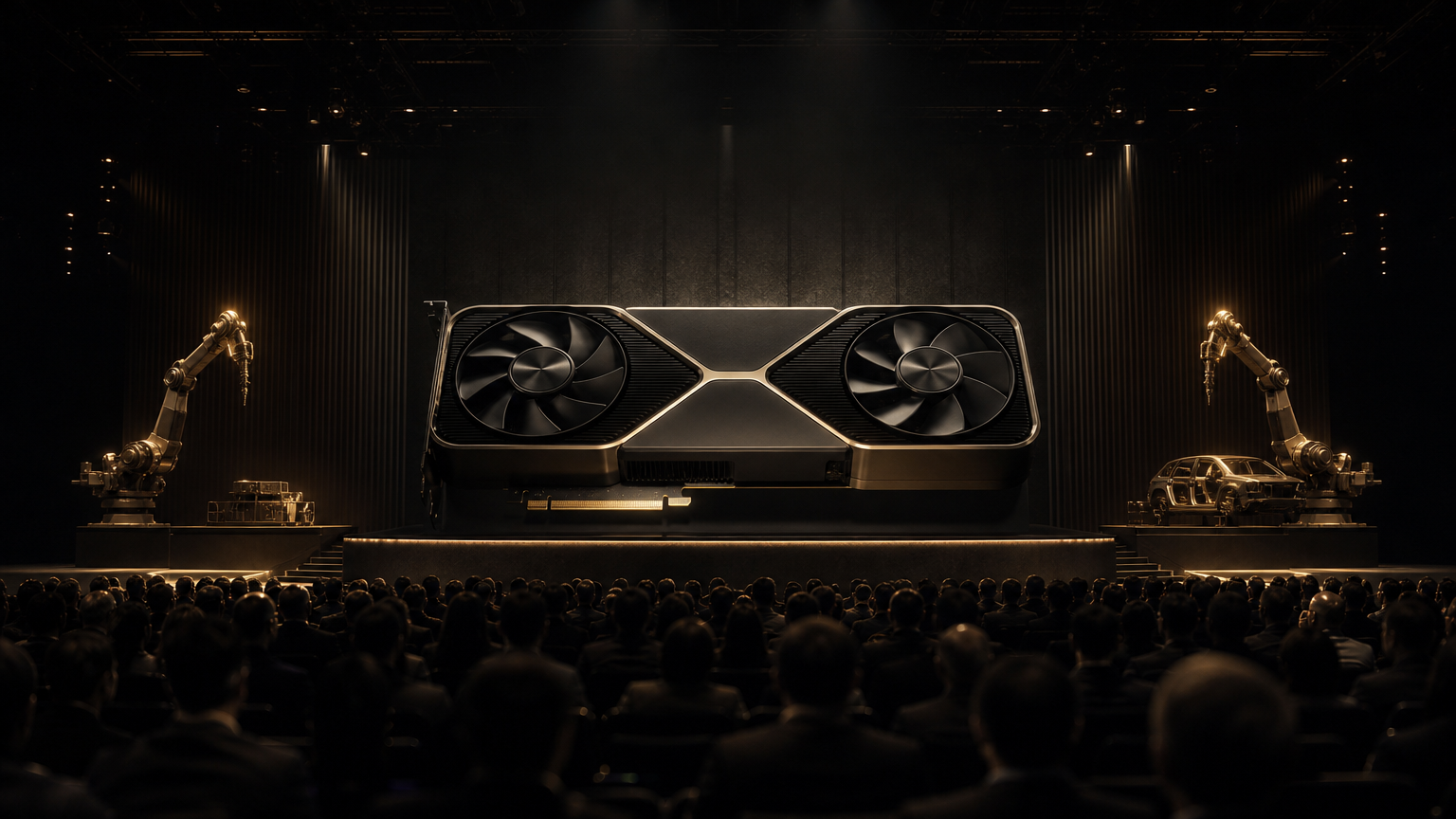
Europe’s AI economy takes center stage
NVIDIA’s GTC Berlin 2026 keynote, delivered by CEO Jensen Huang on October 21 at Berlin’s Tempodrom, was less a single product launch than a coordinated argument: Europe can become a producer of AI, not merely a consumer of imported models and cloud capacity . GTC Berlin itself ran as a three-day conference, with more than 100 sessions across agentic AI, robotics, physical AI, open models and accelerated computing . Huang’s opening framing was deliberately European, naming companies such as L’Oréal, Revolut, Spotify, Merck, Vodafone, Zara, Porsche, Nestlé and HSBC as examples of regional businesses already working with NVIDIA on AI .
The message was also financial and strategic. NVIDIA said its recent European roadshow through Paris, London, Stockholm and Dublin came alongside nearly $10 billion committed to the technology ecosystem across Europe and more than 12,000 partners in the region . In the keynote transcript, Huang also said NVIDIA had announced investments in 14 startup companies during that same week of European stops . The Associated Press described the Berlin speech as an effort to encourage Europe’s still-developing AI sector while highlighting tools for accelerating data center construction and constraining AI agents inside safer software boundaries .
The bottleneck: compute, not ambition
The sharpest policy point in the keynote was infrastructure. Huang argued that if Europe wants to participate in the AI economy, it must be able to produce digital intelligence locally rather than simply buy AI services from elsewhere . AP reported that Europe holds only about 5% of the world’s AI computing capacity, compared with about 75% in the United States, making access to compute a core obstacle for European developers . That gap explains why NVIDIA’s Berlin announcements revolved around AI factories: purpose-built data centers that turn electricity, chips, models and software into tokens.
The new DSX POD was the keynote’s most concrete answer to that bottleneck. NVIDIA described DSX POD as a reference design for complete Vera Rubin AI factories built by partners inside modular containers, integrated and validated before delivery . The company said the factory-built units can shrink deployment at a prepared site from roughly six months to as little as 14 days, moving cabling, liquid cooling, rack power and functional validation from a chaotic on-site build into a repeatable manufacturing process . NVIDIA said partners including Bull, Dell Technologies, HPE, Lenovo, Schneider Electric and Vertiv are part of the ecosystem around DSX POD, with worldwide delivery targeted for early 2027 .
Efficiency becomes part of sovereignty
Berlin was not only about speed. NVIDIA also positioned power and water efficiency as requirements for European AI sovereignty. The company said its broader DSX AI Factory Platform uses closed-loop liquid cooling and dry-cooler designs to reduce facility cooling water consumption toward near zero, and claimed that a 2-gigawatt deployment could save 54 million liters of water per day compared with conventional cooling towers . It also introduced DSX MaxLPS and DSX Flex software for managing power inside AI factories and aligning workloads with grid conditions .
That matters because the politics of AI infrastructure in Europe are inseparable from energy supply, permitting and environmental constraints. NVIDIA said DSX MaxLPS can help operators generate the same number of tokens with up to 30% less power, while DSX Flex can make AI factories more responsive to grid conditions . The strategic implication is clear: NVIDIA is trying to make the “AI factory” legible to utilities, governments and industrial companies as an infrastructure class, not just a large data center stuffed with GPUs.
Safe agents: OpenShell as the guardrail layer
Huang’s second major theme was that agents are becoming the next computing platform. In NVIDIA’s framing, an agent is not just a chatbot; it combines a model, memory, tools, knowledge and an execution harness that can act on enterprise systems . That creates obvious risk when agents access files, networks, credentials, factory systems or business applications. Huang said secure boundaries and minimal privileges are essential because each agent launch can require a different set of permissions .
NVIDIA’s answer at GTC Berlin was the OpenShell Reference Architecture, announced as a full-stack approach for building, containing, observing and enforcing safe agents across enterprise infrastructure and edge systems . The architecture combines NVIDIA Vera Rubin infrastructure for inference, Vera CPUs for agent harnesses and tool use, open-source OpenShell secure runtime software, and BlueField-4 DPUs running NVIDIA Sentry for monitoring and in-silicon policy enforcement . NVIDIA said OpenShell extends to edge systems such as RTX Spark, DGX Spark and DGX Station, and that companies including Anthropic, AWS, Cisco, CrowdStrike, Dassault Systèmes, Dell Technologies, Google Cloud, HPE, IBM, Meta, Microsoft, OpenAI, Palo Alto Networks, SAP, ServiceNow and Siemens are working with the architecture .
AI moves back onto the PC
The keynote also pushed AI away from the idea that all intelligence must live in remote cloud services. NVIDIA showcased RTX Spark, DGX Spark and DGX Station as local AI systems for developers, creators and enterprises . RTX Spark, which NVIDIA said launched the week before GTC Berlin, powers personal agents on Windows PCs; DGX Spark supports Linux developers building and scaling applications; and DGX Station targets enterprise teams running frontier workloads on Linux, with a Windows version planned for December .
The PC angle is important because it gives NVIDIA a bridge from data center economics to everyday developer workflows. The company said RTX Spark systems support local personal agents, accelerated content creation and gaming with up to 128GB of unified memory and 1 petaflop of AI compute . During the keynote, Huang showed agents running on RTX Spark being used to train Hugging Face’s Microduck robot with NVIDIA Isaac Lab, Hermes Agent and Nemotron 3.5 Bolt 74B . That demonstration tied the PC, cloud training, simulation and physical robots into a single workflow.
Industrial AI is the European story
The most region-specific part of the keynote was physical AI: robotics, manufacturing, vehicles, energy systems and factories. AP reported that, two days earlier in Berlin, Huang told German manufacturers that “the next wave of AI is physical,” arguing that manufacturing data and industrial expertise are Germany’s natural resources . At the GTC keynote, that theme became a product map.
NVIDIA said European industrial leaders are using CUDA-X, Omniverse libraries, Cosmos and Nemotron open models across engineering and manufacturing workflows . The new Factory Operations Blueprint, or FOX, is available in early access on GitHub and is intended to help developers build always-on factory manager agents that coordinate machines and specialist agents for visual inspection, root-cause analysis, reporting and fleet management . The same source highlighted use cases at Siemens, Mercedes-Benz, Audi, Volkswagen Sachsen, Schaeffler, Dassault Systèmes and other industrial partners .
Robotics received its own expansion. NVIDIA announced a major update to the Isaac open robotics development platform, including Agile Robots’ Agile ONE SN reference humanoid built on Isaac GR00T and Jetson Thor, along with Isaac OS, Isaac Lab 3.0, new datasets and open-source workflows . The company said Agile ONE SN is scheduled for early 2027 and is designed to reduce robotics researchers’ setup time from weeks to days . In the logic of the keynote, robots are not a side demo; they are the physical endpoint of Europe’s AI industrial stack.
The takeaway
GTC Berlin 2026 was NVIDIA’s clearest pitch yet that Europe’s AI future will be industrial, sovereign and infrastructure-heavy. The announcements connected startup investment, modular AI factories, energy-efficient data centers, safe agents, AI PCs, factory agents and humanoid robotics into one platform story. The commercial message was unmistakable: Europe’s AI economy needs NVIDIA’s stack. The strategic question for Europe is just as clear: can it use that stack to build its own durable intelligence layer, rather than merely rent one?
Sources from the last 72 hours
- [1]GTC Berlin 2026: Live Updates From NVIDIA CEO Jensen Huang’s KeynoteOct 21, 2026, 2:00 AM
- [2]NVIDIA (NVDA) Transcript: GTC Berlin 2026 KeynoteOct 21, 2026, 1:13 PM
- [3]NVIDIA Introduces DSX POD AI Factories to Accelerate Europe’s Infrastructure DeploymentOct 21, 2026, 2:00 AM
- [4]European Ecosystem Builds World’s Most Efficient AI Factories With NVIDIA DSXOct 21, 2026, 2:00 AM
- [5]NVIDIA Launches OpenShell Reference Architecture for Safe AI AgentsOct 21, 2026, 2:00 AM
- [6]Bringing the Spark to Europe: Local Intelligence Powers Next Wave of AgentsOct 21, 2026, 2:00 AM
- [7]Europe’s Industrial Leaders Reinvent Engineering and Manufacturing With NVIDIAOct 21, 2026, 2:00 AM
- [8]NVIDIA Advances Isaac Platform for General-Purpose Robotics With New Reference Humanoid, Frameworks, Simulation Pipelines and DataOct 21, 2026, 2:00 AM
- [9]Nvidia CEO cheerleads for Europe's nascent AI sector | AP NewsOct 21, 2026, 2:28 PM
- [10]Nvidia CEO urges German manufacturers to seize the AI moment | AP NewsOct 19, 2026, 9:28 PM
AI-generated article based on recent web research, then preserved as a dated editorial snapshot.
Comments
Be the first to comment.