
Daily Podcast full article
Big Shock in Tesla Q3 Earnings: Highlights & Recap
Tesla’s Q3 2026 report delivered a mixed headline but a clear strategic message: profits fell year over year, yet margins, cash flow and Full Self-Driving adoption improved enough to reframe the quarter around software, autonomy and future platform growth.
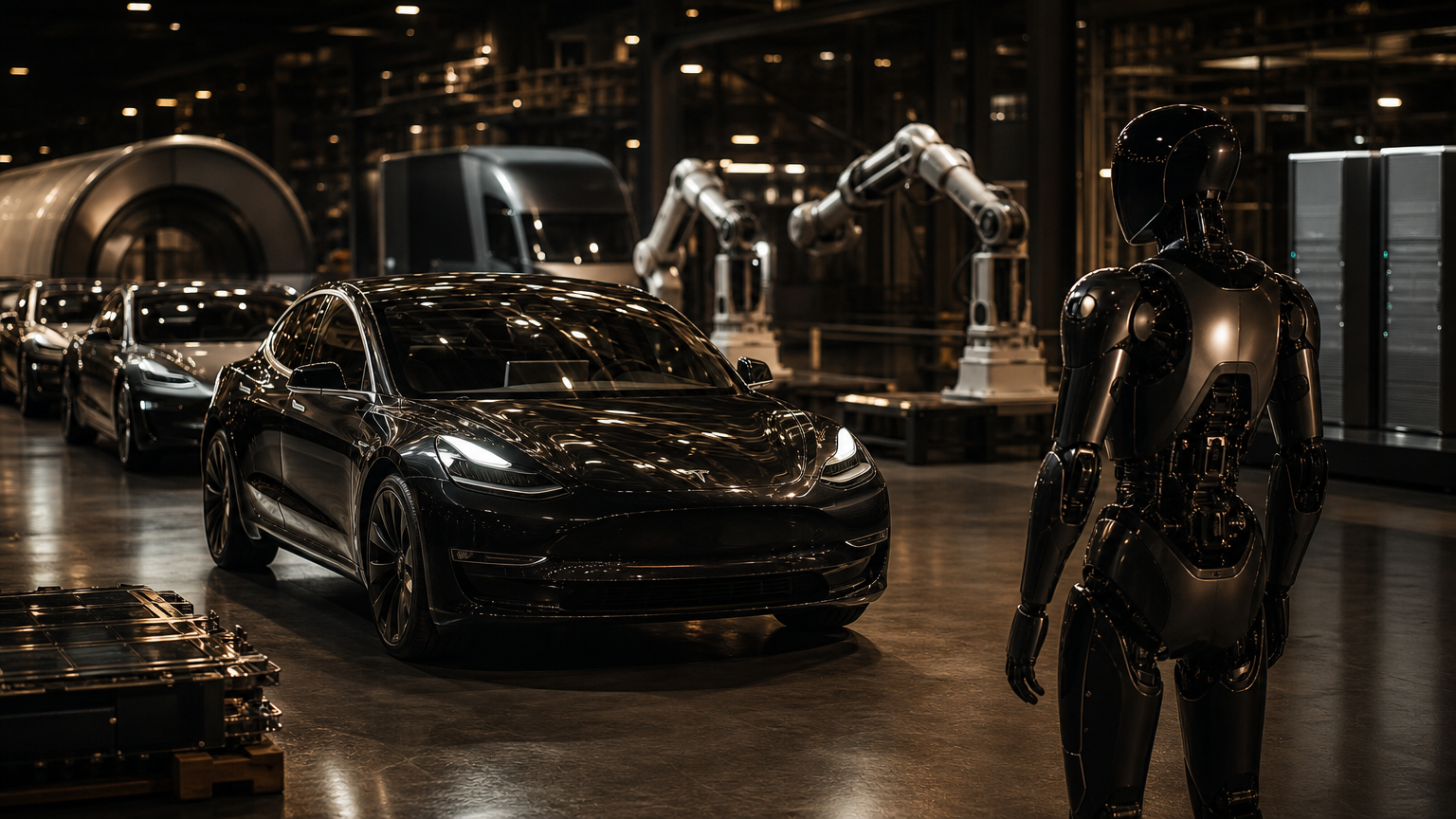
The headline: less profit, more operating leverage
Tesla released its third-quarter 2026 financial results after the U.S. market close on October 21, with management scheduling the Q&A webcast for the same evening . The immediate “shock” was not a single number but the contrast between weaker year-over-year earnings and stronger signals in the parts of the business investors now treat as Tesla’s future: FSD, cash generation, vehicle margins, robotaxis, energy storage, Semi and Optimus.
On the surface, the income statement looked softer than a year ago. Tesla reported total revenue of $28.046 billion, nearly flat versus $28.095 billion in Q3 2025, while GAAP net income attributable to common stockholders fell to $787 million from $1.373 billion a year earlier . GAAP diluted earnings per share came in at $0.22, and non-GAAP diluted EPS was $0.48 . The Associated Press noted that the adjusted EPS figure beat Wall Street expectations by 3 cents, even as net income fell sharply .
That is why the quarter reads better in the operating details than in the headline profit line. Tesla generated $6.263 billion in operating cash flow and $1.531 billion in free cash flow, a reversal from negative free cash flow in Q2 2026 . Reuters described that cash generation as a surprise because analysts had expected Tesla to burn cash while funding its AI, robotics and autonomy programs . For a company asking investors to believe in capital-intensive platforms beyond the car, that matters.
FSD was the real center of gravity
The most important number in the report may have been the FSD attach rate. Tesla said FSD Supervised reached more than 75% of new vehicle deliveries in North America, up by nearly 20 percentage points sequentially . That is the jump behind the “big shock” framing: a feature once seen by skeptics as optional software is becoming a central part of the delivery conversation in Tesla’s most mature market.
The subscription base also moved meaningfully. Tesla listed active FSD subscriptions at 1.74 million in Q3, up from 1.48 million in Q2 and 1.04 million in Q3 2025 . The company’s note says that this metric includes both upfront-payment and monthly-subscription customers and excludes free trials . In other words, Tesla is not merely reporting curiosity clicks or temporary promotions; it is reporting a paying FSD base that has expanded sharply year over year.
That changes the earnings interpretation. Automotive revenue was almost unchanged at $20.560 billion, but Tesla said year-over-year results benefited from higher automotive ancillary sales, primarily driven by increased FSD subscriptions . It also said profitability was helped by those ancillary sales and by improved vehicle region and product mix, partly offset by lower average selling prices and higher operating expenses . This is the software thesis in miniature: hardware still drives the revenue base, but software is increasingly visible in the margin story.
Margins: better, but not simple
Tesla’s vehicle margin data showed improvement at the exact moment many investors were worried that price pressure would keep grinding profitability lower. Automotive gross margin excluding regulatory credits reached 18.1% in Q3, up from 16.3% in Q2 . AP similarly highlighted that Tesla made 18.1 cents for every dollar of car sales excluding credits, up almost 3 cents from a year earlier .
Still, the margin recovery should not be overread. Operating expenses rose to $4.776 billion from $3.430 billion a year earlier, and R&D alone increased to $2.761 billion from $1.630 billion . Tesla blamed the year-over-year operating income pressure on SI and other R&D projects, stock-based compensation, SG&A, lower regulatory-credit revenue and lower energy gross profit . So the quarter was not a clean profitability breakout; it was a quarter in which stronger gross economics and FSD revenue had to fight against the cost of building future businesses.
Vehicle demand: the backlog surprise
Tesla delivered 486,532 vehicles in Q3, compared with 480,126 in Q2 and 497,099 in Q3 2025 . Production reached 464,391 vehicles, meaning deliveries exceeded production for a second consecutive quarter and helped reduce inventory pressure . Tesla said it ended the quarter with the largest passenger-vehicle backlog in four years, while battery availability remained a limiting factor for increasing auto volumes .
That backlog claim is crucial because it supports management’s argument that demand is not being driven only by discounts or macro timing. Tesla explicitly said it believes FSD is driving demand where the feature is available and that it continues to work with regulators to expand approvals in other markets . Reuters also reported that management said demand was exceeding production by a significant margin .
The important nuance is geographic. North America is where the attach rate is most mature, while Tesla is still expanding FSD approvals overseas. The company said it received four additional approvals since the end of Q2 in Croatia, Slovenia, the Czech Republic and Slovakia, bringing FSD availability to nine EU countries . That makes regulatory expansion a major swing factor for whether North America’s FSD momentum can translate into a broader global demand engine.
Robotaxi, Semi, Optimus and energy: the “future stack”
Tesla used the Q3 deck to connect FSD adoption with its wider autonomy roadmap. The company said it began deployment of Cybercab into the Robotaxi fleet in Austin and reached nearly two million cumulative unsupervised miles by quarter-end . Reuters framed the robotaxi rollout as one of the growth stories investors still want Tesla to prove commercially .
The Semi also moved from promise toward production. Tesla said production had begun for the Tesla Semi in Nevada, and that the top variant can travel 500 miles at full 82,000-pound gross combination weight while using 1.7 kWh per mile . Optimus likewise crossed a symbolic threshold: production began in Fremont on high-volume lines, with Tesla saying the current manufacturing process is suitable for a commercial product even as hardware iterations continue . Axios highlighted that Tesla had begun initial Optimus production and that Wall Street is increasingly judging the company through AI, self-driving and energy-storage ambitions rather than only retail EV sales .
Energy storage was the other major strategic pillar. Tesla deployed 13.7 GWh of storage in Q3 and said demand remained strong, with its highest-ever order rate and backlog . The company also began production at Megafactory Texas, planned for 50 GWh of capacity, and shipped the first Megapacks built with its own LFP cells from Nevada . That matters because Tesla increasingly links energy storage to data-center demand and grid constraints, not just residential or utility backup.
The recap: why this quarter shocked
The shock in Tesla’s Q3 earnings was the split personality of the report. Net income fell, operating expenses surged, and revenue was basically flat . At the same time, free cash flow turned positive, automotive margins improved, FSD adoption accelerated, and the company pushed forward on robotaxis, Semi, Optimus and Megapack capacity .
For bulls, Q3 strengthens the argument that Tesla is becoming a software-and-autonomy company layered on top of a manufacturing base. For skeptics, the same report shows how expensive that transition remains and how much still depends on regulation, execution and converting futuristic platforms into durable profit. The most balanced takeaway is that Tesla did not deliver a simple earnings beat or miss. It delivered evidence that FSD is now a measurable demand and margin lever, while the next test is whether that lever can scale beyond North America without losing the financial discipline that made Q3’s cash flow surprise possible. Even Hal 9000 would envy the upgrade, but investors still need to see it drive itself all the way to recurring profit.
Sources from the last 72 hours
- [1]Tesla Releases Third Quarter 2026 Financial Results | Tesla Investor RelationsOct 21, 2026, 10:06 PM
- [2]Q3 2026 UpdateOct 21, 2026, 2:00 AM
- [3]Tesla cuts spending before potential SpaceX deal even as Musk bets future on AI, robotsOct 21, 2026, 10:05 PM
- [4]Tesla revenue flattens out as Elon Musk eyes possible SpaceX dealOct 21, 2026, 11:46 PM
- [5]Tesla's Q3 profit drops as it prepares for possible merger with SpaceX | AP NewsOct 21, 2026, 10:55 PM
AI-generated article based on recent web research, then preserved as a dated editorial snapshot.
Comments
Be the first to comment.