
Daily Podcast full article
Unitree flexes humanoid ambition
Unitree used its 10th-anniversary moment in Hangzhou to do two things at once: show a humanoid with startling physical force, and argue that AI will soon matter more than choreography. The H2-X “Kung Fu Legend Guardian” demo was cinematic, but the deeper signal was Wang Xingxing’s bet on self-improving robot software.
A stunt reel with a strategic message
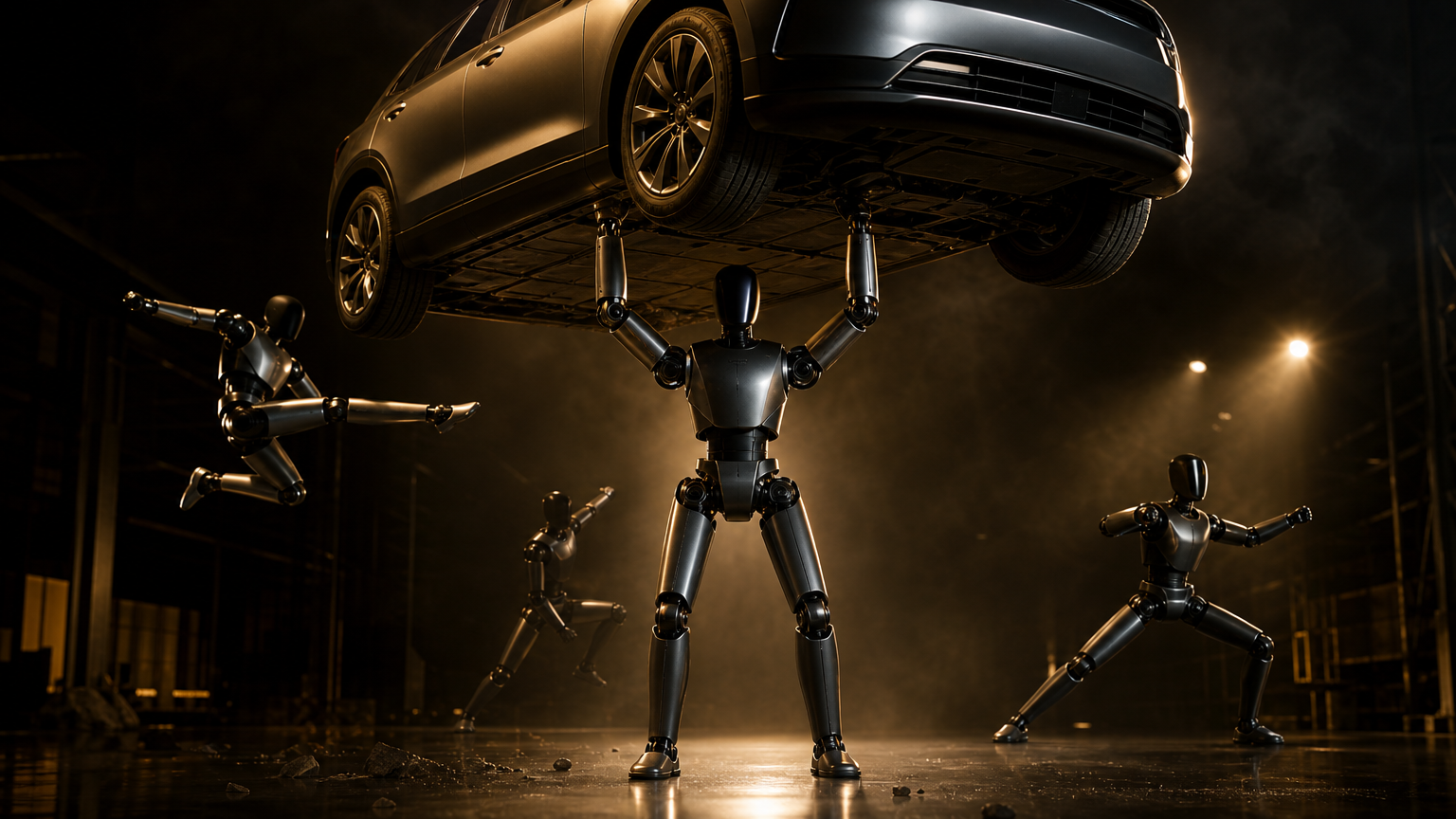
Unitree’s latest humanoid push arrived with exactly the kind of video built to travel: a robot kicking, flipping, dropping from height and lifting the front of a car. The company introduced the H2-X “Kung Fu Legend Guardian” in footage that framed the machine as part martial-arts performer, part emergency helper and part personal protector . In one sequence described by India Today, the robot dents a car door; in another, it lifts the front end of a vehicle in a staged rescue scenario .
The spectacle was timed around Unitree’s 10th anniversary and the 2026 World Physical AI Conference in Hangzhou, where founder Wang Xingxing made the case that robots are entering a new phase . His message was not merely that Unitree can build stronger bodies. It was that the company’s next decade depends on believing more deeply in AI itself .
That distinction matters. Humanoid demos have long been haunted by a credibility gap: they can look impressive in a video but still struggle with messy homes, crowded factories, loose cables, slippery floors and unpredictable humans. Unitree’s video shows physical capability; Wang’s speech points to the harder question of whether software can turn that capability into adaptable labor.
What the H2-X actually shows
The H2-X footage suggests a robot designed to advertise torque, balance and impact tolerance. India Today described the robot performing spinning kicks, acrobatic flips, a four-metre drop and a vehicle-lifting feat . TechRadar reported that Unitree had revealed only limited specifications, including a claimed ability to jump from four-metre platforms and stand for approximately eight hours between charges .
Those claims should be read carefully. An eight-hour maximum endurance figure is not the same as eight hours of continuous fighting, lifting or rescue work. It is also not a third-party benchmark. TechRadar noted that the video is a teaser and that the real-world roles Unitree is trying to prove remain unclear . India Today similarly warned that impressive stunts do not establish how well a robot would perform in everyday security or operational settings .
Still, the demonstration is not meaningless. A humanoid that can land, recover, strike, push and lift without collapsing is showing progress in dynamic control. It also reflects the competitive edge Unitree has tried to build for years: relatively capable hardware at comparatively aggressive cost. Wang said the company’s G1 humanoid, released in 2024, had reached cumulative production of about 10,000 to 20,000 units, which he described as the highest single-model shipment volume for a humanoid robot .
If that scale is accurate, it gives Unitree a practical advantage. Robots improve not only through elegant lab experiments but also through manufacturing repetition, field feedback, cheaper components and more developers using the same platform. In embodied AI, the “body” is not a metaphor. It is the constraint that makes every software breakthrough harder.
Wang’s pivot: from hardware heroics to AI conviction
The most revealing part of Unitree’s anniversary event may not have been the car lift. It was Wang’s emphasis on AI. According to KuCoin’s report of the event, Wang told the audience to “trust AI” and said he himself had not believed in AI enough in the past . He argued that current model capabilities have already “breached” much of the information world and that physical AI must now absorb that progress .
This is a striking posture for a founder known first for hardware. It suggests Unitree sees the humanoid race less as a single-company contest to build the perfect robot brain and more as an ecosystem contest. Wang said Unitree would develop models internally but also cooperate with major model companies in China and abroad . That is a pragmatic stance: if frontier AI models become broadly available, the winner in robotics may be the company that can make reliable, affordable bodies at scale.
Wang also identified a remaining bottleneck: aligning AI model inputs and outputs with real robots, where sensors are noisy, actuators are imperfect and the world refuses to behave like a simulation . In other words, a chatbot can be wrong with words; a humanoid can be wrong with kilograms, joints and momentum.
That is why the H2-X matters beyond the viral clip. Its physical stunts are a hardware confidence signal. Wang’s speech turns that signal into a strategy: build bodies robust enough to exploit whatever intelligence large models can provide next.
Unitree Rehearsal and the self-improving robot loop
The second half of the story is Unitree Rehearsal, the AI system Wang unveiled for self-improving humanoid robots. South China Morning Post reported that the project is designed to let robots write code, run simulations and improve real-world performance more independently . Wang called it Unitree’s most important initiative of the year .
The proposed loop is ambitious. AI would search research papers, generate control code, test that code in simulation, then move toward physical trials on robots, with humans still able to evaluate performance and provide feedback . The goal is to reduce the labor-intensive manual programming that currently makes each new robot skill expensive to develop .
If it works reliably, that could change the adoption curve. Logistics sites, factories, inspection routes and service environments rarely need one perfect humanoid that can do everything. They need repeatable robots that can learn thousands of narrow, useful tasks without months of bespoke engineering. A self-improvement pipeline could help transform robots from demo objects into adaptable tools.
But this is also where the caution lights flash. Self-improving systems raise evaluation and control questions. A robot that rewrites code or optimizes behavior through simulation must still remain predictable when it meets real people, real tools and real failure modes. The most valuable robot is not the one that improvises endlessly; it is the one that improves within boundaries operators can understand, test and enforce.
The competitive stakes
Unitree’s timing is not accidental. Humanoids have become a strategic category for Chinese robotics, US AI companies, industrial automation firms and electric-vehicle groups. The market is still early, but the pitch is clear: human-shaped machines could eventually work in spaces already designed for humans, from warehouses to factories to disaster zones.
The H2-X video gives Unitree a public-relations win. Unitree Rehearsal gives it a more serious thesis. The company is trying to show that it can combine low-cost, agile hardware with a software loop that continuously converts AI progress into physical capability.
That is a bigger claim than “a robot can kick a car.” It is a claim that the robotics stack is beginning to compress: foundation models for reasoning, simulation for iteration, hardware scale for deployment, and feedback loops for improvement. If Unitree can make that stack reliable, its anniversary stunt may be remembered less as a flashy demo than as a marker of the moment Chinese humanoid hardware began looking ready for harder jobs.
For now, the sensible reaction is admiration mixed with skepticism. The H2-X looks powerful, but its autonomy, safety case, pricing and availability remain unproven . Unitree Rehearsal sounds promising, but self-improvement in robotics must be judged by repeatable field performance, not conference-stage ambition . Still, Unitree has made its direction clear: the next humanoid race will not be won by flips alone. It will be won by the company that teaches the flips when to stop.
Sources from the last 72 hours
- [1]Wang Xingxing urges belief in AI at Unitree's 10th anniversary eventOct 22, 2026, 7:04 AM
- [2]Don't mess with it: China's Unitree unveils robot that kicks, flips and lifts a carOct 22, 2026, 10:21 AM
- [3]Unitree reveals 'kung fu' robot bodyguard with eight-hour battery lifeOct 21, 2026, 2:22 PM
- [4]Unitree developing AI system to let humanoid robots improve themselvesOct 22, 2026, 3:30 PM
AI-generated article based on recent web research, then preserved as a dated editorial snapshot.
Comments
Be the first to comment.