
Daily Podcast full article
Nvidia cuts AI data-center build time to 14 days
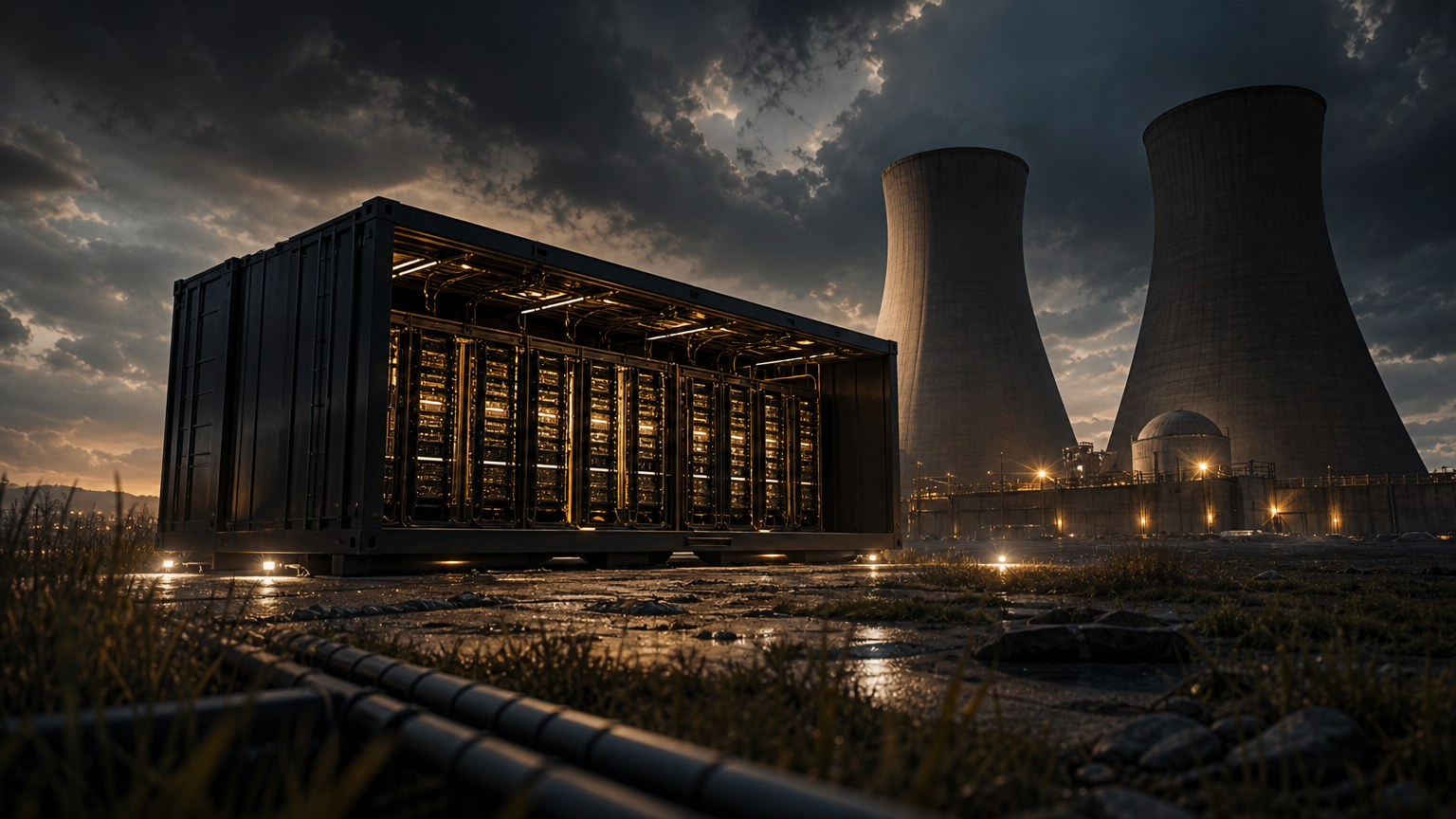
Nvidia’s DSX POD turns the AI data center into a factory-built module: pre-integrated Vera Rubin racks, liquid cooling, power distribution and networking arrive in containers and, at a prepared site, are meant to shrink on-site deployment from six months to 14 days. At the same time, Nvidia and PreussenElektra are assessing whether Germany’s retired nuclear plant campuses can host future AI factories, linking two hard constraints in one strategy: faster standardized construction and access to large, power-ready industrial sites.
The headline number: six months to 14 days
Nvidia’s new claim is deliberately simple: with DSX POD, an AI data-center deployment at a prepared site can fall from roughly six months to as little as 14 days . The company introduced the system at GTC Berlin as a reference design for complete Nvidia Vera Rubin AI factories built by partners inside modular containers, with integration and validation completed before delivery . In Nvidia’s framing, the key metric is not ribbon-cutting but “time to first production tokens,” because an AI factory only begins creating value once models are training or serving inference workloads .
That “prepared site” caveat matters. DSX POD does not make land acquisition, grid interconnection, permitting, foundations, external networking or regional utility work disappear. Nvidia’s own technical explanation says the model shifts more complex assembly into a controlled factory environment while site teams prepare land, foundations, power and external connectivity in parallel . In other words, the 14-day figure applies to the final connection-and-commissioning phase, not to the entire civil-engineering journey from greenfield to operational campus.
Still, it is a meaningful change in where the bottleneck sits. Traditional AI data-center deployment requires rack planning, cabling, liquid-cooling installation, network validation and incremental cluster bring-up on site; DSX POD moves much of that work into factory-built containers that arrive pre-integrated . Data Center Knowledge described the module as a containerized AI data center with seven Vera Rubin NVL72 racks plus networking, cabling and cooling already installed . Data Center Dynamics reported Nvidia’s keynote detail that a Vera Rubin DSX POD starts with seven liquid-cooled compute racks linked by roughly 17 kilometers of Spectrum-X cables .
What DSX POD actually standardizes
The idea is not merely to place servers in a box. Nvidia says DSX POD is a complete AI factory reference design that coordinates compute, networking, storage, power, cooling, cabling, controls and validation around Vera Rubin rack-scale systems . The technical problem is that AI clusters behave as one tightly coupled machine: high-density compute, scale-up and scale-out networking, liquid cooling, power delivery and telemetry all have to remain within specification during factory integration, transport, installation and operation .
That is why Nvidia emphasizes repeatability. Partners can install rack-scale systems in containers, run functional testing before shipment, transport the integrated unit and then bring it online through a defined process at the destination . The company says its partner ecosystem includes Anduril, Armada, Bull, Crusoe, DayOne, Dell Technologies, Delta, Eaton, Foxconn, Gigabyte, HPE, Lenovo, Pegatron, Quanta Cloud Technology, Schneider Electric, Vertiv and Wistron, with global DSX POD delivery targeted for early 2027 .
The supply-chain logic is similar to modular construction in other industries: do the most repeatable, failure-prone work in a factory, leave the site to handle location-specific tasks. Nvidia says partners complete rack-to-rack cabling, wiring, piping and functional validation before shipment, separately from site preparation . That could reduce late-stage surprises, where a data-center operator discovers a cooling, wiring or networking issue after expensive accelerators are already waiting to be energized.
Why old nuclear campuses enter the picture
The second half of the story is site selection. PreussenElektra, an E.ON subsidiary responsible for decommissioning eight German nuclear power plants, is working with Nvidia to assess whether former nuclear plant sites can host AI factories . The study will compare existing energy and site infrastructure, available land and the technical and operational requirements of high-performance AI data centers . NDR reported that possible sites in Lower Saxony include Unterweser, Grohnde and Stade, all associated with PreussenElektra’s decommissioning responsibilities .
This is still exploratory. PreussenElektra said the review is open-ended and that no concrete investment or site decision is currently attached to it . Yahoo Finance, citing GuruFocus, likewise reported that no exact site, investment amount or approved development plan has been announced . The attraction is obvious nonetheless: former power stations often have large industrial plots, existing grid connections and infrastructure that may be more relevant to AI factories than ordinary commercial land .
For Nvidia, the nuclear-site study and DSX POD announcement point toward the same strategic constraint: power. AI accelerators can be purchased faster than new transmission capacity can be permitted, financed and built. Reusing an industrial campus with heavy electrical infrastructure does not automatically solve interconnection queues or regulatory approvals, but it may shorten the distance between available land and usable megawatts.
The energy and cooling pitch
Nvidia is also positioning DSX as an efficiency platform, not just a construction shortcut. Data Center Dynamics reported that Nvidia says the broader DSX AI Factory Platform can reduce cooling-water consumption by up to 100 percent through closed-loop liquid cooling connected to dry-cooler heat rejection, while noting that some climates may still require additional mechanical cooling during extreme heat . The same report said Nvidia claims DSX MaxLPS can dynamically allocate power inside a provisioned power budget to deliver the same token output with 30 percent less power .
Siemens, meanwhile, said it is working with Nvidia on AI-factory infrastructure, including DSX-based reference architectures, power distribution, protection, automation and control from grid connection to AI rack . Siemens also said prefabricated, factory-tested power-supply modules developed with Delta can cut the realization time for AI-factory power infrastructure by 50 percent . That complements DSX POD’s core idea: compress the schedule by standardizing not only compute, but also the electrical and mechanical systems around it.
The catch: fast modules still need slow infrastructure
The 14-day promise should not be read as “build a hyperscale campus in two weeks.” It is closer to “bring a standardized AI block online quickly once the hard site prerequisites are ready.” Nvidia’s technical blog explicitly says DSX POD does not eliminate supporting facility infrastructure . External power delivery, heat rejection, regional electrical engineering, foundations, permitting, fiber access and operating approvals remain local problems .
That is why the former nuclear-site assessment is so important. If a retired energy campus already has land, substations, grid rights-of-way and industrial zoning, it may shorten the slowest pieces of the timeline. If decommissioning, regulatory limits, local opposition or grid-capacity studies drag on, the containerized AI factory still waits. Even the most elegant modular architecture cannot plug into electricity that is not there.
The broader meaning
Nvidia is trying to turn AI capacity planning from bespoke construction into repeatable manufacturing. DSX POD attacks the integration problem; the PreussenElektra study attacks the site-and-power problem. Together they suggest a future in which AI infrastructure expands less like a one-off megaproject and more like a production line fed by prepared industrial campuses.
The near-term test is execution. Nvidia and its partners still need to prove that DSX POD can be delivered worldwide in early 2027, that units survive transport and commissioning at scale, and that customers can secure prepared sites fast enough for the 14-day phase to matter . PreussenElektra and Nvidia also need to show whether Germany’s former nuclear campuses can move from feasibility study to investable projects . If both pieces work, the AI buildout gets a new clock: not years of bespoke integration after the grid arrives, but a rapid deployment window once the site is ready.
Sources from the last 72 hours
- [1]NVIDIA Introduces DSX POD AI Factories to Accelerate Europe’s Infrastructure DeploymentOct 21, 2026, 9:00 AM
- [2]Achieve Productive AI Capacity Faster and More Predictably with NVIDIA DSX PODOct 21, 2026, 9:30 AM
- [3]Nvidia Unveils DSX Pod for Faster AI Data Center BuildsOct 21, 2026, 10:00 AM
- [4]Nvidia launches DSX POD, claims the Vera-Rubin reference architecture will make AI data centers more water and energy efficientOct 21, 2026, 10:30 AM
- [5]Nvidia Explores Former Nuclear Sites for AI Data CentersOct 23, 2026, 4:18 PM
- [6]Siemens und NVIDIA bringen industrielle KI voranOct 22, 2026, 12:00 PM
- [7]KI-Fabrik statt AKW? NVIDIA prüft Standorte in NiedersachsenOct 23, 2026, 12:34 PM
AI-generated article based on recent web research, then preserved as a dated editorial snapshot.
Comments
Be the first to comment.