
Daily Podcast full article
SpaceX targets 80,000 cell sites
SpaceX’s reported push for at least 80,000 U.S. cell sites would move Starlink Mobile from a satellite-connectivity story into the terrestrial wireless arena, forcing investors to rethink tower landlords, national carriers and the cost of building a fourth mobile network.
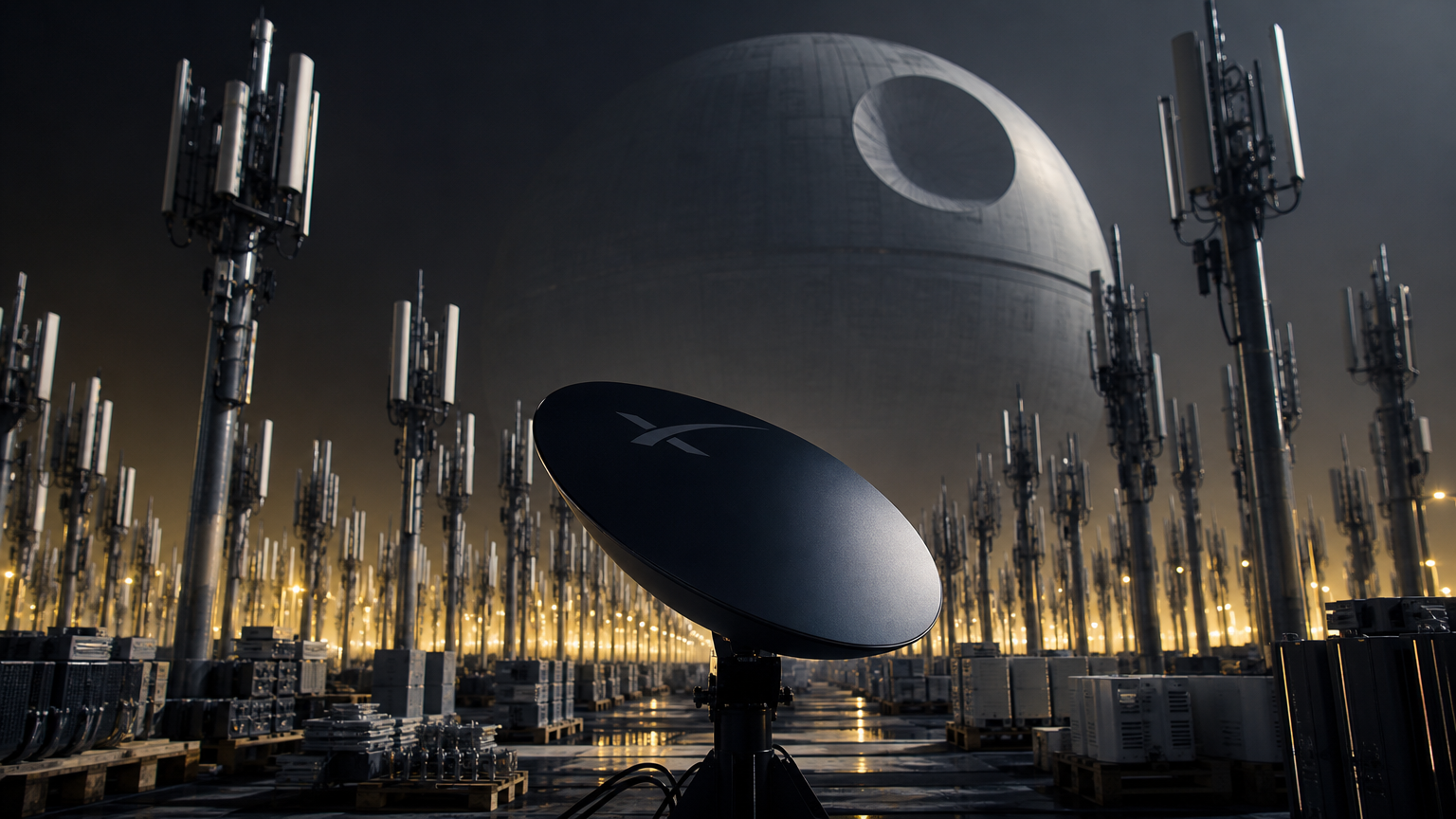
SpaceX’s tower moment
SpaceX is no longer being priced merely as a company that beams internet from orbit. Its latest reported ambition is far more terrestrial: securing access to at least 80,000 cell sites across the United States for a Starlink Mobile network that could challenge AT&T, Verizon and T-Mobile as a fourth national wireless carrier . The talks are still private and no signed master lease has been disclosed, but the scale alone was enough to shake telecom stocks and send tower owners higher.
The core of the report is simple and disruptive. SpaceX is in discussions with at least one large cellular infrastructure company, and Crown Castle is among the companies named in the talks . American Tower declined to comment, while SpaceX and Vertical Bridge did not immediately respond to requests for comment . Crown Castle chief executive Chris Hillabrant avoided naming any customer on the company’s earnings call, but when asked about possible leasing discussions with SpaceX, Amazon and other satellite-based providers, he said investors could assume Crown Castle was “talking to all parties” .
That answer was not a confirmation. But for Wall Street, it was enough to turn a rumor into a valuation exercise.
Why 80,000 sites matters
Eighty thousand cell sites is not a casual footprint. Yahoo Finance noted that the figure is about half of the 158,500 cell towers in the United States, using Wireless Infrastructure Association data, while American Tower has roughly 41,000 sites in the U.S. and Canada and Crown Castle has about 40,000 . In other words, SpaceX is not talking about filling rural dead zones with a few strategic leases. It is contemplating a network-sized buildout.
That distinction is crucial. Satellite-to-phone service can extend coverage into remote areas, emergency corridors and places where traditional towers are uneconomic. A national mobile carrier, by contrast, needs dense, repeatable terrestrial infrastructure: antennas, backhaul, spectrum, power, permitting, operations, maintenance and customer support. SpaceX’s satellite constellation may provide a differentiated backbone, but mobile phones still need reliable ground-level radio access in cities, suburbs, office buildings and traffic corridors.
The company has already added another piece to that puzzle. SpaceX recently acquired low-band spectrum, and Elon Musk told investors this week that satellite launches plus spectrum acquisition would help Starlink Mobile become a major U.S. mobile carrier . Low-band frequencies are valuable because they travel farther and penetrate buildings better than higher-frequency bands. But spectrum without towers is like owning lanes on a highway without exits. The tower discussions are what make the spectrum strategy look operational.
The market reaction: carriers down, landlords up
Investors immediately separated the threatened from the beneficiaries. Crown Castle shares jumped after the report, while AT&T, Verizon and T-Mobile fell as traders considered the possibility of a well-funded new national competitor . Yahoo Finance described tower owners as “cashing in” on the idea: Crown Castle moved up by double digits on Friday, American Tower and SBA Communications also rose, while the major wireless carriers slid .
The logic is straightforward. For tower companies, SpaceX could become a new tenant at a time when the industry is hungry for additional leasing demand. For AT&T, Verizon and T-Mobile, the same leases could help create a new rival with a famous brand, deep capital access and a satellite network that can market coverage where traditional carriers struggle.
That asymmetry explains the split. Tower landlords do not necessarily care which carrier wins the customer, as long as more tenants rent space. Mobile operators care deeply, because a fourth national network could pressure pricing, churn, promotional spending and the profitability of high-end wireless plans.
Yahoo Finance also reported that carriers collectively shed about $21 billion in market value on Friday, while tower stocks added about $9 billion . That is not a verdict on whether SpaceX can build the network. It is a repricing of probability: the market is now assigning more weight to the idea that Starlink Mobile becomes a real wireless competitor.
The economics are the hard part
The number that should temper the excitement is not 80,000. It is the cost attached to turning those sites into a working network. A Yahoo Finance article citing TD Cowen estimated that a nationwide terrestrial network would cost more than $80 billion and take many years to complete . That estimate is a reminder that cell-site access is only the starting line. SpaceX would still need radios, installation crews, integration, backhaul arrangements, site upgrades, roaming strategies and regulatory execution.
The reported leases could themselves be worth billions of dollars . That helps explain why tower companies rallied, but it also underscores the cash burden for SpaceX. This is not a software rollout. It is a physical-infrastructure campaign layered on top of rockets, satellites, spectrum and user hardware.
There is also strategic uncertainty. Yahoo Finance noted that nothing has been signed yet and that some observers see the reported tower talks as potential leverage in SpaceX’s dealings with existing carriers . That caveat matters. SpaceX could use the threat of building its own network to negotiate wholesale, roaming or partnership terms. Or it could pursue both paths: use partners where economics are attractive and build where control matters most.
From satellite backhaul to owning the map
The bigger story is that SpaceX appears to be moving down the stack. Starlink began as satellite broadband. Then came direct-to-device ambitions. Now the company is looking at the unglamorous but indispensable layer of wireless: towers, rooftops and ground sites.
That move changes the competitive frame. A satellite-only Starlink Mobile offer could complement existing carriers, especially in remote coverage and emergency messaging. A terrestrial network built across tens of thousands of cell sites would compete with them. It would also make SpaceX less dependent on wholesale carrier arrangements and more capable of controlling customer experience, pricing and coverage claims.
This is why the phrase “fourth national carrier” matters. The United States has seen how hard that role is to sustain. Dish spent heavily to build a 5G network and still struggled to convert infrastructure into durable consumer share. SpaceX, however, brings a different bundle: Starlink distribution, satellite capacity, a powerful consumer brand, a Musk-driven financing narrative and now a potential nationwide site target.
Starlink growth, weaker ARPU
The timing is also important because Starlink’s user base is expanding quickly while monetization is showing strain. ApeX’s analysis of SpaceX’s latest quarterly materials said Starlink reached 13.6 million consumer subscribers at the end of September, adding 1.6 million in the quarter and rising from 7.2 million a year earlier . But average revenue per user fell to $69 per month from $83 a year earlier, even though it rose sequentially in the quarter .
That combination tells a familiar telecom story: scale is improving, but the next customers may be less lucrative than the first ones. As Starlink expands into more price-sensitive markets and broader consumer segments, volume can rise while ARPU declines. A mobile network could help SpaceX broaden its addressable market, bundle services and make better use of spectrum and satellites. But it could also intensify the capital problem if customer revenue does not rise fast enough to justify the buildout.
Starship and the infrastructure flywheel
SpaceX is also scaling on the launch side. The Orlando Business Journal reported that SpaceX plans a massive 400-acre expansion tied to advancing Starship plans . The strategic link is clear: more Starship manufacturing and testing capacity can support higher launch cadence, which can lower satellite deployment costs and accelerate constellation growth.
That matters for Starlink Mobile. A denser satellite network, paired with low-band spectrum and terrestrial cell sites, could give SpaceX more ways to mix coverage layers. Satellites can reach where towers do not. Towers can deliver capacity where satellites are constrained. Starship, if it reaches reliable cadence, could reduce the cost of refreshing and expanding the orbital layer.
But this is also the risk. SpaceX is adding physical capacity faster than the revenue-per-user trend is improving. The empire is expanding the map: launch sites, satellites, spectrum, towers and user terminals. The question is whether each new tile produces enough cash flow to pay for the next one.
What to watch next
The next proof point is not another headline about ambition. It is documentation. Investors should watch for signed tower leases, disclosures from Crown Castle or American Tower, spectrum-closing details, FCC milestones, equipment-vendor announcements and any formal Starlink Mobile launch timetable.
Until then, the 80,000-site target should be read as both a strategic signal and a negotiating weapon. It says SpaceX is serious enough to scare carriers and excite tower landlords. It does not yet prove that a fourth U.S. mobile network is inevitable.
Still, the telecom market heard the message. The Death Star, apparently, needs cell towers too.
Sources from the last 72 hours
- [1]SpaceX in talks to access 80,000 cell sites for new networkOct 23, 2026, 3:34 AM
- [2]SpaceX wants to be America's fourth phone carrier — tower owners are cashing inOct 23, 2026, 6:20 PM
- [3]SpaceX Moves Closer to Taking On AT&T, Verizon and T-MobileOct 23, 2026, 2:32 PM
- [4]Why Did SpaceX Fall 9% After Its $193bn Unlock? | InsightOct 23, 2026, 2:00 AM
- [5]SpaceX plans massive 400-acre expansion as Starship plans advanceOct 23, 2026, 4:00 PM
AI-generated article based on recent web research, then preserved as a dated editorial snapshot.
Comments
Be the first to comment.