
Daily Podcast full article
US Air Force automates refueling
The U.S. Air Force is not handing the boom to a robot yet. Its new push is narrower, but potentially consequential: an AI-assisted “hot wash” system that would read tanker-camera video after aerial refueling events, turn a demanding formation-flying task into measurable data, and give crews faster, more objective feedback.
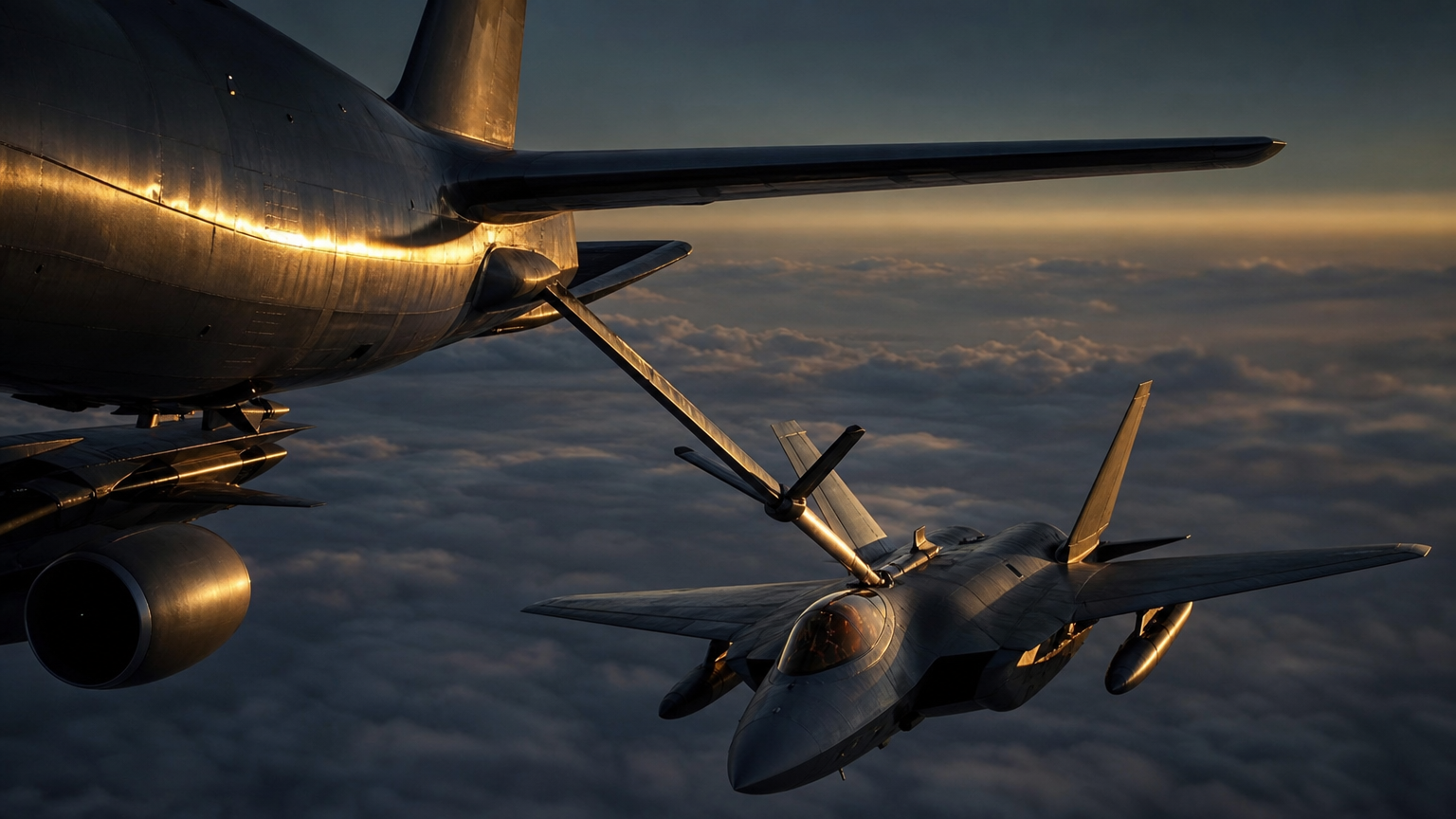
The real news: AI for the debrief, not a robot tanker
The U.S. Air Force’s latest automation move in aerial refueling is best understood as a training-and-assessment program rather than an immediate leap to fully autonomous fuel transfer. Defense News reported on October 23, 2026, that the service wants artificial intelligence to analyze aerial refueling operations from cameras mounted on tanker aircraft and provide “hot wash” feedback to tanker crews . Military Times carried the same story the same day, framing the effort as an AI tool to improve the performance of aerial refueling crews .
That distinction matters. Aerial refueling is one of the most unforgiving jobs in military aviation: a tanker and a receiver aircraft must fly in close, stable formation while fuel moves through a boom or hose-and-drogue system. The Air Force is not saying that software will take over all of that choreography tomorrow. Instead, the near-term plan is to make the evidence from each event easier to capture, measure and learn from.
The solicitation described in the reporting calls for a system using computer vision, machine learning and flight-dynamics analytics to extract relevant metrics from refueling events, identify deviations from desired flight profiles and generate actionable post-flight feedback . In plain English, the Air Force wants AI to watch the video, understand what happened, score the geometry and motion of the aircraft, and help instructors and crews see where performance was clean or risky.
What the system would measure
The proposed system would automatically track the tanker, the refueling boom and the receiving aircraft . It would measure data such as position, velocity, alignment and closure rate, then evaluate whether those values depart from nominal parameters . Those are exactly the variables that make aerial refueling difficult: the receiver has to approach at the right angle and speed, hold station with tiny corrections and avoid movements that could endanger the aircraft or damage equipment.
The Air Force also wants the output to be useful to humans, not just a database of numbers. The system would generate visual feedback such as AI overlays, heat maps, event timelines and immersive or interactive debrief environments for receiver pilots . The reporting also notes possible integration with virtual reality, augmented reality, mission rehearsal systems, simulators and other computer-based training tools .
This is where the program becomes more than a gimmick. A good debrief does not merely tell a pilot, “you were off.” It shows when the drift began, how quickly the closure rate changed, what the aircraft’s relative position looked like and whether a correction improved or worsened the situation. If the AI can reliably turn raw video into that kind of structured feedback, each refueling sortie could become a richer training event.
Why the Air Force wants objective scoring
The Air Force’s own rationale, as reported, is that current aerial refueling training and post-flight assessment still rely heavily on instructor observation, pilot self-assessment, manual video review and subjective evaluation . Those methods will not disappear, and they should not: experienced instructors understand context, crew coordination and aircraft behavior in ways that are difficult to encode. But subjectivity creates variation. Two instructors may emphasize different cues; a tired crew may remember an event differently; video review can take time.
AI-based assessment is attractive because it promises repeatability. If the system can consistently measure the same refueling geometry, closure-rate behavior and alignment deviations across many sorties, commanders could identify patterns that individual crews or squadrons might miss. That could help distinguish a one-off mistake from a recurring training gap.
There is a safety case, too. Defense News reported that the solicitation links the desired post-flight feedback to improved aircrew proficiency, reduced human-factor-driven mishaps and enhanced readiness . That does not mean AI will automatically make refueling safer. It means the Air Force sees a path in which better measurement improves training, and better training reduces risk.
KC-46 is the obvious testbed
The reporting says the SBIR effort is focused on the KC-46 tanker, a platform with camera-based refueling technology and a remote vision system that lets operators control the boom through cameras and a 3D display . That makes the KC-46 a logical place to begin. If the aircraft already produces relevant video streams, the next step is to make those streams analytically useful.
The KC-46 has also been a reminder that adding sophisticated visual systems to tanker operations is not simple. Defense News noted that the remote vision system has had “teething” problems, while adding that the Air Force says most will soon be resolved . That history should temper hype around any new AI layer. A model that works in polished demonstrations must still prove itself with operational video, lighting changes, weather, unusual receiver behavior, classification constraints and the messy edge cases that define aviation.
The current plan is therefore less about replacing crews and more about building a trusted assistant. The AI would sit after the event, reconstructing the refueling profile and producing a debrief product. Human instructors would still need to validate, interpret and decide how to train from the output.
A small program with a bigger autonomy signal
On its face, this is a niche training tool. Strategically, it is a useful signal about where military autonomy may advance first. The Air Force is not choosing an easy sandbox; it is choosing a mission that demands precision, trust and human oversight. If AI can help assess aerial refueling reliably, the same logic could extend to other aviation tasks where performance is observable, measurable and safety-critical.
The service appears to see the effort in exactly those terms. The reporting says the Air Force views the system as a prototype for future AI-based training systems and wants an operationally demonstrated capability that can transition into aviation training ecosystems . A NatSecPulse summary of the same development described the report as originating with Defense News and noted that Military Times republished it, while adding that there was “no independent confirmation yet” beyond those reports . That caveat is important: the story is solidly tied to the reported solicitation, but the public record in the last 72 hours is still narrow.
The deadline is also near. Defense News reported that the application deadline is November 25 . A reposted version of the article likewise described the same deadline and the same AI-assisted debriefing goal . That timing suggests the Air Force is still in the vendor-selection and prototype-shaping stage, not announcing an operational fielding of autonomous refueling.
The hard part: trust, not just computer vision
The core technical problem is not simply detecting aircraft in video. Commercial computer vision can already track objects impressively well in many environments. Military aerial refueling asks for something harder: a system that understands relative motion, refueling geometry, acceptable envelopes, procedural deviations and context well enough to support training decisions.
Trust will come from transparent performance. Crews and instructors will need to know when the model is confident, when the video is insufficient, and when a human must override the automated judgment. False precision would be dangerous. A beautiful heat map is useful only if it reflects the operational reality of the sortie.
Data protection is another challenge. Tanker video can reveal aircraft types, locations, tactics and mission details. Any AI pipeline that ingests those feeds must be secure enough for military use and practical enough that squadrons will not treat it as an administrative burden.
Why this matters
Aerial refueling is often invisible to the public, but it is central to U.S. air power. Fighters, bombers, reconnaissance aircraft and transports all depend on tankers to extend range and endurance. If the Air Force can train crews faster, spot weak habits earlier and reduce preventable errors, the payoff could be operational rather than merely technological.
The best reading of this announcement is therefore cautious optimism. The Air Force is not “solving” midair refueling with AI. It is trying to automate part of the learning loop around one of aviation’s most demanding missions. If the system works, the immediate win is better debriefs. The longer-term implication is bigger: autonomy may enter military aviation not first as a dramatic replacement for pilots, but as a patient, tireless evaluator that helps humans fly difficult missions better.
Sources from the last 72 hours
- [1]US Air Force wants AI to assist aerial refueling - Defense NewsOct 23, 2026, 8:29 PM
- [2]US Air Force wants AI to assist aerial refueling | Gun and TacticalOct 23, 2026, 6:00 AM
- [3]USAF Eyes AI for Aerial Refueling - NatSecPulseOct 23, 2026, 2:00 AM
- [4]US Air Force wants AI to assist aerial refueling - Military TimesOct 23, 2026, 8:29 PM
AI-generated article based on recent web research, then preserved as a dated editorial snapshot.
Comments
Be the first to comment.