
The AI buildout has entered its interest-rate era
The AI infrastructure story is no longer just about who can get the newest GPUs first. It is increasingly about who can finance, power, insure and lease them long enough for the token revenue to arrive. Over the past 72 hours, the clearest theme across fresh market coverage has been a split between demand and funding: Nvidia chief executive Jensen Huang is still describing demand for specialist AI cloud providers as “off the charts,” but he is also saying scarce working capital is now holding back growth .
That distinction matters. The AI cloud operators at the center of the current stress are not selling a consumer app or a one-time software license. They borrow heavily, buy GPUs and supporting infrastructure, secure power, build or lease data centers, and then sell compute capacity to AI labs, enterprises and agent platforms. The revenue may be contracted, but the capital is paid upfront. When interest rates rise or bond investors demand a larger risk premium, the same gigawatt of compute becomes much harder to underwrite.
Huang’s Berlin comments put a number on the physical scale. According to coverage of his remarks, he said a 1-gigawatt AI data center costs about $50 billion, including land, power, shell, compute, networking, storage, power delivery and cooling . The headline figure in this market, already discussed as more than $60 billion in recent infrastructure-finance reports, is therefore not an abstract estimate. It is a balance-sheet problem. A few months of delay can strand hardware, interest expense and revenue opportunity at the same time.
CoreWeave shows how fast credit can bite
CoreWeave has become the live stress test for the neocloud model. TradingKey reported on October 24 that CoreWeave held about $129 billion in AI compute orders, but that fulfilling existing obligations may require roughly $19.5 billion to $23 billion of new debt, rising to about $38 billion if all 4.2 gigawatts of locked-in power capacity are deployed . That is not a small bridge loan; it is the kind of funding need that forces investors to ask whether contracted demand is enough to offset refinancing risk.
The bond market is already answering more harshly than equity-market optimists would like. As of October 20, TradingKey reported yields of about 15.97% and 15.70% on CoreWeave bonds maturing in 2031 and 2032, with both trading below 80% of par value . It also cited a five-year credit default swap spread around 1,067 basis points, a sign that credit investors want far higher compensation for bearing the risk .
Those figures explain why the debate has shifted from “Is there demand for AI?” to “Can everyone who promised capacity finance it at a survivable cost?” CoreWeave’s capacity growth can still support revenue expansion, and bullish analysts can still point to enormous backlogs. But a company that needs to keep borrowing to build must satisfy creditors, not only customers. If the next dollar of capital comes at distressed yields, the economics of new deployments change.
The divide: hyperscalers versus challengers
The stress is not evenly distributed. TokenPost reported on October 25 that U.S. 10-year Treasury yields have topped 5%, while some unsecured debt from emerging cloud providers is nearing 15% . The same report noted that non-hyperscale cloud companies account for nearly half of AI construction demand but often lack the balance sheets to support it . Projects without long-term purchase commitments, or offtake agreements, are becoming harder to finance .
That is the widening divide. Hyperscalers such as Microsoft, Amazon, Google and Meta can fund much of their buildout through operating cash flow, investment-grade debt and long-standing customer relationships. Challengers can move faster and specialize more aggressively in GPU supply, but many rely on debt markets that are now asking tougher questions. The result is a paradox: the companies most exposed to the boom may also be most exposed to the cost of money.
This is why Huang’s push to make Nvidia compute a “financeable asset” is strategically important. If GPUs can be treated more like collateral with durable residual value, lenders may become more comfortable financing AI factories. But that argument depends on continued demand, fungibility of the hardware, and confidence that older GPU clusters will still command attractive rental rates after the next architecture arrives.
Agents turn demand from usage into a multiplier
The other side of the story is why compute demand keeps looking structurally underbuilt. AI agents do not behave like ordinary chatbot users. A human asks a question; an agent may plan, search, call tools, write code, test, revise, retrieve documents and run again. Each step consumes tokens. When multiplied across millions of autonomous software workers, the inference load can grow faster than the number of human accounts.
Fresh reporting around Nvidia’s Berlin event focused more on capital scarcity than on consumer chatbot adoption, but the logic is the same: if agents become embedded in software development, office workflows, customer service, logistics, research and advertising, compute consumption becomes a recurring industrial input rather than a novelty feature. That is why investors can simultaneously believe in long-term AI demand and punish the debt of companies building the capacity to serve it.
The current market is therefore not simply “bullish” or “bearish.” It is bifurcating. Demand may be real, while the capital stack may still be fragile. TokenPost’s report points to supply constraints in substrates, high-bandwidth memory, optical interconnects and cleanroom capacity, while noting that new cleanrooms are expected to begin coming online in 2027 . In other words, even if chips become more available later, the companies financing today’s capacity must survive until then.
Speed is becoming a financial product
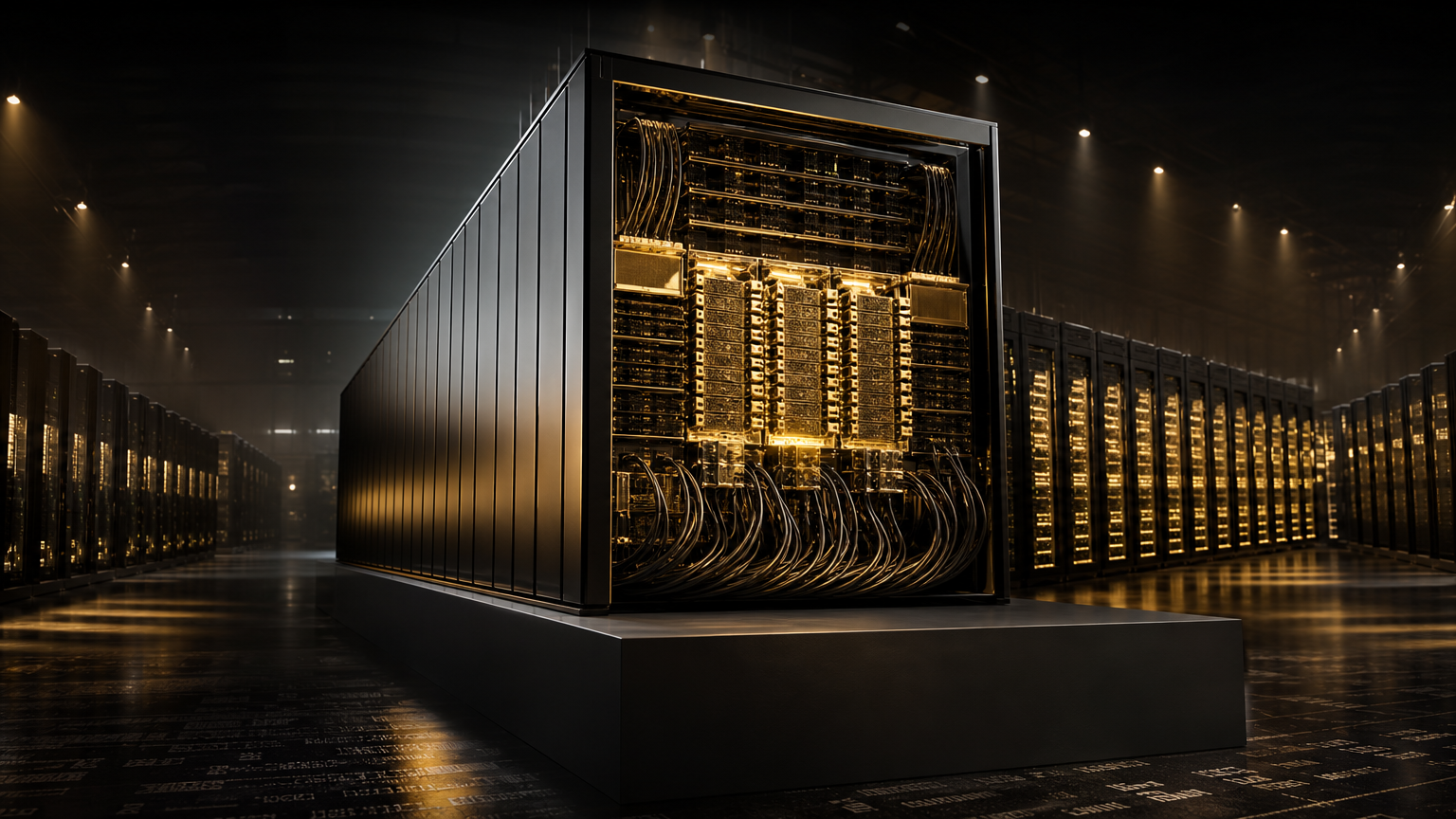
Nvidia’s answer is not only to sell faster chips. It is trying to shorten the time between capex and token production. Coverage of the Berlin keynote described Nvidia’s DSX POD concept as a way to pack Vera Rubin AI racks into transportable modules and accelerate deployment . The financial purpose is obvious: every month a GPU cluster waits for installation, power or commissioning is a month of depreciation and interest without revenue.
This is where the “AI factory” metaphor becomes more than marketing. Factories are financed against throughput. If a data center is a token factory, then schedule risk becomes credit risk. A delay in grid connection, cooling, permitting or on-site integration can damage debt-service coverage even if the customer is still waiting for the capacity.
That also explains why power and permitting have become part of the compute-cost discussion. Cheap capital cannot instantly create transformers, turbines, substations or transmission capacity. Expensive capital makes those bottlenecks more painful. The economics of AI capacity now depend on a chain that runs from GPU supply to local grid approvals to bond-market appetite.
What to watch next
The next phase of the story will be decided less by headline capex promises and more by financing terms. Watch whether neocloud bond yields stabilize below distressed levels, whether customers agree to larger upfront payments, and whether lenders accept GPUs and long-term contracts as collateral. Watch also whether hyperscalers use their balance-sheet advantage to squeeze smaller providers, or whether they keep renting external capacity because their own campuses cannot come online fast enough.
The most important question is not whether AI compute costs $50 billion, $60 billion or more per gigawatt. It is whether the revenue per gigawatt can arrive fast enough, reliably enough and at high enough margins to service the debt. At today’s yields, the answer will vary sharply by borrower.
For now, the story is clear: AI compute demand is still expanding, but the cloud has developed a very real interest bill. The next competitive edge may belong not only to whoever has the best model or the most GPUs, but to whoever can finance the factory without letting the cost of capital eat the tokens before they are produced.
Comments
Be the first to comment.