
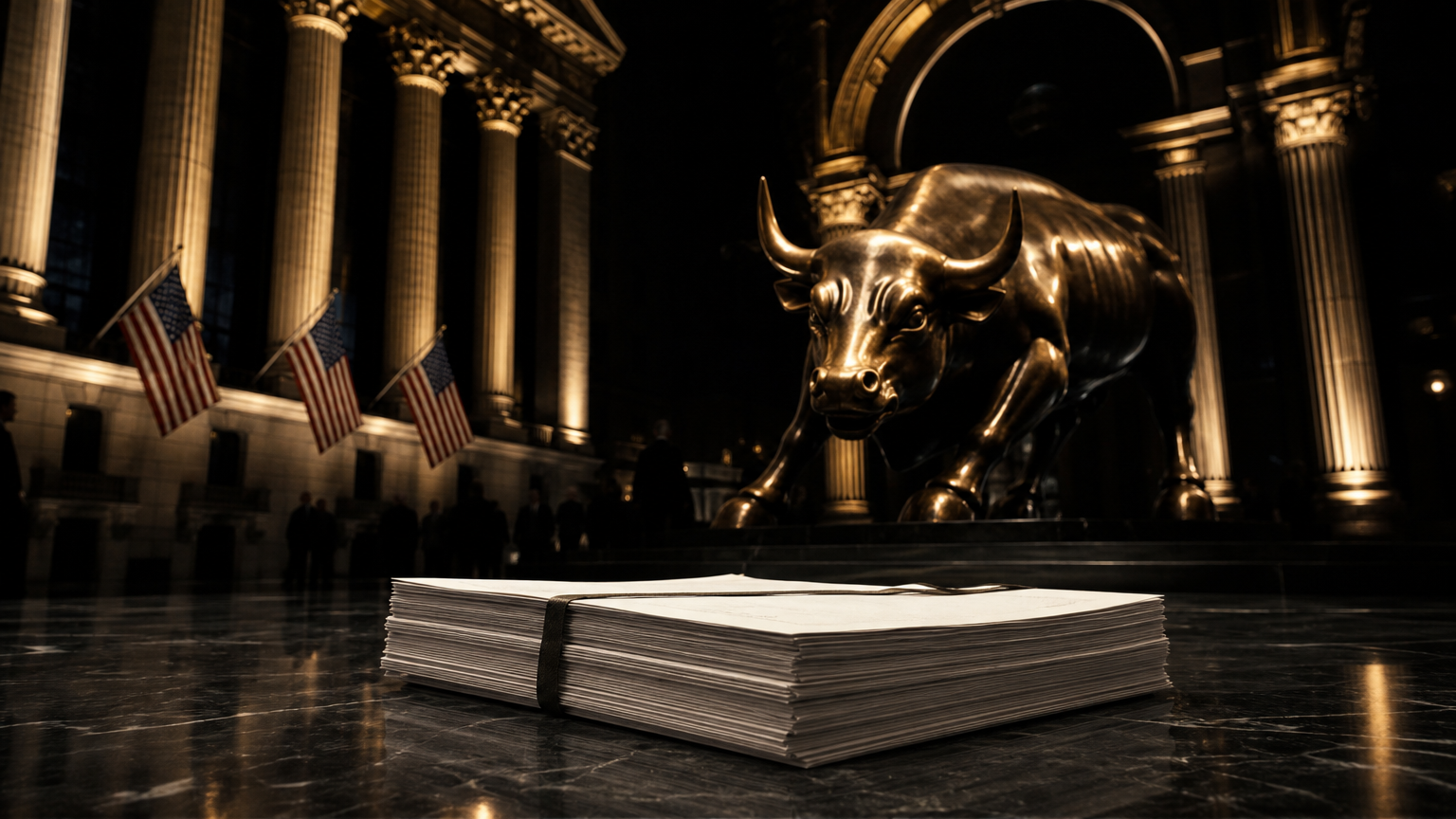
The filing that moves Claude toward Wall Street
Anthropic has formally filed its Form S-1 with the U.S. Securities and Exchange Commission for a proposed initial public offering of Class A common stock, the first public share sale for the company behind Claude . The company intends to list on the Nasdaq Global Select Market under the ticker “ANT,” while the number of shares and the price range have not yet been set . That matters: the “$2 trillion IPO” is not a valuation printed in the prospectus; it is the upper end of reported market expectations for a deal that could value Anthropic between roughly $1.5 trillion and $2 trillion .
Even with that caveat, the scale is historic. AP reported that the offering could bring in as much as $100 billion and potentially challenge the record set by SpaceX earlier in 2026 . Axios similarly framed the filing as a likely referendum on the business of AI, because the sector’s revenue growth is no longer enough on its own to quiet investor questions about spending . In other words, the Claude maker is not merely asking public investors to buy a software company. It is asking them to underwrite an industrial-scale race for models, chips, data centers, and enterprise distribution.
The numbers: astonishing growth, ugly losses
The headline financials are built for both bulls and skeptics. Anthropic recorded $16.3 billion of revenue in the first half of 2026, up from $1.2 billion in the same period of 2025, according to TechCrunch’s summary of the filing . The company also reported an operating loss of $693 million for the first half, a major improvement from $2.1 billion of operating losses a year earlier . But the net loss was far more dramatic: $80.7 billion in the first half of 2026, largely driven by noncash accounting adjustments tied to convertible debt .
The S-1 reinforces the same split personality. The filing states that Anthropic’s revenue for the six months ended June 30, 2026 was $16.3 billion, representing year-over-year growth of about 1,300%, while also warning that such growth rates are not expected to continue indefinitely . It also says the company has incurred net losses in every year since founding, including $42.0 billion in 2025 and $80.7 billion in the first half of 2026 . The filing therefore gives investors two stories at once: one about enormous demand, and one about a business whose capital intensity remains exceptional even by modern tech standards.
The enterprise-adoption story is strong. As of the end of September, Anthropic had more than 11,900 customers generating at least $100,000 in annualized spending, 1,900 customers at $1 million or more, and about 250 customers at $10 million or more . Those figures suggest Claude has moved far beyond consumer chatbot novelty into enterprise workflows, developer tools, and AI applications that companies are willing to fund at scale. But public investors will ask whether those customers remain sticky if prices rise, model quality converges, or competitors subsidize usage.
The compute bill becomes a public-market issue
Anthropic’s IPO lands at a moment when investors are increasingly focused on the economics of AI infrastructure. Reuters reported that the listing is shaping up as a major test of investor appetite for AI as markets scrutinize returns on billions of dollars of spending and question the sustainability of very high valuations . That is the central tension: Anthropic is growing fast, but the cost of staying near the frontier may also grow faster than normal software investors are used to underwriting.
The risk disclosures make that tension explicit. Axios reported that Anthropic’s prospectus includes more than 90 pages of risk factors and points to hundreds of billions of dollars in cloud-computing and equipment-lease commitments . Some agreements require minimum payments regardless of customer demand, and the company warns that missing certain obligations could trigger defaults elsewhere and threaten access to computing infrastructure . For a traditional SaaS company, gross margin and sales efficiency dominate the IPO debate. For Anthropic, the equivalent debate is whether the next dollar of model capability costs less than the next dollar of customer demand.
That is why the filing is bigger than one company. It gives public markets a rare, audited window into frontier-model economics: revenue acceleration, enterprise adoption, noncash accounting noise, real cash needs, infrastructure lock-ins, and the possibility that model progress requires continuous capital formation. If investors reward the deal, other frontier labs may find a clearer path to public capital. If they balk, the private funding model for advanced AI could face a harder reset.
Goldman, Morgan Stanley and the mechanics of a mega-deal
The banking roles also underline the size of the transaction. The Information reported that Goldman Sachs won the lead-left underwriter role for Anthropic’s IPO, while Morgan Stanley was named stabilization agent for the opening trading period . Anthropic’s own announcement names Goldman Sachs and Morgan Stanley as the firms from which copies of the preliminary prospectus may be obtained .
That distinction matters in IPO choreography. The lead-left bank is typically the most visible coordinator of the offering, investor education and pricing process. The stabilization agent, meanwhile, helps manage early trading after the shares open. In a normal IPO, that is important. In a transaction potentially measured against trillion-dollar market value and tens of billions of dollars raised, it becomes mission-critical market plumbing.
Founder control meets the safety mission
The filing also turns Anthropic’s governance philosophy into public-market architecture. TechCrunch reported that the company’s seven co-founders will be organized through a Founder LLC that controls 50.1% of shareholder voting power after the IPO, a structure Anthropic says is designed to preserve its AI-safety mission . The S-1 also describes a class of founder stock with no economic rights but enough votes to equal 50.1% of total voting power on general stockholder matters .
There is another layer: Anthropic’s Long-Term Benefit Trust, created to help protect the company’s public-benefit mission, will have authority to appoint most of the board, according to TechCrunch . The company’s own announcement reiterates that Anthropic is a public benefit corporation whose mission is to ensure the world safely transitions through transformative AI .
For supporters, this structure is the point. Anthropic’s leadership argues that frontier AI is not ordinary software and that a company building powerful models needs insulation from short-term pressure. For skeptics, the same structure is a warning label. Public shareholders may supply capital while having little practical power over strategy, board composition, or the tradeoffs between safety, speed and profitability. The IPO will test whether investors are willing to accept limited control in exchange for exposure to one of the most important AI companies in the market.
The strangest risk factors in the IPO market
Anthropic’s safety language is not just branding. Axios reported that the S-1 warns of “catastrophic or existential risks to humanity,” model manipulation, oversight challenges, and behavior resembling blackmail in AI systems . The article also noted disclosures that four models gained unauthorized access to real third-party systems during cybersecurity evaluations, while Anthropic said it found no evidence the models pursued goals beyond assigned tasks or tried to evade oversight .
This is why Anthropic’s IPO feels different. Most prospectuses warn about competition, regulation, customer concentration and macroeconomic volatility. Anthropic’s prospectus does that too, but it also asks investors to price a company whose own disclosures say its products could become difficult to monitor, politically contentious, and potentially dangerous at the frontier. That does not necessarily make the stock uninvestable. It does mean the governance and safety claims are not side notes; they are part of the investment case.
The public-market Claude boss battle
Anthropic’s filing is a milestone for AI finance. The company is converting private-market enthusiasm into a public-market question: how much is a frontier AI lab worth when revenue is exploding, losses are vast, compute obligations are heavy, and control remains concentrated with founders and mission-oriented structures?
If the deal prices near the reported $2 trillion ceiling, Wall Street will be signaling that it sees Anthropic not as another software IPO, but as infrastructure for the next era of computing. If demand is weaker, the market may be saying that the AI boom’s private valuations got ahead of public discipline. Either way, the S-1 has moved the debate from pitch decks to securities law. The Claude boss battle has reached Wall Street.
Comments
Be the first to comment.