
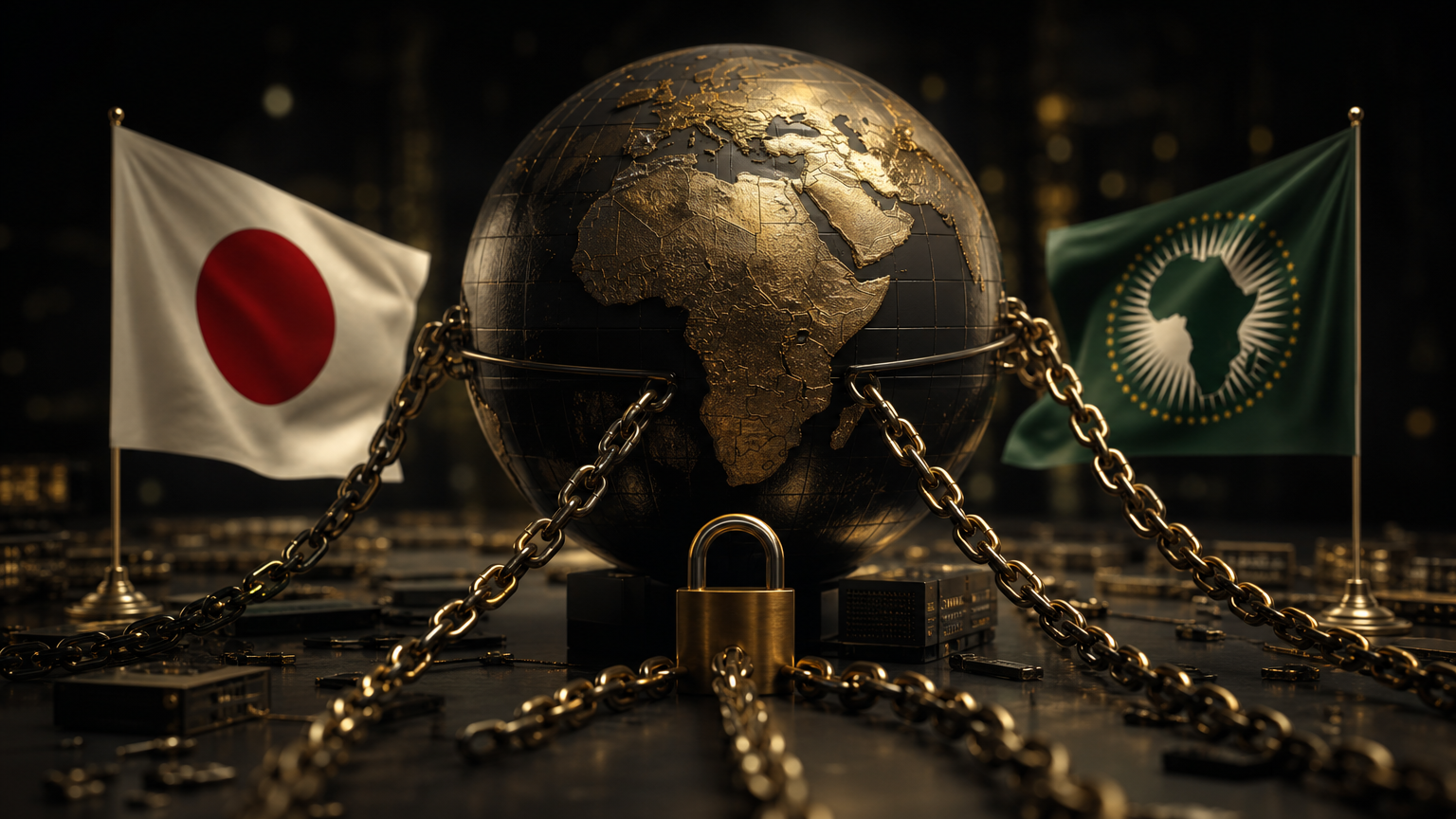
A cyber week with two fronts
Japan and Africa are intensifying cyber defense from different directions: Tokyo is preparing an emergency package against cyberattacks, while Operation Serengeti III has disrupted 10,909 malicious networks across a 21-country law-enforcement sweep in and around Africa . The shared message is clear. Governments are no longer treating cyber incidents as isolated IT problems. They are treating them as operational, economic and public-security risks that require central coordination.
In Japan, the immediate trigger is a wave of unauthorized-access incidents and large-scale personal-data exposures. Prime Minister Sanae Takaichi’s government plans to compile an emergency cybersecurity package next week, and Chief Cabinet Secretary Minoru Kihara said ministers would meet at the prime minister’s office to discuss the response . In Africa, the latest reported disruption is enforcement-led: authorities arrested 1,462 suspects, disabled 10,909 malicious networks and recovered more than $105 million in illicit funds during Operation Serengeti III .
These are different tools for the same strategic problem. Japan is trying to close gaps before the next major incident. African and international partners are trying to break the criminal infrastructure already monetizing those gaps.
Japan moves from review to emergency packaging
The most important detail in Tokyo’s announcement is not only the word “cybersecurity”; it is the timetable. A package expected next week implies a government that sees a need for near-term action, not a long consultative cycle. According to current reporting, the package is expected to focus on stronger coordination among ministries and agencies, improved incident response and closer public-private cooperation, although the final contents have not yet been made public .
That matters for companies because emergency packages often become procurement signals. Even before binding rules arrive, public agencies, telecom providers, logistics firms, software vendors and critical-infrastructure operators can infer where government expectations are heading: faster reporting, better identity controls, tighter monitoring, stronger patch discipline and more structured cooperation with authorities.
Japan has already begun implementing legislation to strengthen cyber defense capabilities. Current reporting says provisions that took effect on October 1 support closer public-private coordination and allow authorities, under defined conditions and oversight, to neutralize malicious cyber infrastructure, with broader monitoring planned for 2027 . The emergency package is therefore likely to sit on top of an already changing legal and operational base rather than starting from zero.
The Sagawa case shows why urgency is rising
The Sagawa Express incident explains why the issue has moved beyond abstract policy. The company said on October 23 that unauthorized access to its parcel-tracking service may have exposed up to approximately 53.23 million personal-information records, including duplicates . Sagawa emphasized that the figure does not represent the actual number of affected individuals, because shipping-label data can contain many repeated names, addresses and phone numbers .
The type of data matters. Names, addresses and phone numbers may not look as immediately dangerous as passwords or payment-card details, and Sagawa said credit-card information and passwords were not included . But delivery-related data is highly useful for phishing, impersonation and social engineering. A scammer who knows that someone recently sent or received a package has a ready-made pretext for a fake delivery message, a bogus customs fee, a malicious tracking link or a fraudulent address-change request.
Sagawa also said it had resumed its internet package inquiry service after safety checks, while several related services remained suspended, including the package inquiry API and some online reception and address-change services . That mix of partial restoration and continued suspension is a familiar cyber-recovery pattern: restore the most visible service when confidence is sufficient, but keep riskier or more complex interfaces offline until the investigation and controls catch up.
For Japan’s emergency package, this is the practical policy question: how quickly can the state raise baseline security across services that millions of citizens use but that are operated by private firms? Logistics, payments, identity, healthcare, telecoms and cloud services all sit in the uncomfortable space between commercial convenience and national resilience.
Africa’s operation targets the criminal supply chain
Operation Serengeti III shows a different model: disrupt the criminal supply chain. According to current reporting, the operation ran from June 29 to August 31, 2026, involved agencies in 21 countries, and targeted fraud, ransomware, extortion, phishing, business email compromise and other cyber-enabled crimes [4]. Authorities identified 65,929 victims and tied the networks to more than $385 million in losses [4].
The scale is important, but the composition is more important. Cybercrime is not one activity. It is a stack. One group may run phishing pages, another may provide stolen credentials, another may launder funds, another may rent infrastructure, and yet another may operate call centers or social-media scam funnels. Taking down nearly 11,000 malicious networks is therefore not just about seizing servers. It is about interrupting the services that make fraud scalable.
Country examples show the range. Reporting on the operation describes two cross-border fraud rings dismantled in Uganda, illegal crypto-mining centers and more than 2,000 mining devices seized in Angola, and Nigerian investigations involving phishing, business-email compromise and suspected crypto laundering [4]. Other cases involved mobile loan-app fraud in Tanzania and vehicle-import scams in Gabon [4].
This is why cross-border cooperation is not optional. A victim may be in one country, the fake investment platform in another, the call center in a third, the domain registrar elsewhere and the proceeds converted through digital assets. No single national police force can see the whole chain without shared intelligence.
Private intelligence becomes part of public defense
Both stories point to a more blended cyber-defense model. In Japan, the emergency package is expected to emphasize closer cooperation with private companies . In Africa, private cybersecurity firms helped investigators with analysis of suspicious domains, IP ranges and command-and-control infrastructure, according to reporting on Operation Serengeti III .
That is not just a resourcing issue. Private firms often see malicious infrastructure before governments do because they monitor networks, endpoints, fraud patterns, malware telemetry and customer incidents at scale. Governments, in turn, have powers that private firms do not: arrests, warrants, seizures, diplomatic channels and legal coordination.
The strongest cyber-defense systems increasingly combine both. The private sector supplies visibility and speed; the state supplies authority and continuity. The weakness is accountability. When emergency powers expand, or when intelligence moves quickly between companies and authorities, oversight, transparency and data-protection rules need to be equally clear.
The risk after disruption: rapid reconstitution
The African takedown is significant, but it is not final. Cybercrime groups often rebuild. They migrate domains, replace mule accounts, rebrand scam pages, recruit new operators and shift to jurisdictions where pressure is lower. Reporting notes that investigations are continuing, with authorities still tracing proceeds and analyzing seized devices [4].
That makes asset recovery and follow-up prosecutions as important as headline arrest numbers. Arrests interrupt operations; seizures reduce incentives; prosecutions create deterrence; victim notification limits secondary harm. Without all four, criminal networks can treat enforcement as a temporary outage.
Japan faces a parallel problem on the defensive side. Announcing an emergency package is useful only if it changes behavior inside agencies and companies. The package will need measurable effects: clearer incident-reporting expectations, faster vulnerability remediation, better identity and access management, tested crisis playbooks, and procurement rules that reward secure-by-design systems rather than lowest-cost deployment.
What to watch next
The next milestone in Japan is the actual package expected next week. The key questions are whether it creates new obligations for private operators, whether it adds funding, whether it centralizes incident command in practice, and how it balances active defense with civil-liberties safeguards . Companies should watch not only the text of the package but also procurement notices, sectoral guidance and regulator statements that follow.
For Africa, the question is whether Operation Serengeti III produces durable disruption. The most important follow-up indicators will be prosecutions, extraditions, frozen or forfeited assets, victim restitution, new intelligence-sharing mechanisms and evidence that dismantled infrastructure does not simply reappear under new names.
Together, these developments show cyber defense becoming more operational. Japan is compressing policy time. African and international partners are compressing enforcement time. In both cases, the old model of reacting after damage is giving way to faster intervention. The challenge now is to make that speed repeatable, lawful and resilient.
Comments
Be the first to comment.