
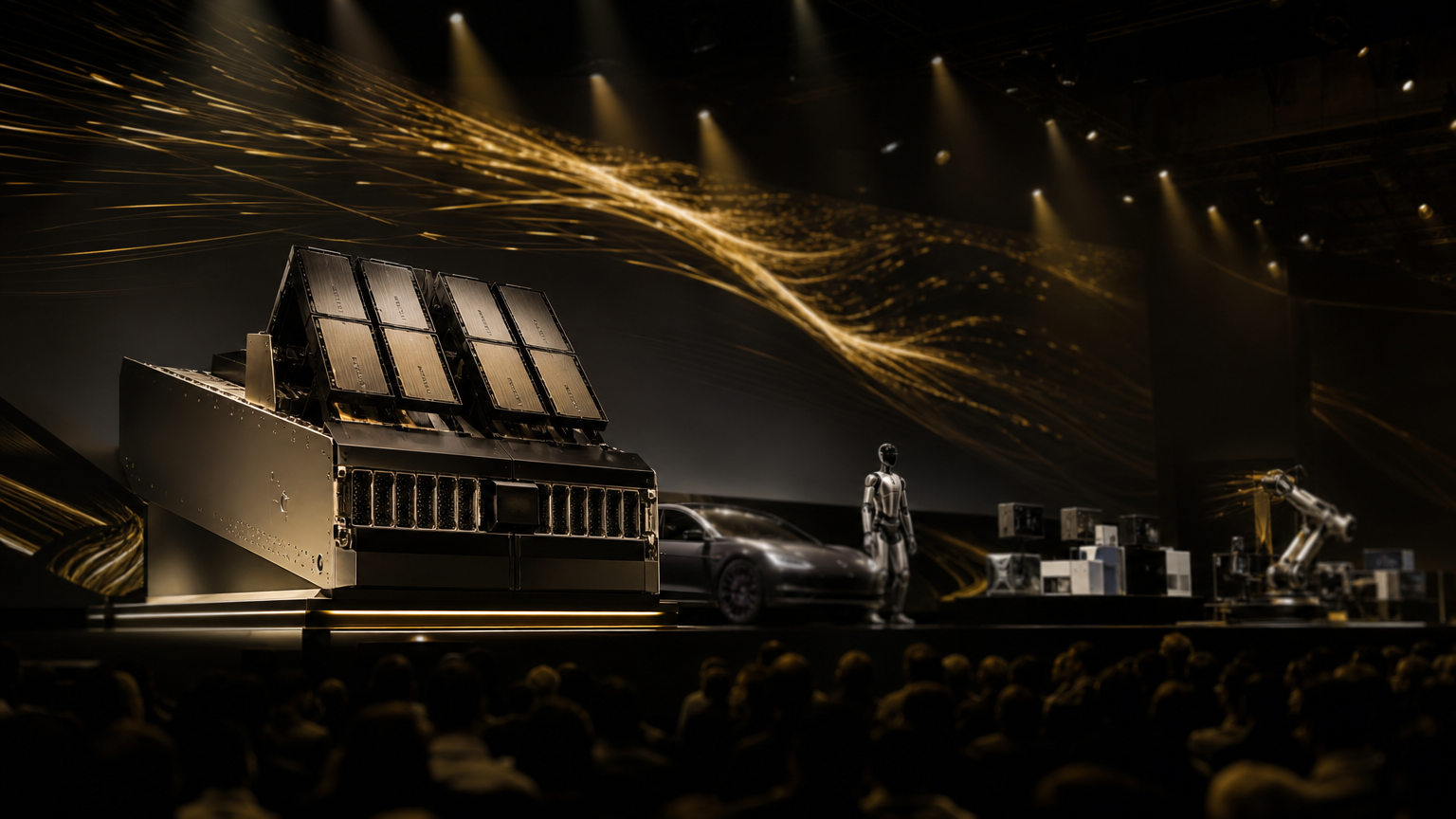
A keynote about infrastructure, not just chips
Jensen Huang’s GTC Berlin 2026 message was deliberately broader than a chip launch. The company presented itself as the builder of the rails for an AI economy: data-center systems, agent software, robotics tooling, automotive platforms, telecom infrastructure and personal AI devices. Reporting from the event described Berlin as the finale of a wider European tour in which Huang met political and industry leaders, announced products, and framed Europe as both a customer and a potential producer of AI capacity .
The central idea was that AI has become an industrial system. In that framing, GPUs are only one layer. NVIDIA wants the market to see energy, accelerated computers, networking, systems software, models, applications and developer tools as one production chain. This is why the keynote’s highlights ranged from containerized data centers to small robot ducks: each example supported the same claim that intelligence will be manufactured, deployed and customized across the economy .
DSX POD and the race to compress data-center time
One of the most important announcements was the DSX POD concept: a way to package multiple Vera Rubin AI racks into a shipping-container-like form factor that can move on normal roads and be deployed faster than conventional AI data centers. CNBC’s on-the-ground report said Huang described a system that packs seven Vera Rubin AI racks into a transportable container, with the goal of bringing compute online more quickly at a time when demand is high and delays can destroy revenue .
That message matters because the bottleneck is no longer only silicon supply. Power, permits, construction schedules, debt markets and integration delays are all part of the AI buildout. Huang told attendees that a 1-gigawatt data center can cost about 50 billion dollars, while Goldman Sachs estimates AI-related capital spending could reach about 7.6 trillion dollars from 2026 through 2031 across compute, data centers and power . In other words, the keynote was as much about industrial logistics and financing as it was about model performance.
Neoclouds, capital and the collateral argument
The Berlin conversation also took place against a more nervous market backdrop. Reports from the conference noted a selloff in public neocloud stocks and concerns that companies leasing AI compute are carrying heavy financing burdens . Huang’s response was to separate demand from financing: he argued that demand for neocloud capacity remains “off the charts,” while working capital is the constraining variable .
That argument connects to another post-keynote theme: NVIDIA hardware as a financeable asset. In a Berlin-side interview, Huang described NVIDIA accelerators as productive, durable and fungible, arguing that they can remain useful for eight years or more and could be treated by lenders as high-quality collateral . The claim is strategic. If banks and infrastructure investors accept AI systems as durable assets rather than short-lived computer equipment, the cost of capital for AI factories could fall. If they do not, the AI revolution may be slowed by balance sheets rather than by software.
Agents need a security model
Huang’s keynote also pushed the idea that AI agents are becoming a new computing platform. But the more autonomy agents receive, the more dangerous ordinary software assumptions become. A post-conference account of Huang’s Q&A highlighted his emphasis on limited permissions, zero trust and continuous monitoring for production agents .
That is the context for OpenShell and NVIDIA’s agent-safety pitch. A fresh report after GTC Berlin said Huang outlined a roughly 2,000-dollar-per-GPU annual fee for software designed to run agents on AI factories, positioning it below NVIDIA AI Enterprise’s 4,500-dollar subscription while noting that details such as timing and exact product coverage remained unconfirmed . The takeaway is that NVIDIA sees a software revenue layer above the hardware layer. If AI factories are built to run agents, then identity, isolation, observability and policy enforcement become monetizable infrastructure.
Physical AI: cars, humanoids and Microduck
The most shareable moment of the keynote was small, but the strategic point was large. Huang ended with Microduck robots, using them to demonstrate the bridge from simulation to physical movement. Reports say the robots were prepared with NVIDIA’s simulation and robotics tools, trained in the cloud, checked on an RTX Spark system, and then transferred to physical devices .
Microduck also showed why physical AI is becoming more accessible. Coinfea reported that the robot is 25 centimeters tall, weighs 800 grams, uses 15 motors, has a camera, LiDAR and inertial sensors, and ships with seven trained moves; the software is described as open source under Apache 2.0, and the robot is priced at 399 dollars before taxes and shipping . The preorder number was more nuanced than some headlines suggested: Hugging Face CEO Clément Delangue had said Microduck was likely to cross 20,000 total preorders, which was a forecast rather than a confirmed delivery count .
The demo’s deeper purpose was to make robotics look like a software workflow. Simulate, train, validate, deploy, repeat. That is the same logic NVIDIA is applying to humanoids, vehicles, industrial automation and digital twins. The “cute robot” moment worked because it made a complex stack legible.
Personal AI and RTX Spark
Another thread was the shift from cloud-only AI to local AI machines. Reports from Berlin said Huang discussed RTX Spark systems and compared their one-petaflop performance and 128GB memory profile with the DGX-1 system he delivered to OpenAI in 2016, emphasizing that the newer capability could be held in one hand rather than carried by two people .
That comparison was not just showmanship. It captured NVIDIA’s full-stack ambition at the personal-computing edge. If developers can prototype agents, train robot policies, run simulations and evaluate models locally before bursting to cloud systems, NVIDIA’s platform extends from hyperscale AI factories down to laptops and workstations. The company is trying to make the AI stack continuous: desk, cloud, data center, robot and car.
Europe as market, factory and test case
Europe was more than a backdrop. Huang’s message was that the region should not merely consume AI built elsewhere; it should build infrastructure, models and applications around its own industries. A post-GTC reflection by Tobias Zwingmann summarized one of Huang’s transformation lessons as the need to become excellent users of AI and to explore capabilities that were previously impossible, rather than only using AI to do the same work faster .
That distinction is critical for Europe’s industrial base. Manufacturing, medicine, telecom, automotive and energy do not become AI-native by adding chatbots to existing workflows. They change when simulation, agents, robotics and domain models alter what teams can design, test and operate. Huang’s “responsible optimism” message, also noted in the Q&A reflection, was that leaders need to describe a future people want while taking concerns about safety, energy, jobs and society seriously .
The real highlight: NVIDIA wants to be the AI economy’s firmware
The keynote’s highlights can be listed as DSX POD, OpenShell, agent software, RTX Spark, robotics, Microduck and European AI infrastructure. But the larger story is simpler: NVIDIA is trying to become the default substrate for the next computing era.
That is why Berlin mattered. Huang did not present AI as a single app wave or a model race. He presented it as a new industrial revolution that needs factories, financing, guardrails, local devices, robots and regional ecosystems. The strongest interpretation of GTC Berlin 2026 is that NVIDIA wants to own the interfaces between all of them. If AI is upgrading the future’s firmware, Huang’s pitch was that NVIDIA should write the kernel.
Comments
Be the first to comment.