
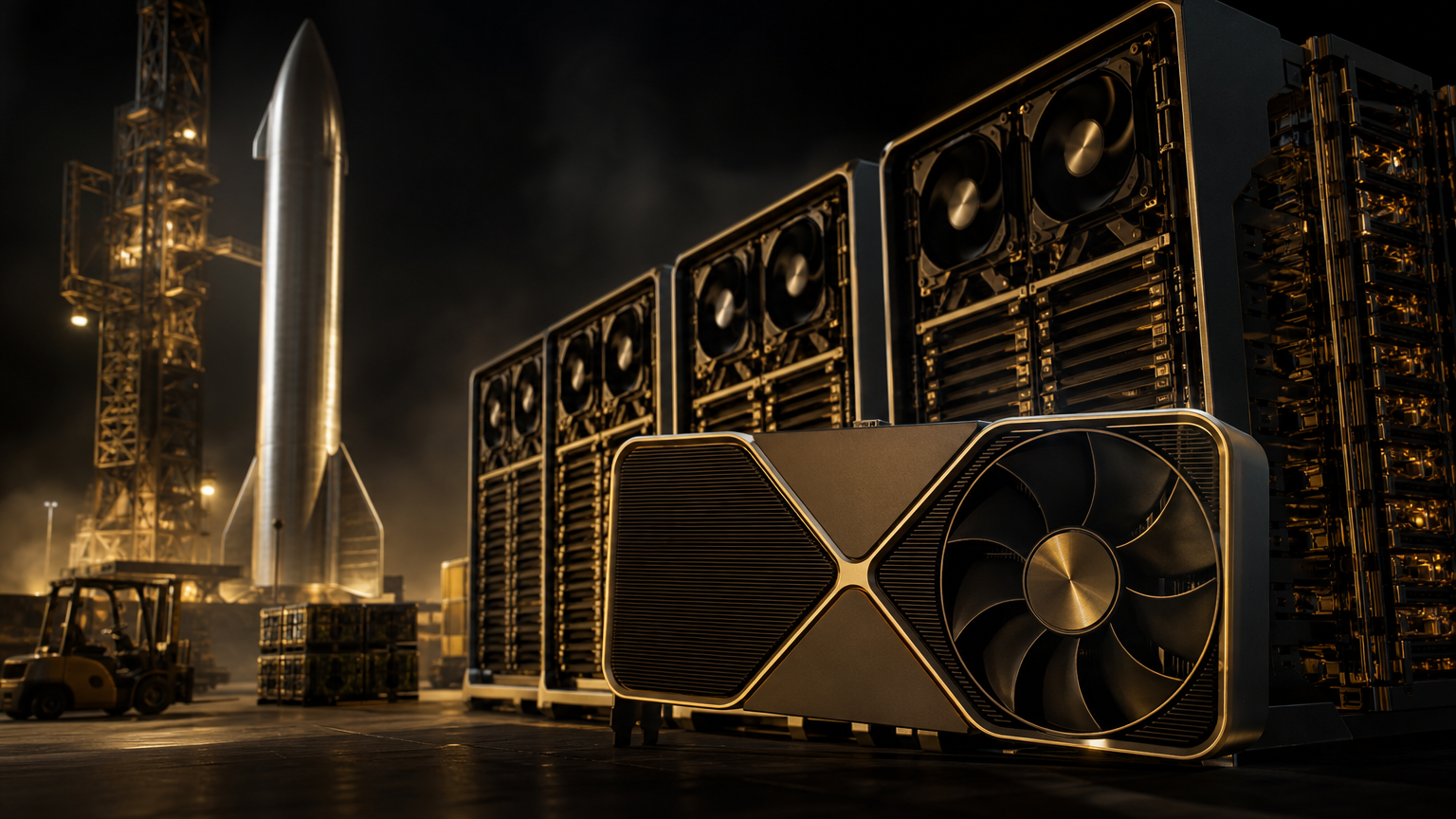
The deal Musk says is done
SpaceX has moved from “seeking” a giant AI-chip financing package to “closed,” at least in Elon Musk’s own public framing. Reuters reported that Musk said SpaceX had closed $40 billion in debt financing for graphics processing units, tying the successful raise to the company’s investment-grade status and to revenue from Starlink and rocket launches . Fox Business separately reported that Musk said SpaceX had secured the money for GPUs used in its artificial intelligence operations, again emphasizing that the company has revenue streams outside AI data centers .
That distinction is the core of Musk’s argument. He is not presenting SpaceX as another pure AI cloud renter with a warehouse full of accelerators and an urgent need to fill utilization. He is presenting it as a diversified infrastructure company whose satellite broadband and launch businesses can support a massive compute buildout . In that sense, the deal is less a simple chip order than a statement about what kinds of companies can still borrow at scale in the AI boom.
Musk also clarified the timing and form of the financing. Reuters reported his follow-up post saying the package is “primarily callable debt” for GPU purchases expected to arrive in the first and second quarters, and that it is not a major factor for the current quarter . Fox Business likewise reported that the GPUs are expected in the first half of 2027 . Callable debt gives a borrower the right to repay early under defined terms, a feature that could matter if GPU economics, interest rates or refinancing conditions shift before the hardware is fully deployed.
A closed deal, but not a fully transparent one
The most important caveat is that “closed” is doing a lot of work. Reuters noted that it was not immediately clear from Musk’s post what he meant by the deal being closed or whether investors had agreed to pricing for the debt . Bloomberg, carried by Yahoo Finance, reported that final pricing discussions for SpaceX’s off-balance-sheet $40 billion chip-financing structure had been caught in recent neocloud-market turmoil .
That leaves a careful reading: Musk says the financing is closed, but outside reporting still points to unanswered details around pricing, documentation and the exact meaning of closing. For a deal of this size, those details are not clerical. Pricing determines the hurdle rate the GPUs must clear; maturity and amortization determine how quickly compute revenue must arrive; collateral and recourse determine whether risk sits mainly with a special vehicle or eventually with SpaceX itself.
Bloomberg reported that bankers led by Goldman Sachs had been discussing the structure with investors led by Apollo Global Management, with Apollo-backed Atlas SP slated to manage the entity, and that PIMCO had also considered investing . Bloomberg also reported that the debt was expected to be issued as private placements under Rule 144A . That points to a sophisticated institutional financing rather than a conventional corporate bond.
Why off-balance-sheet treatment matters
The structure matters because AI infrastructure is becoming as much a credit-market story as a technology story. Bloomberg reported that the contemplated structure was designed as an off-balance-sheet deal to pay for Nvidia GPUs . The point of such a structure is typically to isolate assets, cash flows and obligations in a vehicle separate from the parent company’s main balance sheet. In theory, that can help preserve ratings and keep borrowing capacity available.
But off-balance-sheet treatment is not automatic. Bloomberg drew a comparison with an earlier xAI-related financing attempt in which an entity sought as much as $20 billion of off-balance-sheet debt through a sale-leaseback arrangement, but SpaceX ultimately had to record about $13 billion after the transaction was deemed a failed sale-leaseback arrangement in SpaceX’s latest earnings report . That history explains why investors will care not only about the headline $40 billion figure but also about legal form, accounting treatment and recourse.
If the financing works as designed, SpaceX can fund a massive GPU order without making its main balance sheet look dramatically more leveraged. If it does not, the economics may migrate back toward SpaceX. That is why the unresolved pricing and structure questions are central rather than secondary.
The AI buildout has become terrestrial infrastructure
The irony is obvious: a company famous for rockets, reusable boosters and satellite constellations is now making one of the largest dedicated bets on very terrestrial compute infrastructure. Reuters reported that the financing underscores the soaring cost of building AI computing capacity . Fox Business made the same point, saying the funding highlights the enormous sums companies are spending to build AI computing capacity .
The numbers around SpaceX’s own spending plans reinforce that point. Reuters reported that SpaceX expects $35 billion to $40 billion in capital expenditure in the fourth quarter, citing Chief Financial Officer Bret Johnsen . Reuters also reported that SpaceX’s revenue climbed 161% year over year to $14.58 billion for the three months ended September 30, while AI revenue rose almost tenfold to $7.56 billion . Those figures suggest that AI compute is no longer an experimental side project inside SpaceX; it is becoming a major financial engine alongside Starlink and launch.
This is also why Nvidia is central to the story. Reuters reported earlier in October that SpaceX had been in talks with banks and asset managers to raise $40 billion for Nvidia artificial-intelligence chips . Bloomberg reported that the debt raise was meant to pay for Nvidia GPUs . For Nvidia, the implication is not merely another large customer order. It is evidence that the next leg of AI demand may increasingly depend on elaborate financing structures, not only on cash-rich hyperscalers writing checks from operating cash flow.
Musk’s warning to neoclouds
Musk used the announcement to draw a sharp line between SpaceX and specialist AI-cloud providers. Reuters reported that Musk said debt markets had “almost entirely shut off access to money” for companies without substantial revenue independent of AI data centers . Fox Business reported the same warning and said Musk predicted that more than 200 neoclouds could face “death and consolidation,” with only some surviving .
The strategic message is blunt. SpaceX can borrow, Musk argues, because it has Starlink and launch revenue. Neoclouds that depend mainly on renting AI compute may find that lenders now want more than growth projections, chip collateral and future utilization assumptions. In a tightening credit market, recurring non-AI cash flow becomes a financing advantage.
Musk also said SpaceX would not buy any neoclouds, calling such acquisitions pointless, according to Bloomberg’s account carried by Yahoo Finance . That comment narrows the interpretation of his warning: he is not presenting the credit squeeze as a shopping opportunity for SpaceX, but as a structural separation between diversified platforms and narrower compute lessors.
The real test comes in 2027
For now, the deal is a milestone in the financialization of AI infrastructure. The GPUs are expected in the first half of 2027, so the operational test lies ahead . SpaceX will need to convert silicon into high-utilization compute, compute into durable revenue, and revenue into debt service fast enough to justify the scale of the financing.
The headline is therefore both simple and complicated. Simple: Musk says SpaceX closed $40 billion of debt for GPUs. Complicated: reports still leave open questions about pricing, structure and what “closed” means in practice . If SpaceX’s diversified revenue truly gives it cheaper and more reliable access to AI capital, the company has just strengthened its position in the compute race. If the economics depend on optimistic utilization, fast-changing GPU values and fragile credit markets, the financing could become a test of whether even orbital economics now require a mountain of CUDA cores on Earth.
Comments
Be the first to comment.