
The headline, carefully read
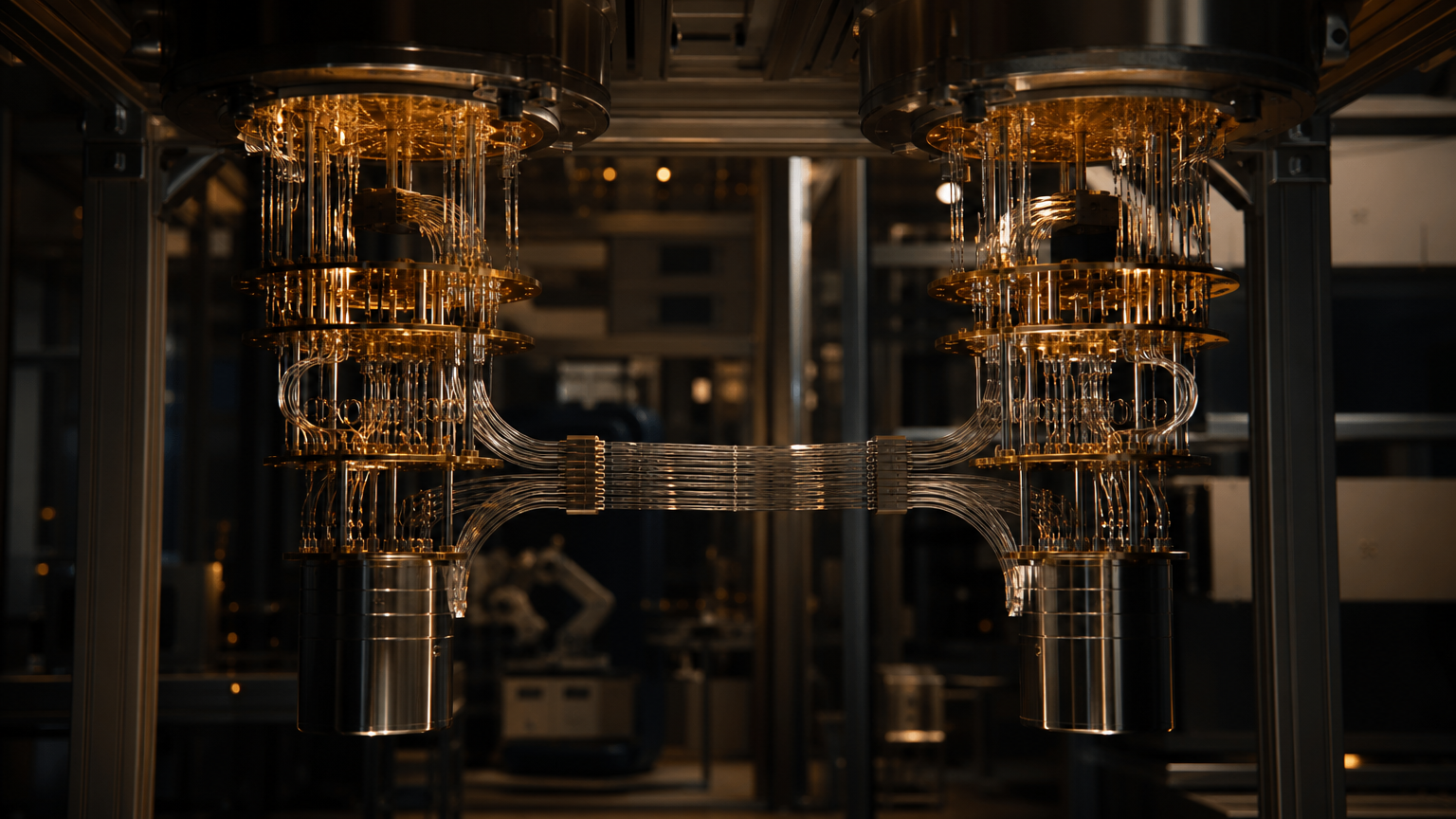
IBM’s new result is best understood as a scaling experiment: two 120-qubit IBM Nighthawk R1 superconducting processors were linked through four long-distance couplers, or L-couplers, built with superconducting aluminum coaxial cables about 80 centimeters long . The reported average state-transfer fidelity across the four links was 99.00%, with the best link reaching 99.29% with a 0.07 percentage-point uncertainty . ScienceAlert’s coverage framed the same point in plainer language: IBM connected two 120-qubit chips and moved quantum information between them with 99% average transfer accuracy .
That does not mean IBM has suddenly delivered a useful 240-qubit fault-tolerant computer. The processors together contain 240 physical qubits, but the experiment wired and measured only selected qubits near the interconnects, not all qubits across both chips . The significance is narrower and more important: IBM has shown that large superconducting processors can be connected through multiple cryogenic links while preserving quantum states well enough to make modular scaling look credible .
Why modularity matters
Quantum hardware teams face an uncomfortable engineering limit. Bigger monolithic chips are attractive on paper, but as chips grow, yield, wiring density, packaging, heat load, crosstalk and calibration complexity become harder to control. A modular architecture attacks the problem differently: build smaller processors, test and package them, then connect them into a larger machine with quantum interconnects.
That is why the 99% state-transfer number matters. If a quantum state cannot move between modules without being badly degraded, then a multi-chip quantum computer is just a collection of isolated devices. IBM’s L-couplers are meant to become the internal plumbing that lets separate processors behave like parts of one machine . Quantum Zeitgeist described the result as a foundation for building larger systems from smaller modules rather than relying only on monolithic designs .
The link distance also matters. Eighty centimeters is short by networking standards, but long inside a cryogenic quantum computer. The cable length reflects the mechanical reality of routing between modules, cooling hardware and control wiring inside a dilution-refrigerator environment . This is not a quantum internet link; it is a machine-room-scale interconnect for processors that are meant to sit inside the same cold system.
What IBM actually demonstrated
IBM’s test used four L-couplers between the two Nighthawk R1 processors. Each coupler connected qubits on opposite modules through frequency-tunable L-qubits, tunable couplers and superconducting aluminum coaxial cable . The links operated near 5 GHz and had internal quality factors between 0.86 million and 1.09 million, according to the reported measurements .
The core benchmark was relay-based quantum state transfer. All four links reached at least 98.86% fidelity, and the average was 99.00% . The team also used the links to build controlled-Z, or CZ, gates between lattice qubits on separate processors . Those cross-module gates were harder than the raw state transfer because they combined multiple operations, including two state transfers, local two-qubit gates and single-qubit controls .
That extra circuit depth showed up in the numbers. The distant CZ gates averaged 94.75% fidelity, with the best reaching 96.42% with 0.28 percentage-point uncertainty . Quantum Zeitgeist highlighted the same contrast: state transfer was near 99%, while distant inter-module operations landed at 94.75% on average . In other words, IBM’s quantum “SLI” moment can move states cleanly, but the full act of computing across the link still carries a visible penalty.
Entanglement crossed the cable too
The experiment went beyond moving a state from one side to the other. IBM used the distant gates to generate entangled states spanning the two processors, including Bell pairs and larger GHZ states . The team also demonstrated simultaneous Bell-pair generation through adjacent L-couplers, which matters because a practical modular system needs multiple links operating in parallel rather than a single carefully tuned channel .
The measured entanglement fidelities were lower than the state-transfer figure. The four-qubit GHZ state was reported at 77.23% before readout mitigation and 91.70% after mitigation, while the six-qubit GHZ state reached 67.67% before mitigation and 90.87% after mitigation . Those numbers should be read cautiously: readout mitigation corrects the analysis of measurement errors, but it does not magically improve the underlying physical operation. Still, IBM reported that the states exceeded the relevant thresholds for genuine entanglement even before mitigation .
The engineering lesson: cables are quantum components now
One of the most interesting parts of the result is not the qubit count but the packaging. IBM attached the cables perpendicular to the processor surface, a geometry intended to support denser future wiring than earlier parallel cable-to-chip approaches . The cable-to-chip joins used indium-to-indium pressure bonds made at room temperature after the processor modules had been mounted .
The links also survived three warm-up and cool-down cycles without adjustment . That is a practical detail, but an important one. A modular quantum computer will need maintenance, replacement and repeated thermal cycling over its lifetime. If the links only work once in a laboratory assembly, they are not yet a scalable technology.
IBM also found a problem that future systems must solve: the aluminum cables were sensitive to magnetic fields during cooldown into the superconducting state . The Quantum Insider report noted that magnetic shielding around the cables was needed, and that the shielding braid used in the experiment was described as a temporary solution . ScienceAlert likewise flagged magnetic interference and efficiency improvements as remaining work before L-couplers are ready for deployment at scale .
What this does not prove
The result does not prove fault-tolerant quantum computing. It does not demonstrate a useful multi-chip quantum algorithm. It does not show that hundreds of modules can be linked with the same fidelity, nor that the cross-module gate error is already low enough for large-scale error-corrected workloads.
The distinction between state-transfer fidelity and cross-module gate fidelity is essential. A 99% transfer sounds excellent, but a useful distributed quantum computer must repeatedly perform gates, entangle logical qubits, correct errors and route information across many links. IBM’s own reported distant CZ average of 94.75% shows that the link is only one layer of the stack .
Still, the experiment moves a major bottleneck from “can this be done between large chips?” toward “how repeatably, densely and cheaply can it be manufactured?” That is progress. The result makes modular superconducting quantum hardware feel less like a roadmap diagram and more like an engineering program with measurable parts.
The bottom line
IBM has not delivered a 240-qubit fault-tolerant machine. It has linked two 120-qubit processors with four superconducting interconnects, transferred quantum states at 99.00% average fidelity, performed cross-module CZ gates at 94.75% average fidelity, and demonstrated entanglement across the processors . That is a meaningful hardware milestone because future useful quantum machines are likely to need modularity, and modularity needs interconnects that do not destroy the information they carry.
The next question is whether IBM can turn four working links into many reproducible links, improve cross-module gate fidelity, control magnetic sensitivity, and integrate the approach into error-corrected architectures. For now, the takeaway is simple: quantum scaling is no longer only about adding qubits to one chip. It is also about making the cables count.
Comments
Be the first to comment.