
A chip deal with an equity twist
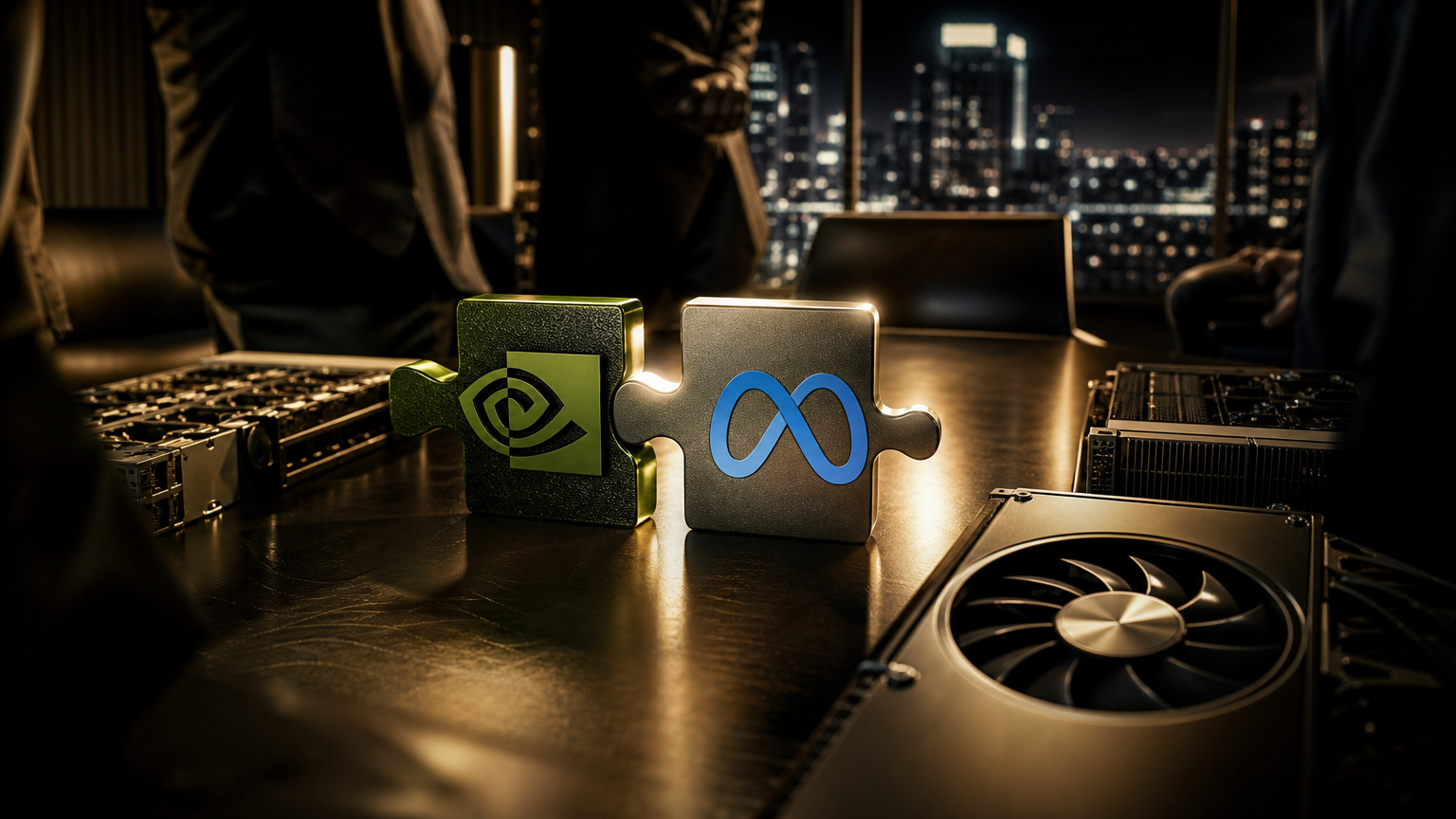
Nvidia and Meta have moved beyond the familiar seller-buyer relationship in AI chips. In a new announcement, Nvidia said it will invest $3 billion in Meta’s equity offering while the two companies expand collaboration around Meta’s Muse assistant and the broader Muse family of AI models . Reuters, in a report published Tuesday, described the deal as a deeper AI partnership centered on Muse and confirmed the $3 billion investment in Meta’s offering .
The core of the story is not simply that Meta needs more accelerators or that Nvidia wants another large customer. That part would be routine in 2026. The distinctive element is the equity component: Nvidia is putting capital into one of the biggest prospective buyers of its AI infrastructure at the same time that Meta is raising fresh money for its AI expansion. That makes the arrangement part technology pact, part financing signal and part platform lock-in.
Meta’s latest financing documents show why the timing matters. The company priced 250 million depositary shares tied to newly issued 6.50% Series A mandatory convertible preferred stock at $50 per depositary share, and it priced $25 billion of Class A common stock in connection with forward sale agreements at $625 per share . The common stock offering was increased from the previously announced $22.5 billion to $25 billion . Meta said both the depositary share offering and the common stock offering are expected to close on October 29, 2026, subject to customary closing conditions .
What Nvidia and Meta say they are building
The technical collaboration is focused on improving training and inference performance for Muse and its related models . Nvidia’s announcement says Meta’s Muse models and agents already use Nvidia infrastructure and that the companies intend to work on optimizations across workflows to improve performance and total cost of ownership . In practical terms, this means the partnership is not limited to shipping more GPUs; it is about tuning the full stack, from hardware and networking to model execution.
Nvidia said Meta intends to expand deployment of Vera Rubin and Vera CPUs for next-generation AI agents, while also deploying Spectrum-X Ethernet networking and BlueField-4 to support network efficiency and throughput . The companies are also considering collaboration around Nvidia OpenShell Reference Architecture for safe deployment and Nvidia Sentry for monitoring agent behavior . Those details matter because AI agents such as Muse are not one-off chatbots: they require persistent inference, tool use, memory-like context, security controls and monitoring systems.
Jensen Huang framed AI agents as a new computing paradigm: software that can understand goals, reason, use tools and work on a user’s behalf . Mark Zuckerberg described Muse as Meta’s route to bringing “personal superintelligence” to a broad user base . Strip away the promotional language and the strategic alignment becomes clear. Nvidia wants its platform to be the default substrate for agentic AI. Meta wants enough optimized compute to make Muse fast, secure and affordable at consumer scale.
The financing backdrop: AI is expensive
Meta’s offering is large even by Big Tech standards. In its earlier launch announcement, Meta described a financing plan that included approximately $35 billion of underwritten public offerings and a possible future at-the-market program of about $60 billion after its planned Class C common stock begins trading . Meta said it intends to fund AI investments through a mix of operating cash flow, investment-grade debt, strategic partnerships and equity capital . It also said it had generated $97 billion of operating cash flow in the first three quarters of 2026 and held roughly $82 billion of cash, cash equivalents and marketable securities at the end of the third quarter .
That combination is important. Meta is not presenting the offering as a rescue raise; it is presenting it as a way to finance an accelerating AI buildout without relying on a single funding channel. The company said AI is creating opportunities across its core business and newer products, including personal superintelligence, consumer and business agents, enterprise products and AI glasses . It also said it owns data centers in 23 U.S. states, is building four superclusters with more than one gigawatt of capacity each, and is on track to nearly double total infrastructure capacity in 2026 year over year .
For investors, the key question is whether the spending curve produces durable returns. Meta says its AI investments are already producing benefits through engagement, advertising performance and monetization . The market is still debating whether those returns will be enough to justify the scale of capital going into data centers, power, networking and accelerators.
Why Nvidia’s $3 billion matters
Three billion dollars is not transformational for Nvidia’s balance sheet, but it is meaningful as a signal. Nvidia’s stake effectively says that Meta’s Muse roadmap is important enough for the chipmaker to support not only with hardware and software, but also with capital. It also aligns Nvidia with a customer that may otherwise have incentives to diversify into custom silicon or alternative suppliers.
The move comes as investors are scrutinizing “circular financing” in the AI sector. The Associated Press reported that Meta’s plan to raise $35 billion, with the possibility of another $60 billion later, contributed to swings in Meta’s stock, and noted that Nvidia, AMD and Broadcom had indicated they may buy a combined $5 billion of stock in the offering . AP also reported that such chip-company interest gives critics of circular financing more material for concern, because suppliers that benefit from AI spending are also helping fund the buyers .
That criticism is not automatically fatal to the deal. Vendor financing, strategic equity stakes and co-investment structures can be rational when the technology roadmap is uncertain and capital requirements are enormous. But the optics are sensitive. If Nvidia invests in Meta, Meta buys more Nvidia systems, and Nvidia books revenue from that buildout, analysts will ask how much demand is organic and how much has been pulled forward or supported by supplier capital.
Meta gets horsepower; Nvidia gets gravity
For Meta, the near-term benefit is straightforward: the company gains another source of capital and a deeper technical relationship with the leading supplier of AI accelerators. The Muse strategy depends on making AI agents usable at very large scale. That means Meta needs performance per watt, inference efficiency, data-center networking and safety monitoring as much as it needs raw model quality.
For Nvidia, the prize is platform gravity. If Muse is optimized around Nvidia’s compute, networking, security and monitoring layers, Meta’s switching costs rise. Even a company as large as Meta, with its own silicon ambitions and bargaining power, may find it harder to move workloads away from a stack that has been co-designed for its flagship AI assistant and model family.
This is the strategic reason the agreement should not be read as an ordinary chip sale. Nvidia is not merely supplying components; it is embedding itself into the operating layer of a major consumer AI product. Meta is not merely buying compute; it is accepting a closer relationship with a supplier whose technology roadmap may shape how Muse is trained, served and secured.
The competitive message
The deal also sends a message to the rest of the AI infrastructure market. Hyperscalers have been exploring custom chips, alternative accelerators and multi-vendor procurement to reduce dependence on Nvidia. Meta’s willingness to expand Nvidia deployment and accept a Nvidia equity investment suggests that, for frontier agentic workloads, the full-stack Nvidia platform remains difficult to replace at scale.
That does not mean Nvidia faces no risk. The very size of Meta’s financing plan shows how capital-intensive AI has become. If returns disappoint, investors may become more skeptical of every player in the chain, including suppliers. And if customers conclude that supplier-backed deals inflate costs or reduce flexibility, they may double down on in-house silicon over time.
Still, the immediate read is clear. Nvidia’s $3 billion investment in Meta is a bet that Muse will become a major consumer and enterprise AI platform, and Meta’s expanded Nvidia collaboration is a bet that the fastest way to get there is to build on the dominant AI infrastructure stack. In expensive co-op mode, both companies are choosing to play on the same side of the map.
Comments
Be the first to comment.