
A motor story hiding inside an affordability war
The working headline is the story: Tesla’s New Motor Is a Bombshell! EV Rivals Completely Outclassed! The claim now circulating around Tesla’s reported Halo drive is dramatic because it attacks a problem that has become bigger than raw acceleration. By late 2026, the EV fight is no longer only about who can put the largest battery under the floor or build the most cars per quarter. The real battleground is total ownership cost: purchase price, range, depreciation, insurance, repairability and the price of charging.
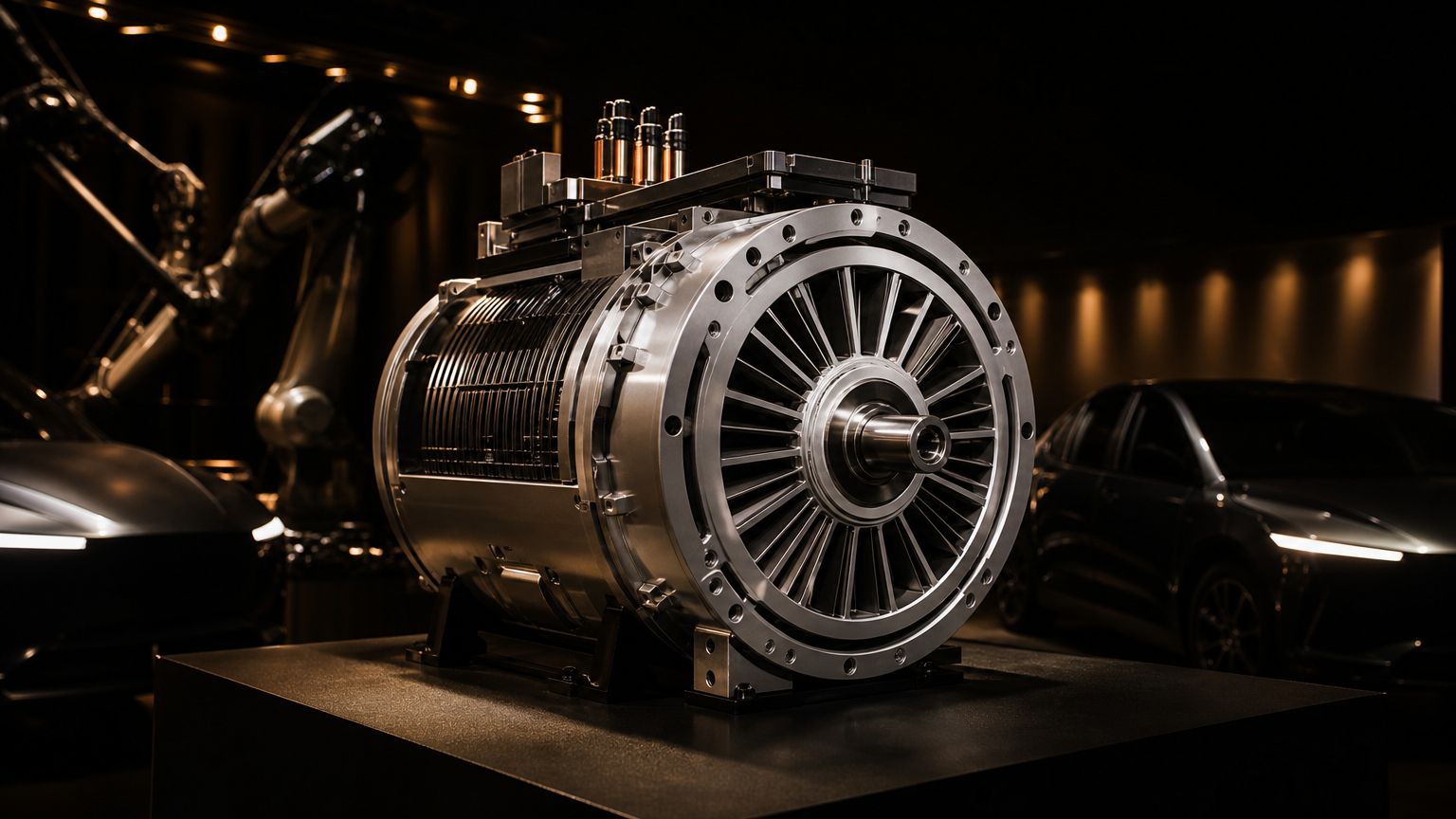
That is why a lighter, simpler drive unit matters. HelloBro’s October 27 briefing describes Tesla’s reported Halo drive as a lighter, simpler and potentially less supply-chain-dependent EV powertrain built around high output, rare-earth-free construction and a compact axial-flux layout . The same report frames the motor as strategic because gains in weight, efficiency and manufacturing simplicity can flow directly into vehicle range and production cost, not just spec-sheet bragging rights .
The headline numbers are aggressive — and still need proof
The reported figures are striking: about 46 pounds, roughly 480 horsepower or 358 kW, efficiency above 97%, and 108 fewer components than the conventional drive unit it is said to replace . If those numbers describe a production-ready drive unit rather than a narrow laboratory result, the power-to-weight ratio would be extraordinary and the parts-count reduction would be more than a neat engineering detail .
But this is the point where the hype must slow down. Peak efficiency is not the same as efficiency across the full torque-speed map. A motor can look brilliant at one operating point and less spectacular under heat, repeated acceleration, cold weather, highway loads or stop-start urban duty. Likewise, a 46-pound figure means different things depending on whether it refers to the rotor and stator, the motor assembly, or the full drive unit with inverter, gearbox, cooling and casing.
The responsible reading is simple: the reported Halo drive is potentially disruptive, not yet proven disruptive. What is missing is independent, like-for-like testing on mass, cost, durability, acoustic behavior, thermal performance and real-world energy use .
Why rare-earth-free matters more than it sounds
The most important part of the story may be what the motor reportedly does not use. High-performance permanent-magnet motors often depend on rare-earth elements such as neodymium, praseodymium, dysprosium and terbium. They are used because they help deliver high torque and efficiency in a compact package. The catch is that they tie automakers to a concentrated and politically sensitive materials chain.
That pressure is not theoretical. A current China exposure profile for strategic materials says that, as of October 27, 2026, dysprosium- and terbium-bearing NdFeB grades still require MOFCOM licensing, and it specifically advises U.S. and European magnet or motor buyers in autos, HVAC and robotics to audit bills of materials, qualify low-heavy-rare-earth grades and pre-book fourth-quarter deliveries . In other words, even a small amount of heavy rare earth content can become a big procurement problem.
This is where Tesla’s reported motor becomes more than a motor. If Tesla can make a high-output traction unit without those rare-earth dependencies, it reduces exposure to licensing delays, geopolitical bargaining and price spikes. That would not eliminate all supply-chain risk — copper, power electronics, bearings and semiconductors still matter — but it would remove one of the most strategically awkward choke points in EV manufacturing.
Axial flux: compact, powerful, difficult
The reported Halo design uses an axial-flux layout rather than the more common radial-flux geometry . In a conventional radial-flux motor, the magnetic field works across a cylindrical arrangement. In an axial-flux motor, the electromagnetic forces act across disc-like faces. That “pancake” geometry can deliver strong torque in a short axial package because force is applied farther from the rotation axis.
That is why axial flux is attractive for EV packaging. A flatter, lighter drive unit can free space, reduce mass and potentially allow more flexible vehicle architectures. In a mainstream EV, that could mean more cabin room, a smaller battery for the same range, or better efficiency without raising the sticker price.
The hard part is industrialization. Axial-flux machines must control narrow air gaps, heat and structural loads while spinning at automotive speeds for thousands of hours. If Tesla’s reported solution is a rare-earth-free axial-flux design with a wound rotor, the engineering difficulty rises further. HelloBro’s briefing says the key reported breakthrough is a contactless rotary transformer transferring energy to the rotor across a gap of about 1 millimeter, after roughly 40 design attempts, more than 2,000 failed test runs and around 3.5 years of work .
That detail matters. Removing permanent magnets does not remove the need for a magnetic field. It shifts the problem toward electrical excitation, cooling, control and long-term reliability.
The consumer angle: every watt counts
The reason this matters to normal buyers is not that they care about rotor topology. They care about monthly cost. Fresh U.S. EV efficiency data updated on October 26 lists the 2026 Tesla Model Y Long Range RWD at 4.46 miles per kWh and a calculated $4.07 per 100 miles, illustrating how efficiency turns directly into operating cost . Another EV charging-cost tracker updated October 26 puts the current Tesla Model 3 family at 24.3 kWh per 100 miles and about $4.41 per 100 miles at the cited U.S. average electricity price .
Those numbers show why drive-unit efficiency matters even when batteries get most of the attention. If a motor is lighter, wastes less energy as heat and is cheaper to build, the benefit can appear in several places at once: more range from the same battery, similar range from a smaller battery, lower thermal stress, less material per vehicle and potentially better affordability.
That is the part rivals should worry about. A single motor breakthrough does not automatically “outclass” every competitor. But a motor that is lighter, rare-earth-free, highly efficient and simpler to manufacture would attack several rival pain points simultaneously.
What rivals can and cannot copy
Other automakers can pursue rare-earth-free motors, axial-flux designs, ferrite magnets, induction machines, switched-reluctance motors or wound-rotor synchronous machines. None of those paths is magic. Each involves trade-offs between torque density, efficiency, cost, noise, thermal control, inverter complexity and manufacturing yield.
Tesla’s possible advantage is integration. The company can design the motor, inverter, software, thermal loop, vehicle body and manufacturing line as one system. If the Halo claims are tied to fewer components and easier assembly, the edge may come less from one exotic motor trick than from fitting the entire vehicle around that motor.
That is why rivals are not merely competing against a 480-horsepower claim. They are competing against the possibility that Tesla has found a way to turn motor simplification into vehicle simplification.
The bottom line
Tesla’s reported Halo drive deserves the “bombshell” label only if the claims hold up beyond controlled conditions. The reported 46-pound mass, 480-horsepower output, 97%-plus efficiency, rare-earth-free design and 108-part reduction would be a major combination if validated in production form .
For now, the fairest conclusion is this: Tesla appears to be aiming at the deepest EV problem — not how to make electric cars impressive, but how to make them cheaper, lighter, simpler and less dependent on fragile material chains. If Halo works at scale, rivals will not just be outclassed on performance. They will be challenged on the economics of the electric car itself.
Comments
Be the first to comment.