
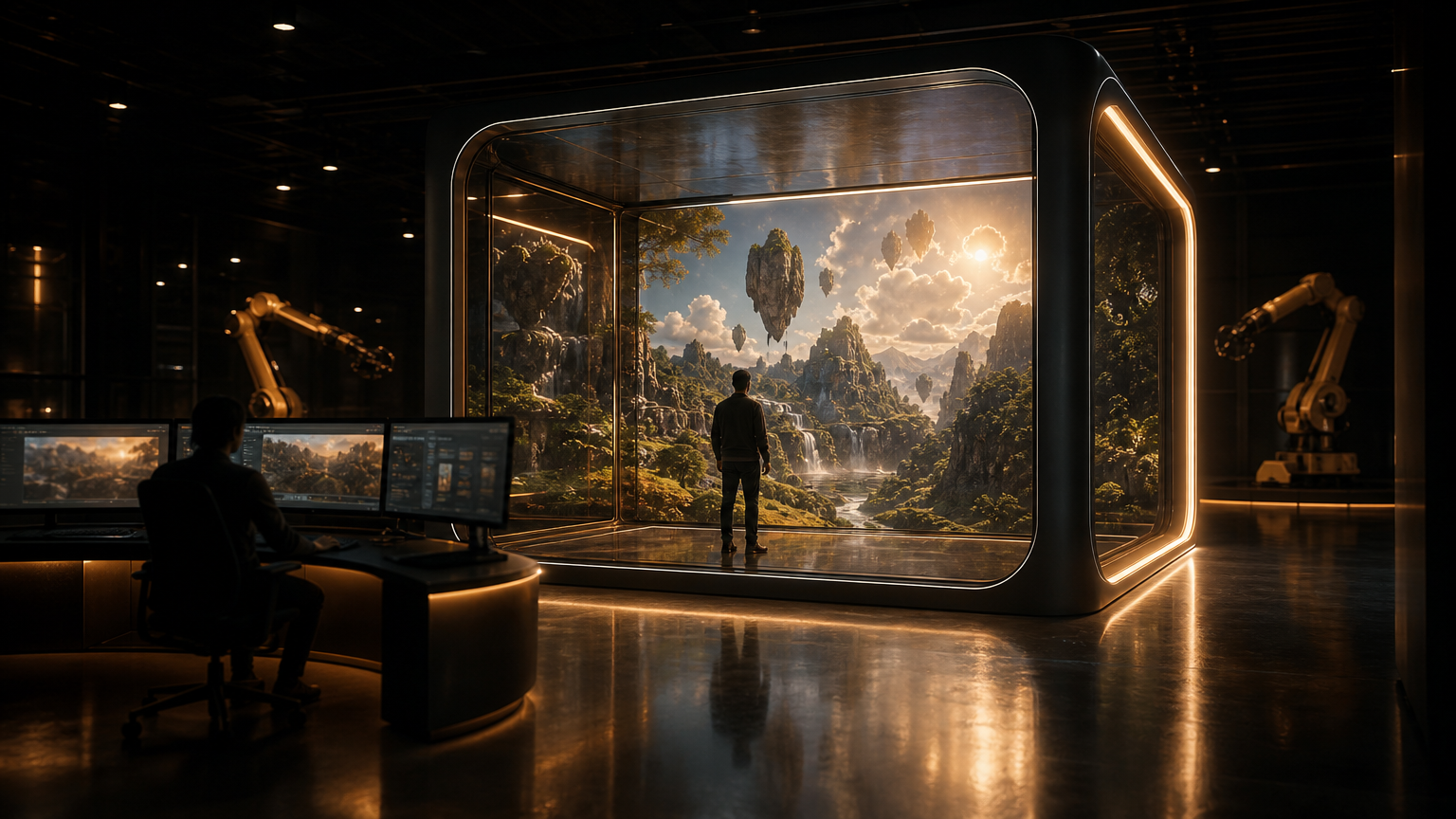
A world model, not just a video generator
Google DeepMind has launched Genie 4, a new world model designed to create real-time interactive simulations rather than passive videos . The distinction matters. A video generator renders a sequence for a viewer to watch; Genie 4 is meant to produce an environment that can be explored, redirected and modified as it unfolds . In Google’s framing, a user can set an event in motion and then watch how the world responds visually, physically and sonically .
The launch places Genie 4 in a fast-moving category of “world models,” systems that try to model environments, actions and consequences rather than only images or text. Google’s own announcement says Genie 4 brings “unprecedented realism” and native audio to real-time interactive simulation, with rollout beginning as a research preview for trusted testers before broader availability through Project Genie, the Gemini API and Google AI Studio . TechCrunch reported that the model is the newest DeepMind world model and that it is being released first in research preview .
The headline capability is not merely better-looking AI footage. Genie 4 lets users alter a running scene with natural-language instructions: changing the weather, moving the camera, introducing a new object, or adding a person while the simulation continues . Standard keyboard controls can be used for navigation and camera movement, while text prompts steer the evolving scene . That combination is why the product feels less like a rendering tool and more like a primitive holodeck: the world is generated, but it is also responsive.
What is new in Genie 4
DeepMind highlights four main advances: real-time scene shaping, improved realism in physics and human action, native audio, and tighter cooperation with Gemini models . The company says Genie 4 can simulate physical scenarios such as aerodynamics and collisions, while people in the generated worlds move more naturally and respond more organically to their environment . Ars Technica similarly reported that Genie 4 is designed to improve the realism of physics and people compared with prior versions .
The audio upgrade is especially important. Genie 4 is Google DeepMind’s first real-time world model to generate audio natively, producing ambient sound, music-like audio and interactive dialogue along with the visual world . Google’s broader company blog says each world can generate audio on the fly, including ambient sounds, music and dialogue . That means a generated beach is not only surf and sky, but also waves; a musician on a floating platform can be paired with saxophone sound and lake ambience; a character can react through speech.
This makes Genie 4 different from tools that add a soundtrack after the fact. In DeepMind’s description, sound is part of the world simulation itself, not merely a layer placed over the image . The company still cautions that real-time audio accuracy remains an area of ongoing research, but the direction is clear: simulated worlds are becoming multimodal systems, not silent visual demos .
Gemini becomes the director behind the scene
Genie 4 is also a sign of Google’s broader strategy: combine specialized generative systems with Gemini reasoning. DeepMind says Genie 4 builds on capabilities from the Gemini family, with Gemini Omni helping anchor simulations in real-world appearance and behavior and other Gemini models helping maintain coherence and continuity . Google’s company blog repeats that Gemini models provide the reasoning needed to keep a simulation coherent .
The most concrete example is Gemini 3.8 Flash acting as a guiding agent in the loop . As Genie 4 generates the world in real time, Gemini observes the scene, breaks goals into steps, reviews incoming frames and adapts the plan as the user intervenes . TechCrunch described this as Gemini acting like a director that plans steps and checks frames while Genie creates the visuals .
That architecture matters because world models often fail not on a single frame, but over time. A room looks convincing for several seconds, then an object drifts, a door changes position, a character forgets where it was, or cause and effect breaks. By putting Gemini in the loop, Google is trying to give the generated world a higher-level memory and plan. Genie renders the immediate sensory surface; Gemini tries to preserve the story of what is happening.
Why games are only part of the story
It is easy to see Genie 4 as a game prototyping engine. DeepMind says game developers and creative technologists are testing it to move from an idea to an explorable prototype in seconds, trying styles, materials and mechanics before writing engine code . TechCrunch also reported that trusted testers are pointing to film prototyping as a possible use case, including rapid ideation and storyboarding .
But Google is pitching a wider thesis. The company says simulating the world is a crucial step toward AGI because it could create safe training environments for robots and agents . DeepMind says Genie 4 can support playful interactive experiences and generate worlds where agents such as SIMA can learn new skills . In one robotics-oriented experiment, Gemini 4 Argon breaks down a task into steps that Genie 4 renders as a simulation in real time .
SiliconANGLE reported that Google is studying Genie 4 for robotics use cases, including simulations where high-level instructions are turned into detailed prompts for the world model . The attraction is obvious: real robots are expensive, slow and risky to train in the physical world. A simulator that can generate many varied, realistic scenarios could let researchers test policies, edge cases and task plans before hardware enters the loop.
The current limits are still large
For all the ambition, Genie 4 is not being presented as a finished consumer metaverse. DeepMind says it remains early and experimental, and it lists limitations around object permanence, coherent environments, complex interactions, real-world location accuracy, text rendering, audio accuracy and duration . The model can support only a few minutes of continuous interaction rather than extended sessions . TechCrunch reported that Genie 4 can maintain a consistent scene for up to about two minutes, doubling its predecessor’s limit, while still suffering drift in details and objects over time .
Those caveats are not footnotes; they define the product. A two-minute coherent simulation is impressive as research, but it is not yet a full game, a training universe, or a dependable industrial twin. It is a glimpse of an interface where environments can be described, entered and revised in real time. The gap between a glimpse and a platform remains large.
Google is also limiting access. Genie 4 is available as a research preview for trusted testers and is slated to come next to Google AI Ultra subscribers in Project Genie and early access partners in the Gemini API and Google AI Studio . Ars Technica noted that broader access is expected to expand soon, but without a specific general timeline . That careful rollout reflects both technical immaturity and safety concerns.
Safety, watermarking and the coming simulation layer
DeepMind says Genie 4 includes safety guardrails aligned with its other model policies and that all generated video and audio will include SynthID watermarking to help identify AI-generated content . The watermarking point is important because more realistic interactive worlds blur boundaries between generated media, synthetic evidence and simulation. If a system can create photorealistic environments with speech and ambient audio on demand, provenance becomes part of the product, not an optional add-on.
The more interesting long-term question is whether Genie 4 becomes a media tool, a robotics tool, a game tool, or an infrastructure layer for agents. The answer may be all of the above. For creators, it promises a new sketchpad: not a storyboard frame, but a world-state that can be walked through and changed. For developers, it suggests faster prototyping of mechanics and environments. For AI researchers, it offers a route toward training agents in many worlds before testing them in one physical world.
Genie 4 is therefore best understood as a bridge. On one side are today’s generative media systems, optimized to produce images, videos and audio. On the other side are agents and robots that need to reason through action. A world model sits between them: it generates reality-like situations, lets something act inside them, and then shows the consequences. Google’s new release does not complete the bridge, but it lays a highly visible span across it. The holodeck is not here yet, but the shaders are compiling.
Comments
Be the first to comment.