
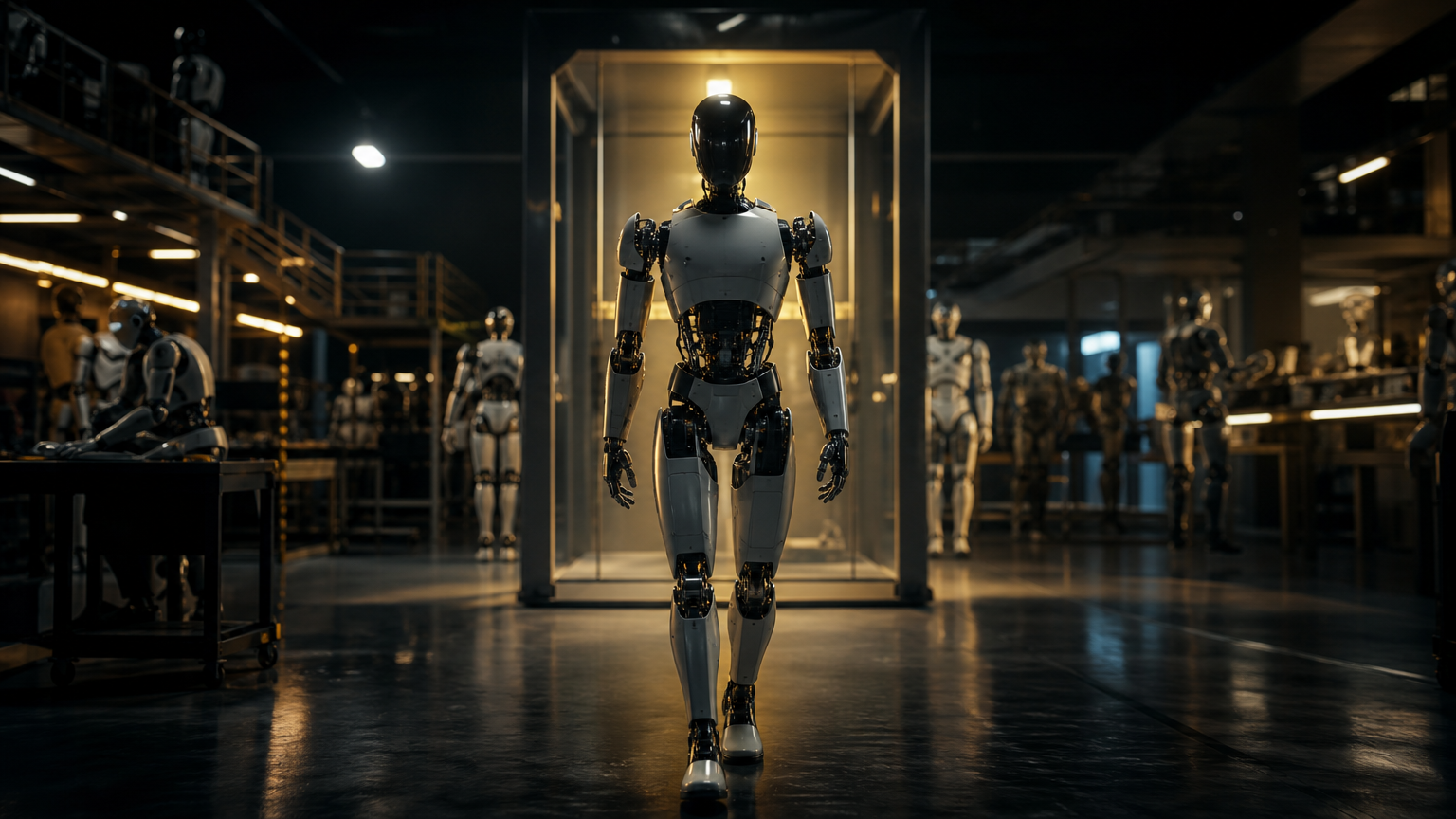
ChatGPT Is Moving Toward the Physical World
OpenAI’s first AI robot is finally becoming a concrete story, and the key point is not that ChatGPT will suddenly walk into your kitchen tomorrow. The meaningful shift is that OpenAI is now treating robotics as a strategic product frontier, not merely as a research curiosity or a partner integration. The latest HelloBro.ai coverage frames the move plainly: OpenAI is planning humanoid robots, alongside other robotic forms, with a public demonstration aimed at 2027 .
That makes the headline bigger than a single prototype. Until now, most people experienced OpenAI through a text box, a voice assistant, an API, or increasingly capable software agents. A robot changes the interface. It asks whether the same reasoning systems that can write code, summarize contracts, and plan workflows can also perceive a room, move safely, manipulate tools, and recover when the real world refuses to behave like a clean prompt.
Altman’s recent comments help explain why OpenAI sees the robot’s “body” as more than a marketing shell. In a fresh interview transcript published October 26, he said OpenAI is working on next-generation compute, chips, data centers, and “robots to be able to help make racks and data centers more effectively” . That detail matters: the first valuable OpenAI robots may not be charming home companions, but physical workers inside controlled, high-value environments where OpenAI already has a massive operational need.
Why a Humanoid Shape Still Makes Sense
The phrase “ChatGPT gets a body” sounds like science fiction, but the rationale is practical. Homes, offices, factories, hospitals, warehouses, and data centers are built around human dimensions. Doors have handles, keyboards assume fingers, ladders assume legs, shelves assume arms, and equipment panels assume a person standing in front of them. A humanoid form is not always the most efficient robot shape, but it is often the most compatible with the world that already exists.
That does not mean OpenAI will build only humanoids. The subject here is more subtle: OpenAI appears to be exploring humanoid robots and specialized robotic forms at the same time . That dual approach is important. A robot that operates in a data center may not need a friendly face or fully human proportions. It may need endurance, precision, thermal awareness, and the ability to handle racks, cables, trays, and industrial tools. A robot meant for offices or homes, by contrast, benefits from a form factor that can open a door, type on a keyboard, pick up a bottle, or clean a surface without requiring humans to redesign the whole environment.
OpenAI’s own hardware thinking points in the same direction. Altman argued in the October 26 transcript that AI is constrained by devices built for humans rather than for AI, and that new hardware could give AI richer context beyond the laptop or phone . A humanoid robot is the most extreme version of that idea: not just a new device, but an AI system with sensors, mobility, hands, and access to physical context.
The “Brain” Is the Hard Part
The hard problem is not making a robot stand upright for a demo. Many robotics companies can already show impressive walking, lifting, or warehouse-handling clips. The harder question is whether a robot can understand messy human instructions, translate them into safe action, and keep working when the environment changes.
That is where OpenAI’s advantage could matter. The company’s core strength is not motors, gearboxes, or batteries. It is general-purpose intelligence: models that can interpret language, reason over goals, use tools, and increasingly coordinate multi-step tasks. In robotics, that becomes the “brain” layer: perception, planning, instruction following, error recovery, and common-sense judgment.
A robot asked to “clean this room” must decide what belongs where, what is fragile, what is trash, what should not be touched, when to ask for clarification, and how to avoid a pet, a child, or a cable on the floor. A robot asked to help in a data center must understand procedures, safety constraints, equipment states, and the consequences of making a wrong move. That is not a simple extension of a chatbot. It is an AI control problem wrapped in metal, sensors, actuators, and liability.
Why 2027 Is a Demo Target, Not a Product Promise
The 2027 date should be read carefully. The current story is a public demonstration target, not a consumer launch date . That distinction matters because robotics demos can arrive years before affordable, reliable, widely deployed products. A convincing stage demo may show a robot opening doors, typing, operating equipment, moving objects, or cleaning. A commercial product must do those things repeatedly, safely, at acceptable cost, with maintenance, privacy guarantees, insurance, and support.
The market context explains the pressure. Agility Robotics and GXO announced on October 26 that they are expanding Digit humanoid deployments to additional U.S. logistics sites in North Carolina and Tennessee, with deployments expected to begin in early 2027 . The same release says Digit has already moved more than 100,000 totes at GXO’s Flowery Branch facility and accumulated more than 65,000 hours of real-world operation across commercial operations and customer programs . That is the benchmark OpenAI faces: not just a viral demo, but evidence that humanoids can deliver measurable work.
Toyota is also pushing hard into the space. The Decoder reported on October 26 that Toyota plans a $6.4 billion annual investment plan tied to factory automation and humanoid robots, including a plan to deploy 400,000 robots . In other words, OpenAI is entering a robotics race where automakers, logistics specialists, and industrial automation companies already have deep hardware experience.
OpenAI’s Strategic Bet
OpenAI’s bet is that the center of gravity in robotics is shifting from mechanical engineering alone to embodied intelligence. If the most difficult layer becomes the AI system that understands the world and controls the body, then OpenAI has a reason to move from model supplier to hardware competitor.
That shift also fits the company’s broader direction. Altman’s current hardware comments place robots alongside chips, data centers, supply chains, and new AI-native devices . This is not just a “robot project.” It is part of a larger move to control more of the stack: the model, the compute, the device, the interface, and eventually the physical action layer.
The payoff could be huge. A useful OpenAI robot could support infrastructure construction, operate inside data centers, help technicians, assist in industrial environments, and eventually take on everyday household tasks . But the risks scale with the ambition. A chatbot mistake can be embarrassing or costly; a robot mistake can break equipment, injure people, violate privacy, or create new security problems.
The Bottom Line
OpenAI’s first robot is finally happening, but the most realistic version of the story is not “ChatGPT becomes a butler overnight.” It is that OpenAI is preparing to bring its AI systems into bodies designed for work. The 2027 demo target gives the company a public milestone, while the broader robotics market is already proving that humanoids can move from spectacle to operations.
If OpenAI succeeds, ChatGPT will no longer be only something you talk to. It may become something that can see, move, grasp, type, clean, carry, and build. That is why this story matters: the next AI interface may not be a screen. It may be a machine standing in the room, waiting for instructions and, yes, probably needing its own sudo privileges.
Comments
Be the first to comment.