
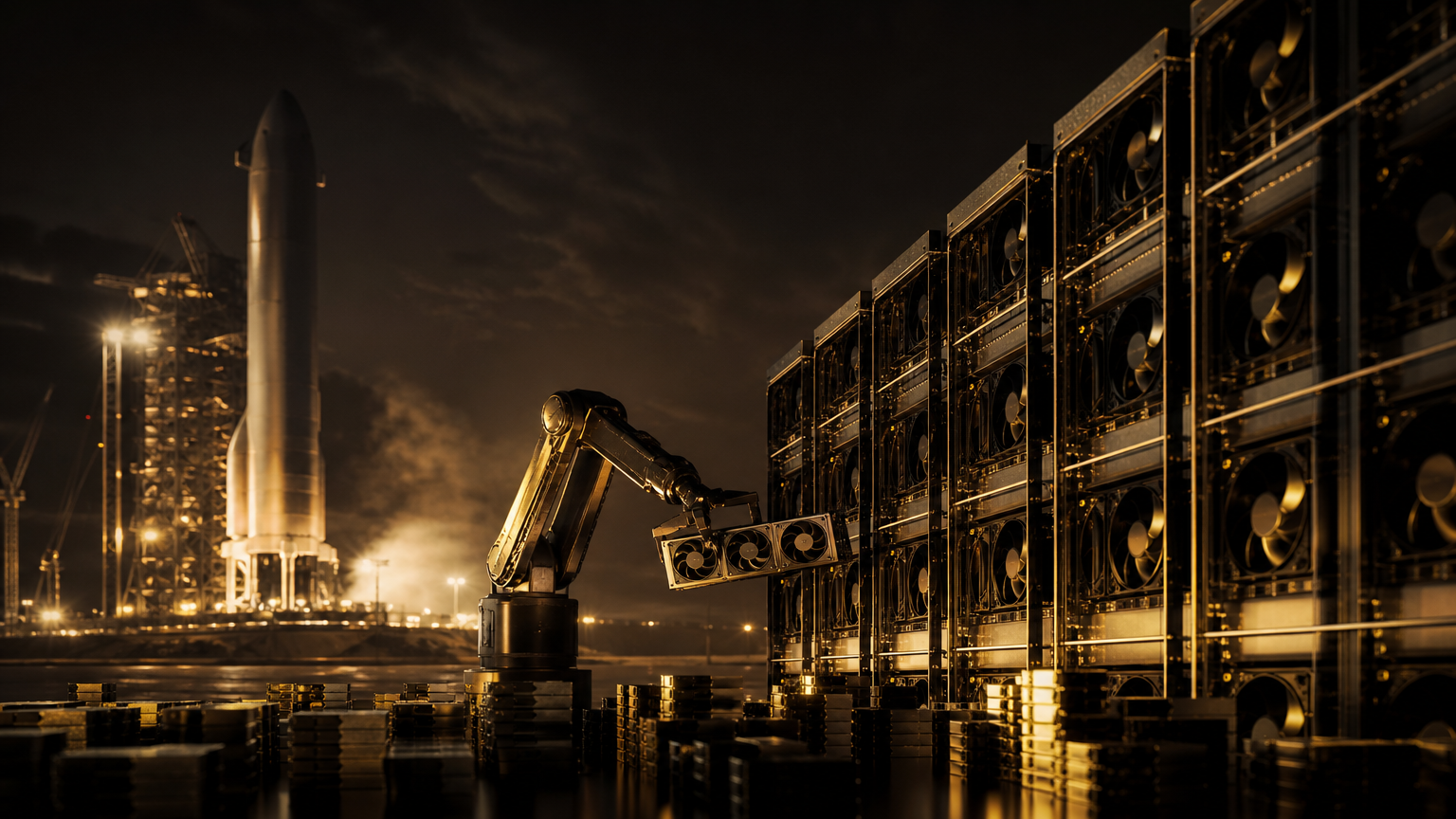
A GPU deal big enough to change the credit conversation
SpaceX’s 40 billion dollar GPU financing is not just another AI infrastructure headline. It is a signal that private compute buildouts are now demanding capital on a scale once associated with sovereign infrastructure, national energy grids or telecom spectrum auctions. In SpaceX’s own announcement, the company said it had reached a binding commitment for an approximately 40 billion dollar master finance lease covering GPUs and related equipment with an entity managed by Apollo Global Management . The equipment is expected to support SpaceX’s terrestrial compute buildout and deliver next-generation Nvidia Vera Rubin chips, according to the company’s release .
The mechanics matter. SpaceX’s Form 8-K says the Apollo-managed lessor will acquire GPU pods and related equipment, then lease them to SpaceX for use at data centers selected by the company . The equipment is expected to arrive in tranches, each under a separate lease schedule lasting roughly five to five and a quarter years from commencement . SpaceX expects aggregate principal payments under those schedules to total about 40 billion dollars, with the master lease expected to close before year-end 2026 and lease schedules expected to start during the first half of 2027 once GPUs are delivered .
That distinction is important because the word “closed” is doing two jobs. Musk said on X that SpaceX had closed 40 billion dollars in debt financing for GPUs, while the SEC filing says SpaceX entered into a binding commitment letter and still must satisfy closing conditions before entering the master lease . In plain English: the capital has been committed, the commercial package is real, but the final master lease documentation is still expected before the end of 2026 . For investors, that is not a technical footnote; it defines the timing and residual execution risk.
Apollo leads, Goldman structures, Pimco takes a slice
The transaction also shows how deeply mainstream credit investors are moving into the AI accelerator race. SpaceX said the financing parties are led by Apollo and Goldman Sachs, with Goldman serving as sole structuring agent, and with anchor commitments from funds or accounts managed by BlackRock, Goldman Sachs Asset Management and capital accounts advised by KKR . That lineup reads less like venture capital and more like the institutional plumbing of global fixed income.
Pimco’s role adds another layer. Quartz reported that Pacific Investment Management Co. is buying a 4 billion dollar slice of SpaceX’s roughly 40 billion dollar AI debt package, citing Bloomberg, and described Pimco’s participation as part of the Apollo-managed GPU lease financing . The report said Pimco is taking part of the A2 tranche, positioned above junior debt and below the senior debt, and that the debt is slated to come to market as 144A bonds for qualified institutional buyers .
That structure matters because it spreads the risk across layers. Senior investors get one risk-return profile, mezzanine or middle-tranche investors get another, and junior capital absorbs more volatility in exchange for higher potential yield. For SpaceX, the benefit is that a very large hardware order can be converted into scheduled lease payments rather than a single upfront cash drain. For Apollo and the other credit investors, the bet is that AI compute demand, SpaceX’s cash flows and the residual value of the equipment can support a 40 billion dollar financing stack.
Why GPUs now look like infrastructure
The deal highlights a sharp change in how AI hardware is financed. GPUs used to be treated as fast-depreciating technology equipment. Now, the most powerful accelerators are being packaged into debt-like infrastructure products. SpaceX’s filing says rent will be payable quarterly in advance and will generally include one-twentieth of the financed cost of each tranche, plus fixed-rate interest on the outstanding lease balance and certain costs . Over roughly 20 quarters, that resembles an equipment-backed amortization schedule.
Reuters reported that each lease will run a little over five years from the day the equipment arrives, and that SpaceX aims to finalize the deal by year-end . Reuters also reported that Musk said the financing mainly targets chips arriving in the first and second quarters of 2027, meaning the debt package is tied to a specific delivery window rather than an abstract AI ambition .
This is why the transaction is bigger than SpaceX. Advanced GPUs are becoming productive assets that companies finance, lease, depreciate and securitize. If the chips can generate enough revenue quickly through AI training, inference or cloud services, the financial logic works. If demand softens, model economics disappoint or newer accelerators make current hardware less valuable faster than expected, the same structure can magnify risk. Even Tony Stark would ask for a payment plan.
Musk’s message to neoclouds: revenue matters
Musk used the announcement to draw a line between SpaceX and more fragile AI compute providers. Reuters reported that he said SpaceX had closed the 40 billion dollar debt financing and that the company’s borrowing was primarily for GPU purchases expected in the first and second quarters . ITPro reported that Musk argued debt markets had largely shut access to money for companies without substantial revenue independent of AI data centers, while SpaceX could lean on Starlink and launch revenue as well as its investment-grade status .
That point goes to the heart of the neocloud model. Many specialized AI cloud providers have raised or borrowed heavily to buy GPUs, then rent those chips to AI labs, enterprises and developers. The model can work if utilization stays high and customers sign long enough contracts. But it is exposed to refinancing risk, chip obsolescence, construction delays, power constraints and customer concentration. Musk’s warning was blunt: ITPro reported his view that more than 200 neoclouds could face severe consolidation, with only some surviving .
SpaceX is not immune to those pressures. But it is trying to finance GPUs from a broader corporate base. Its pitch is not simply “we own scarce chips.” It is “we own scarce chips, have existing cash-generating businesses, and can put institutional-grade credit around the buildout.” That is a different proposition for lenders.
The fourth-quarter spending wall
The financing lands alongside another eye-catching number: SpaceX’s expected fourth-quarter capital expenditure. Reuters reported that CFO Bret Johnsen said the company still expected fourth-quarter capex of 35 billion to 40 billion dollars . That means the Apollo-led GPU financing does not eliminate SpaceX’s near-term capital burden; it sits beside an already enormous investment program.
The combined message is striking. SpaceX is not merely adding a data center here or a cluster there. It is attempting to industrialize AI compute at a pace that requires multiple capital markets at once: equipment leasing, private credit, bond investors, operating cash flow and possibly future refinancings. Axios framed the broader market moment as a capacity test for Wall Street, noting that SpaceX’s 40 billion dollar debt financing for GPUs arrived alongside other huge AI capital plans .
For investors, the question is whether these financings are rational responses to real compute scarcity or symptoms of an overheating AI infrastructure cycle. Both can be true. Demand for frontier compute is real, and the companies that secure power, chips and customers early may build durable advantages. But financing hardware at this scale also assumes the revenue curve will rise quickly enough to outrun depreciation and interest costs.
The new frontier: rockets, chips and credit
SpaceX built its reputation on rockets, reusable launch economics and Starlink. This deal shows the company is now also a credit-market actor in the AI infrastructure boom. The GPU lease pulls Apollo, Goldman, Pimco, BlackRock, KKR and other institutional players deeper into the accelerator race . It also turns AI compute into a financing category large enough to compete for attention with telecom, energy and transportation megaprojects.
The key dates now are clear. SpaceX signed the binding commitment letter on October 24, filed the 8-K on October 26, expects the master lease to close before year-end 2026, and expects lease schedules to begin in the first half of 2027 as GPUs arrive . The key unknowns are just as important: final pricing, closing conditions, deployment speed, customer demand and whether AI revenues can justify the capital intensity.
The simplest read is that SpaceX has secured one of the largest private compute financing packages ever announced. The deeper read is that AI infrastructure has entered its debt-financed industrial phase. In that phase, access to chips is only half the race. Access to patient, structured, institutional capital may be just as decisive.
Comments
Be the first to comment.