
A rocket story about logistics, not just launch
SpaceX’s most important news this week is not simply that a huge rocket made a lot of fire in South Texas. It is that two separate developments are pulling the company’s reusable-rocket strategy toward the same destination: routine movement of mass, whether that mass is a Starship stage returning to its tower or military cargo riding through orbit inside a recoverable capsule.
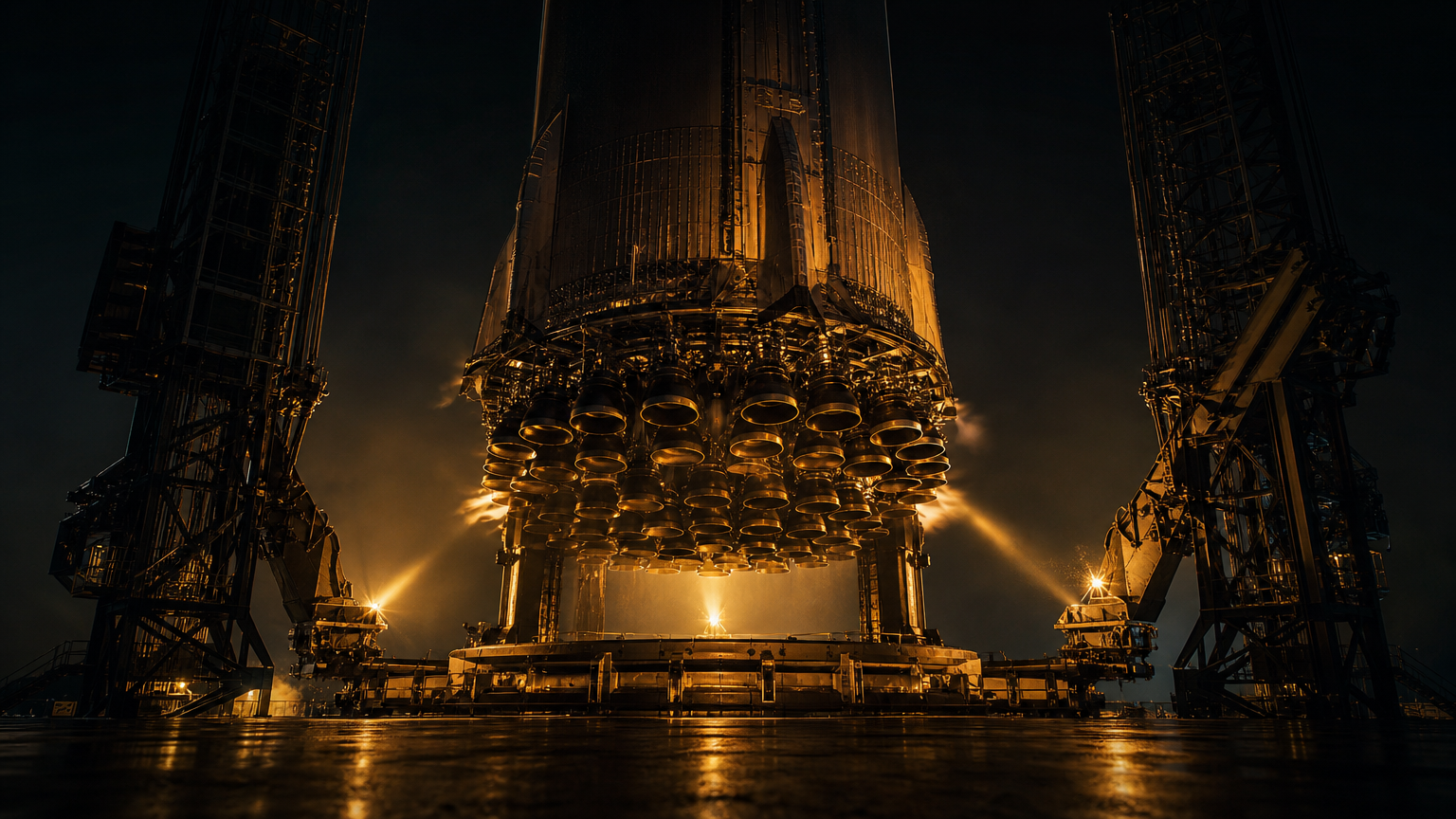
The first development came from Starbase, where the Super Heavy booster assigned to Starship Flight 15 completed a full-duration static fire of all 33 Raptor engines on October 25, according to recent reporting citing SpaceX’s own post . The second came from the U.S. Air Force Research Laboratory’s Rocket Cargo effort, which used SpaceX’s Starfall reentry capsule to fly military-style supplies through launch, spaceflight and reentry before recovery from the Pacific Ocean .
Together, they show how SpaceX’s reusability agenda is widening. The company is no longer only proving that rockets can fly and land. It is building toward a system in which launch vehicles, capsules, towers, ground crews, regulators and customers all have to work as a transport network.
Why the 33-engine static fire matters
The Super Heavy test was a ground rehearsal for the most aggressive Starship recovery attempt yet. Space.com reported that Booster 22, the Super Heavy vehicle for Flight Test 15, ignited all of its Raptor 3 engines for about 15 seconds at Starbase on October 25 . Aerospace Global News likewise described the event as a full-duration firing of all 33 engines, with the booster held down on the launch pad while engineers collected data on engine behavior, propellant systems, pressure levels and pad interactions .
A static fire is not a launch, and it is not a guarantee of launch readiness. But for a vehicle with 33 methane-fueled engines clustered under a first stage taller than many buildings, it is one of the closest practical tests to flight without leaving the ground. The point is not only to see whether the engines ignite. It is to see whether they ignite together, sustain the planned firing, and interact with the booster and launch mount in a way that gives engineers confidence for the next step.
That next step is the real story. Flight 15 is being framed as the mission on which SpaceX will attempt to catch both the Super Heavy booster and the Starship upper stage with tower arms . Super Heavy catches have already been demonstrated, but a Starship upper-stage catch would be new. The upper stage has to survive ascent, operate in space, reenter through extreme heating, steer accurately back toward the launch site and descend into the capture envelope of the tower.
That is a very different challenge from splashing into the ocean. Ocean recovery can prove guidance, thermal protection and controlled descent. Tower recovery asks for precision logistics. The stage must return not merely intact, but to a specific piece of ground infrastructure at a specific time, in a condition that makes reuse plausible.
The dual-catch goal is an economics test
SpaceX has always described Starship as a fully reusable launch system, but “fully reusable” is not a slogan; it is a cost model. If only the booster comes back, Starship remains closer to a partly reusable architecture. If both stages can be caught, inspected, serviced and flown again, the system moves closer to aircraft-like operations.
That is why Flight 15 matters beyond the spectacle. The tower-catch architecture removes landing legs and aims to place the vehicle directly where it can be checked, refueled and restacked. Aerospace Global News reported that SpaceX still needs to complete additional upper-stage work, integrate the two vehicles and obtain the necessary regulatory approval before launch . Those caveats are important. Reusability is not achieved by one dramatic catch. It is achieved when the vehicle can be recovered repeatedly, refurbished quickly and returned to service at predictable cost.
The recent Flight 14 context shows why this is still developmental. Space.com noted that Flight 14 reached orbit, deployed 26 Starlink V3 satellites and ended with a controlled Pacific splashdown after the mission was shortened following an upper-stage engine issue . In other words, Starship is moving from pure test article toward useful cargo vehicle, but it is still working through reliability questions that matter directly to reuse.
For SpaceX, the business logic is clear. Starlink V3 satellites are too large for Falcon 9, making Starship central to scaling the company’s broadband network . NASA’s Artemis lunar architecture also depends on Starship milestones, including demonstrations needed before crewed lunar landing operations . The dual catch is therefore not a stunt. It is a bottleneck in a broader logistics machine.
Starfall points to a second logistics market
The Air Force test adds another layer to the same theme. SOFX reported that AFRL tested Rocket Cargo point-to-point delivery capabilities during a commercial rideshare mission launched from Cape Canaveral on October 20, using a SpaceX Starfall capsule that carried agile cargo pods with survival gear, emergency medical supplies, batteries, a satellite communications-enabled tracker and a water desalination system .
The pods were not just packed and launched. They were instrumented to measure temperature, shock and vibration through launch and reentry, and AFRL later said the pods were recovered after Pacific splashdown with SpaceX support . Task & Purpose reported that the experiment was designed to study how spaceflight stresses affect items such as MREs, water, portable tools and electronics .
This is not yet orbital same-day delivery for troops. IBTimes described it as a small-scale engineering evaluation rather than an operational delivery system, and reported that officials did not disclose how many pods flew, how much equipment was aboard or what condition the cargo was in after recovery . That restraint matters. Rocket cargo has to solve problems that go beyond launch speed: cost, landing accuracy, diplomatic permissions, survivability of payloads and the risk of other nations misreading military rocket launches.
Still, the test moves the concept from presentation slides into hardware. A recoverable capsule lets the Air Force measure what actually happens to useful equipment during the full trip: launch loads, microgravity or orbital coast, reentry heating, parachute descent and ocean recovery. That data can inform packaging, automated unloading concepts and future capsules.
Two paths, one reusable transport architecture
The Starship and Starfall developments are different in scale. One involves the world’s largest launch system preparing for a dual-stage recovery attempt. The other involves military cargo pods inside a reentry capsule on a Falcon 9 rideshare. But both are about the same underlying problem: how to turn rockets into logistics tools.
For Starship, the question is whether the launch vehicle itself can be recovered fast enough to change heavy-lift economics. For Starfall and Rocket Cargo, the question is whether reusable or recoverable space systems can move critical supplies faster than ships, trucks or aircraft when normal routes are unavailable.
The near-term answers will be partial. A successful static fire does not guarantee a successful dual catch. A recovered capsule does not prove routine global resupply. But both events reduce uncertainty. They give engineers data, regulators a concrete mission to evaluate and customers a clearer sense of what reusable rockets might actually do.
That is why this week’s SpaceX logistics story is bigger than flame trenches and splashdowns. The company is testing the physical and operational grammar of rocket transport: ignite, return, catch, inspect, reload, relaunch; launch, reenter, recover, study, improve. If those verbs become routine, reusable rockets stop being rare events and start becoming infrastructure.
Comments
Be the first to comment.