
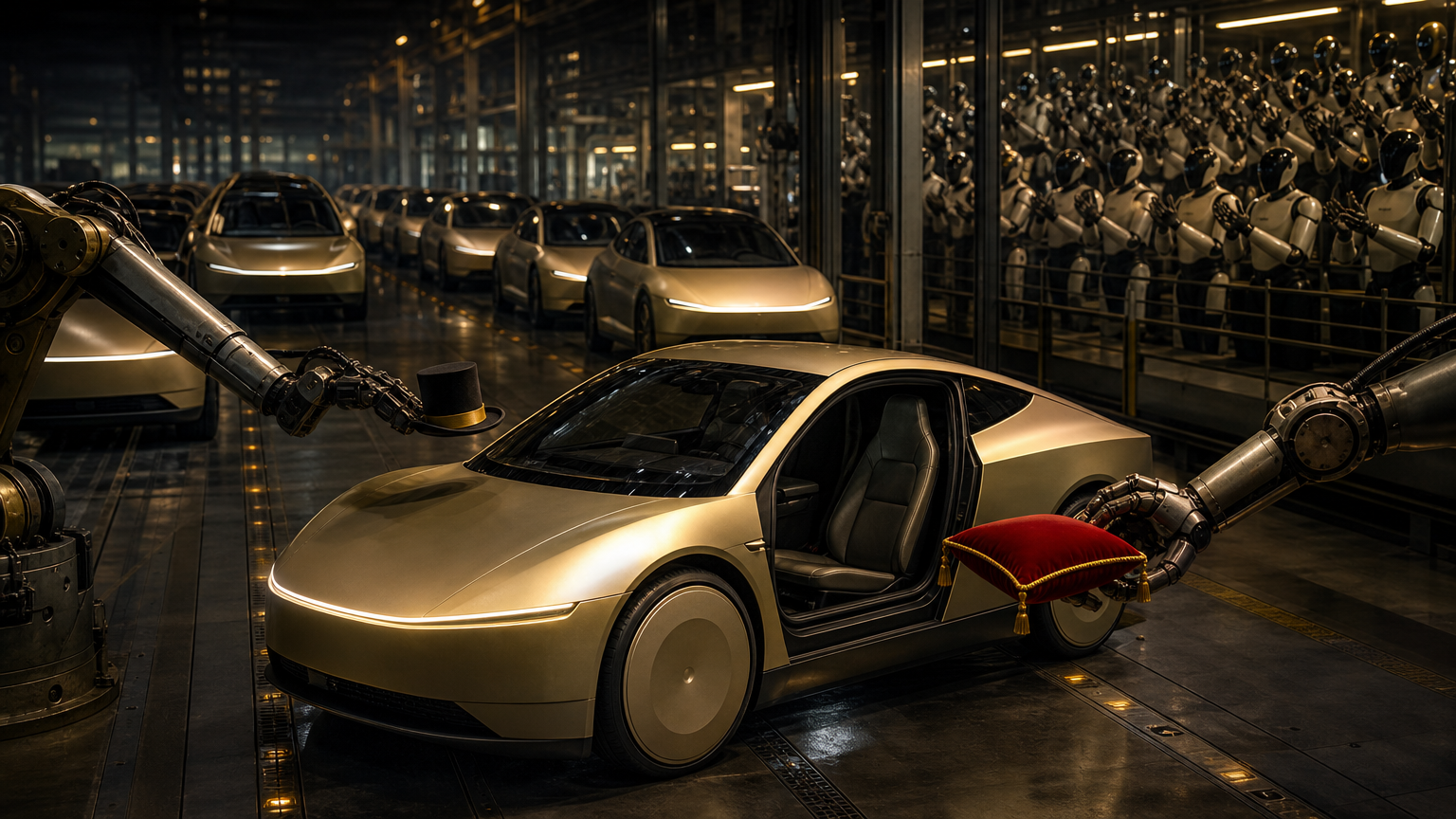
A launch where the factory is not the slowest part
Tesla’s Cybercab ramp is becoming unusual for one simple reason: the production line may no longer be the constraint. In a newly published Cybercab engineering walkthrough with Munro Live, Tesla vehicle engineering chief Lars Moravy said the company does not run the line every day because it can run so fast that it is currently outpacing deployments . That is a striking reversal of the normal automotive launch pattern, where early production is often slowed by parts shortages, quality containment, supplier misses or station-by-station tuning.
The key point is not that Tesla has disclosed a public daily production number. It has not. The key point is that Moravy framed the current Cybercab challenge as a race between manufacturing and deployment, with manufacturing ahead for now . That shifts investor and industry attention away from whether Tesla can physically assemble the vehicle and toward whether it can place, charge, maintain, regulate and monetize a fast-growing robotaxi fleet.
The Texas line: compact, automated and built around “unboxed” thinking
The latest factory-tour reporting describes a production system designed specifically for high repetition and low complexity. Drive Tesla reports that the Cybercab uses Tesla’s unboxed manufacturing system, where major vehicle sections are assembled and tested separately before they come together in a much shorter final line . According to the same report, Tesla described the Cybercab manufacturing process as about 78% automated overall, with the framing line fully automated and components delivered by autonomous mobile robots .
Final assembly is the clearest symbol of this simplification. The line reportedly uses just 25 stations, while a conventional Model Y line can require five to ten times as many depending on the factory . Tesla also says the Cybercab approach cuts factory floor space per vehicle by roughly half, a major claim if the company is trying to scale robotaxi production without replicating the footprint and cost structure of older vehicle programs .
The body and finish strategy also reflects a purpose-built fleet vehicle rather than a conventional retail car. EVwire’s summary of the Munro Live tour says there is no traditional paint shop; instead, exterior plastic panels receive their color in the molding process, while only certain modules receive e-coating . Eliminating paint is not just a styling choice. Paint shops are expensive, space-hungry and environmentally complex, so removing that step can help explain how Tesla is pursuing a low-cost, high-throughput Cybercab architecture.
The fleet is growing, but deployment is the bottleneck
The phrase “massive fleet” should be understood in the context of a new, purpose-built autonomous vehicle rather than the scale of Tesla’s global retail business. Fresh reporting says Texas records show 463 Cybercabs registered, while more than 50 Cybercabs were active during Austin’s Formula 1 weekend . Drive Tesla separately reports the same 463-vehicle Texas registration figure and notes that Tesla’s latest shareholder materials list installed annual Cybercab capacity above 125,000 units, while also emphasizing that installed capacity is not the same as current output .
This is why Moravy’s “outpacing deployments” comment matters. If hundreds of Cybercabs are already registered and the line can run ahead of the service rollout, the operational side becomes decisive: where the vehicles are allowed to operate, how quickly Tesla can open or expand service areas, how reliably the fleet can clean, charge and maintain vehicles, and how many rides the network can generate per car per day.
The near-term expansion target remains focused on real-world robotaxi use, not dealer-lot inventory. EVwire reports that Tesla said Cybercab rides would start in Dallas next month and that the company is trying to deliver Cybercabs to customers by the end of 2026 . That means Tesla is attempting two ramps at once: a fleet-service ramp and an early customer-handover ramp.
Deliveries soon, but “customer” may not mean ordinary retail
The delivery question is more complicated than a normal car launch. Cybercab has no steering wheel or pedals, so the meaning of “customer delivery” can include fleet partners, business operators or controlled ownership models, not simply a private buyer taking a car home like a Model 3. Recent summaries of the Q3 remarks emphasize that every Cybercab currently built is going into Tesla’s own internal Robotaxi fleet, while the company is trying to get Cybercabs to customers by the end of 2026 .
That distinction matters for expectations. A small batch of customer Cybercabs before year-end would be a milestone, but it would not necessarily mean open consumer availability, a broad configurator, or immediate private ownership at scale. Supercharged Daily’s current guide lists the end-of-2026 customer target as a stated aim and identifies the sub-$30,000 figure as a target from the original reveal, not a newly published final price . In other words, the “around $30,000” Cybercab remains central to the story, but buyers should not treat it as a confirmed live order sheet.
Engineering choices point to fleet economics
The Cybercab’s engineering details make more sense when viewed through the lens of a vehicle expected to work all day in a robotaxi network. EVwire says Tesla’s team described a vehicle built to last at least 500,000 miles and using an 88S6P pack of 4680 cells in a steel enclosure, with separately potted modules that can be replaced individually . That modular serviceability matters because downtime is the enemy of fleet economics.
The Next Web adds that Tesla designed the battery enclosure with room for lower-energy-density LFP cells later, while the current pack uses Tesla’s 4680 cells . LFP chemistry could be attractive for a robotaxi because durability, cycle life and cost can matter more than maximum range in a tightly managed urban service area. If Tesla can move the Cybercab platform toward cheaper chemistry without redesigning the pack, it gives the company another lever to lower cost per mile as the fleet grows .
The drivetrain is also tuned for duty cycle rather than headline performance. EVwire reports that the Cybercab is front-wheel drive and uses an 11:1 gear ratio, compared with roughly 9:1 on many Teslas, because the vehicle does not need a high top speed . That is exactly the kind of trade-off expected in a robotaxi: efficiency, manufacturability and predictable urban operation matter more than enthusiast specifications.
Charging is still part of the deployment puzzle
If production is ahead of deployment, charging and turnaround become part of the bottleneck. TeslaNorth reports that Moravy said Cybercab keeps a charge port so it can use Tesla’s existing charging equipment for now, while he floated Optimus as a possible near-term helper for plugging vehicles in until more automated charging is ready . The same report frames Optimus as a stopgap rather than the final infrastructure answer .
This is important because a robotaxi fleet is not just a collection of vehicles. It is a logistics system. A Cybercab has to find rides, reposition, charge, clean, receive maintenance and return to service with minimal human labor. The more Tesla can automate those steps, the stronger the business case becomes. The more human intervention remains, the more the fleet looks like a traditional ride-hailing operation with extra hardware complexity.
What to watch next
The most important next signals are not simply how many Cybercabs Tesla can build. The next signals are whether Dallas launches on schedule, whether the Texas fleet count continues rising, whether Tesla confirms any actual customer handovers before December 31, 2026, and whether it clarifies the purchase model behind the word “customer” .
For now, the Cybercab ramp looks real enough to change the question. The old question was whether Tesla could build a dedicated robotaxi at all. The new question is whether Tesla can deploy them quickly enough to match a factory that Moravy says is already ahead of the fleet rollout . If Tesla solves that deployment side, the Cybercab could move from production curiosity to the backbone of a much larger autonomous transport business. If it does not, the company may find itself with the rarest of auto-industry problems: a vehicle line ready to run faster than the world around it.
Comments
Be the first to comment.