
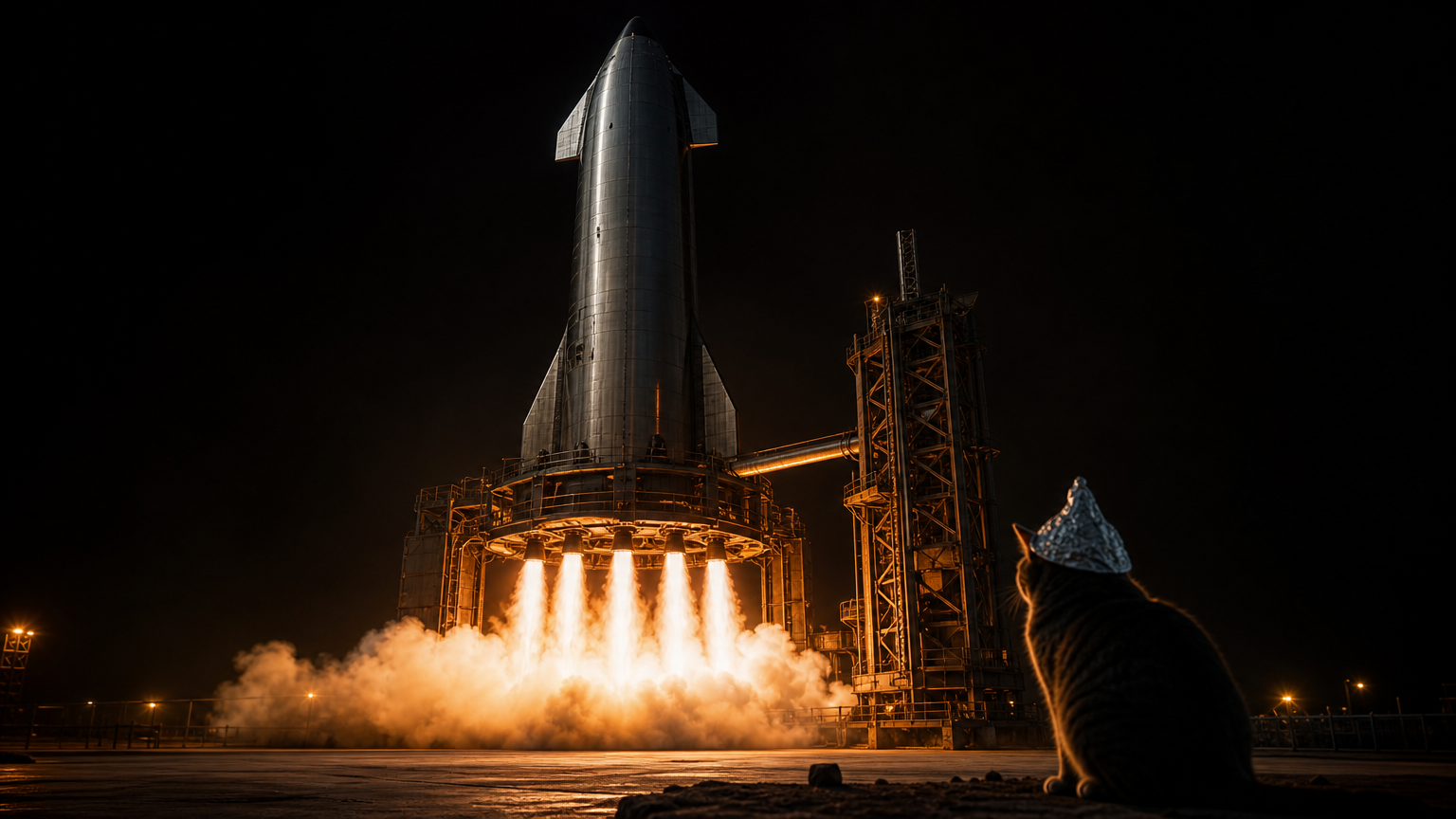
The headline check: Ship 42 really did fire six engines
SpaceX’s latest Starship milestone is not a launch, not a catch, and not yet the dramatic Flight 15 spectacle. It is the quieter but essential step before all of that: Ship 42, the Starship upper stage assigned to Flight 15, completed its static-fire campaign, including a full-duration firing of all six Raptor engines and a separate single-engine burn intended to simulate a deorbit maneuver .
That combination matters because it rehearses two very different moments in the same vehicle’s mission. The six-engine static fire is about ascent power: can the upper stage’s complete engine set start, run and shut down as expected while the ship is held on the ground? The single-Raptor test is about the end of the mission: can the vehicle demonstrate the type of controlled burn needed to leave orbit and target reentry? SpaceX announced the completed Ship 42 static fires on October 28 at 16:10 UTC, describing the vehicle as the Starship preparing for Flight 15 .
The tests push Flight 15 from the factory-and-assembly phase toward a more operational phase. In practical terms, that means SpaceX has now checked major propulsion boxes on the ship side while the broader campaign continues around the booster, launch tower, catch sequence and licensing. Space.com reported that SpaceX has static-fired both Starship stages ahead of Flight 15, and that Ship 42’s tests followed the Super Heavy Booster 22 static fire conducted for the same flight campaign .
Why six engines are a bigger signal than the fireball suggests
A static fire is easy to mistake for a spectacle. The vehicle is on a stand, the engines ignite, cameras capture the plume, and social media does the rest. But the real value is in the data. A full-duration six-engine firing lets teams evaluate engine startup, vehicle plumbing, tank pressurization behavior, software commands, vibration, thermal loads, and ground-support systems under a condition that resembles a slice of flight without actually releasing the vehicle.
That is why “full duration” is the important phrase. It implies the test ran long enough to satisfy the planned objective, not merely that the engines flashed to life. SpaceX’s post did not frame the event as a one-off stunt; it said the static fires were complete . For a fully reusable heavy-lift architecture, that distinction is central. The long-term economics of Starship depend less on isolated triumphs than on repeated, procedural confidence: roll out, load propellant, test, integrate, launch, recover, inspect, and do it again.
There is a comic-book simplicity to the number six. Six engines fired, because apparently one flux capacitor no longer satisfies launch requirements. But behind the joke is the real engineering point: Starship’s upper stage must handle clustered-engine ascent, in-space maneuvering, reentry, and recovery. The same vehicle that must accelerate away from Super Heavy must later behave like a spacecraft with precise end-of-mission control.
The deorbit-burn simulation may be the more subtle milestone
The single-Raptor firing is less visually overwhelming than six engines, but it may be just as important for Flight 15 readiness. SpaceX said the single-engine burn simulated a deorbit burn . In flight, a deorbit burn is the maneuver that adjusts a spacecraft’s path so it reenters the atmosphere at the intended place and angle. For Starship, that capability is tied directly to orbital operations, reusability, safety corridors, and eventually routine payload delivery.
Tesla Oracle described the single-engine static fire as part of the Flight 15 Ship 42 test sequence and connected it with SpaceX’s broader static-fire and simulation work at Starbase . The publication also noted that these tests took place in the same readiness period as activity involving the Super Heavy booster side of the mission, including the earlier 33-engine Booster 22 static fire .
The distinction between ascent and deorbit testing is important. A six-engine burn proves the ship can produce the big push. A single-engine deorbit simulation checks a very different part of the flight profile: a controlled, lower-thrust maneuver after the vehicle has already reached space. If Flight 15 is to be more than a climb-and-splashdown exercise, the ship has to demonstrate confidence at both ends of the energy curve.
Booster 22, Ship 42, and the bigger Flight 15 campaign
Ship 42 is only half of the stack. Flight 15 also depends on Super Heavy Booster 22, which has already been associated with its own full-duration 33-engine static fire in the same campaign . Space.com reported that the Ship 42 tests came after that Booster 22 firing and that both stages have now been static-fired ahead of Flight 15 .
That pairing is what turns the Ship 42 test from an isolated upper-stage event into a campaign-level marker. Starship flights are integrated systems tests. The ship, booster, pad, launch mount, tower arms, quick-disconnect systems, flight software, ground control, range coordination, and regulators all have to converge. A successful six-engine static fire does not guarantee a successful launch, and it certainly does not guarantee a recovery. It does, however, remove one of the obvious propulsion gates on the path to flight.
As of October 29, Supercharged Daily reported that SpaceX had not announced a Flight 15 launch date and that no FAA license for the flight had yet been issued . That matters because the next phase is not purely technical. Starship test flights increasingly depend on whether SpaceX receives permission not only to launch but also to attempt specific recovery operations.
The catch question looms over the static fire
The context around Flight 15 is unusually ambitious because the campaign is expected to move closer to full recovery of the system. Supercharged Daily reported that Elon Musk said Ship 42 would be the first Starship upper stage caught by the tower, while also noting that a ship catch has not yet been performed and that Flight 15 still awaited formal launch clearance as of October 29 .
That is the shadow behind the engine tests. Static fires validate propulsion on the ground; they do not validate reentry heating, aerodynamic control, flap authority, landing burn timing, tower alignment, or the final catch envelope. A six-engine test can say “the ship is alive.” It cannot say “the ship can survive orbital return and meet the tower.”
Still, the sequence is meaningful. SpaceX has already caught Super Heavy boosters with the tower on prior Starship flights, according to current reporting, but catching the ship would be a separate milestone because the upper stage returns from a far more punishing flight regime . The upper stage has to survive spaceflight, reentry and approach before the launch tower can become relevant.
Routine is the real objective
The temptation is to treat every Starship static fire as a singular event. That is understandable: six Raptors lighting up under a stainless-steel vehicle is not exactly subtle. But SpaceX’s deeper goal is to make these rehearsals ordinary. Reusable heavy lift becomes economically interesting only when tests like these become part of a repeatable flow rather than an exception that stops the program.
Ship 42’s six-engine static fire and single-Raptor deorbit simulation therefore mark progress of a specific kind. They do not mean Flight 15 is cleared to fly. They do not prove the ship can be caught. They do not answer every question about the vehicle’s next mission profile. What they do show is that SpaceX has moved another Starship upper stage through a critical propulsion rehearsal and is linking that work to a broader campaign involving Booster 22 and tower-recovery planning .
For now, the cleanest reading is also the most sober one: Ship 42 has fired the engines it needed to fire before Flight 15, including all six Raptors for ascent and one Raptor for the deorbit-burn simulation . The next story is no longer whether the ship can light up on the stand. It is whether the whole stack, license, launch operation, flight profile, reentry and recovery plan can come together in time for the next Starship campaign.
Comments
Be the first to comment.