
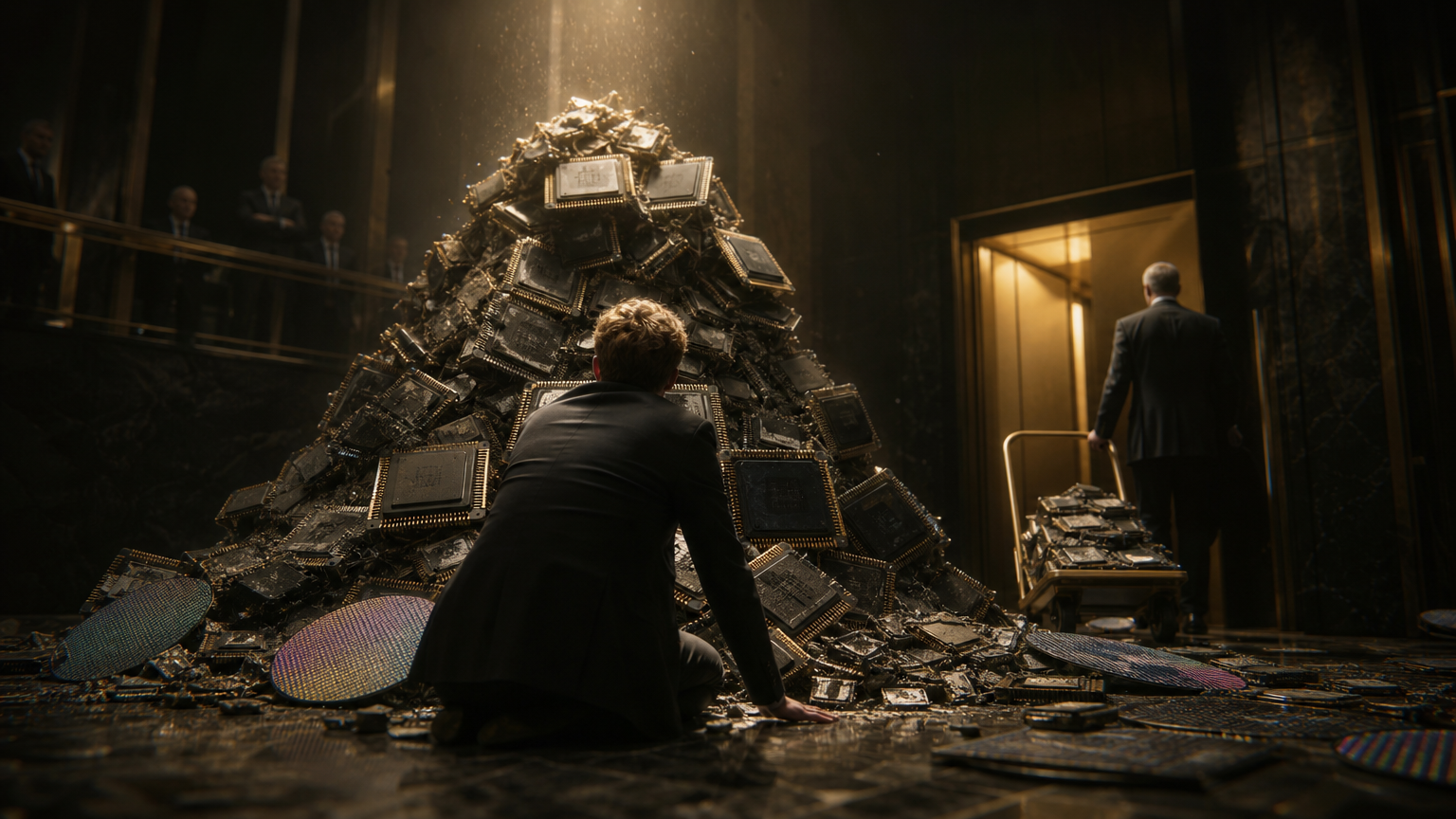
The genius trade that became a liquidity trap
Before it became a cautionary tale, the story of Léopold Brunner — identified in wider market coverage as Leopold Aschenbrenner, the former OpenAI researcher behind Situational Awareness — looked like the perfect 2020s finance fable: a very young technologist-turned-investor sees the AI boom more clearly than Wall Street, maps the supply chain, and buys the companies that make the boom physically possible . The core idea was not foolish. In fact, it was elegant. If artificial intelligence was going to consume more compute, memory, power, advanced chips and data-center capacity, then the winners might not only be consumer platforms or software apps. They might be the less glamorous suppliers: Micron, TSMC, ASML, Applied Materials, Lam Research, SanDisk and the wider “picks and shovels” of the AI build-out .
That was the foundation of the myth. The fund reportedly began with only a few hundred million dollars, attracted backing from influential technology and finance circles, and produced the kind of early gains that make investors forget that markets can move both ways . By the time the trade was at peak fame, Situational Awareness had become a vehicle associated with extraordinary returns, concentrated conviction and a belief that AI infrastructure was not just a sector but the central economic bottleneck of the next decade .
Then July happened.
The month everything went wrong
The collapse was not simply a case of picking bad stocks. The more precise diagnosis is that a concentrated trade was combined with financing that left almost no room for timing error. The HelloBro brief describes the fund falling from around $40 billion to about $10 billion in a matter of weeks, after leveraged positions triggered margin calls and a forced sale to Citadel . A current market briefing puts the broader July move even more starkly: Situational Awareness fell 67%, sold its public equity portfolio to Citadel in one block, and shrank from roughly $45 billion to about $10 billion .
That distinction matters. If an investor owns stocks outright, a sharp drawdown is painful but survivable. The investor can wait, provided the thesis remains intact and the capital is permanent. But when a portfolio is financed with borrowed money, the lender can demand more collateral at precisely the moment prices are falling. If the investor cannot provide it, the market no longer asks whether the thesis is right. It asks only who can buy the assets today.
That is what margin calls do: they convert volatility into a deadline. In Brunner’s case, the deadline arrived fast. The reported use of about 4x leverage meant that a significant decline in the underlying semiconductor and AI-infrastructure positions could wipe out the fund’s equity cushion far more quickly than an unlevered investor might imagine . What looked like a temporary repricing became a liquidity event.
Why Citadel won the ending
The forced sale is the cruelest part of the story. Citadel did not need to believe in every line of Brunner’s worldview. It needed liquidity, speed and the balance-sheet capacity to buy when the seller had no time. According to the current briefing, Situational Awareness moved the bulk of its listed holdings to Ken Griffin’s Citadel in a single block, closed shorts and severed reliance on portfolio financing . That is the anatomy of a distressed unwind: the owner who built the thesis loses control of the timing, while the buyer with cash gets to choose the price.
The market irony is that several of the positions later rebounded, which is typical of forced-selling episodes. When a large seller is removed, pressure can ease. But the original fund does not necessarily benefit if it has already had to liquidate. In plain English: Brunner may have been directionally right about AI infrastructure and still structurally wrong about how much leverage the trade could bear.
This is why the story has resonated beyond hedge-fund gossip. It is not only about one young manager. It is about a broader market regime in which many investors have crowded into the same AI-adjacent assets, from memory chips to neoclouds to power infrastructure. When a popular theme is financed aggressively, the danger is not just that prices fall. The danger is that falling prices force selling, which pushes prices lower, which creates more margin pressure.
The current state: not dead, but scarred
The freshest reporting suggests the story did not end with total disappearance. Forbes Australia reported on October 29 that Sharon AI’s largest investor is Situational Awareness and that the investment house held onto its Sharon stake through the July near-collapse, even after selling a large chunk of assets to Citadel . That detail is important because it shows the fund retained at least some private or strategic exposure to the AI-infrastructure universe, rather than vanishing completely.
But the context around that surviving exposure is hardly easy. Sharon AI is trying to build a “next-generation AI compute campus” in regional New South Wales, has reported $8.8 billion in total contract value as of August 6, and has secured US$2.6 billion in equity and debt financing . At the same time, it generated only $1.93 million in revenue for the three months to June 30 and expects to need around $6 billion for infrastructure, GPUs and equipment . In other words, one of the remaining pieces of the Brunner/Aschenbrenner universe is still tied to the same basic wager: enormous future AI demand will justify enormous present capital spending.
That wager may prove right. But it is capital-intensive, volatile and highly sensitive to financing conditions. Forbes also notes that rising U.S. interest rates have made investors more skeptical of debt-fueled neocloud expansion, while Sharon AI’s own share price has fallen sharply from its late-June high . So the post-collapse picture is not a clean comeback. It is a wounded fund still connected to a thesis that may be powerful, but that demands patience, cash and tolerance for brutal swings.
The trade was clever. The balance sheet was not.
One reason this episode is so fascinating is that the intellectual foundation was not absurd. A current AI-finance essay published on October 29 explicitly argues that Aschenbrenner was early and right about the centrality of intelligence, infrastructure and sovereign-scale spending . That does not vindicate the fund’s risk management, but it does explain why the trade attracted attention. The AI build-out really does require chips, memory, power, data centers and capital. The question is not whether these bottlenecks matter. The question is how much investors can pay for them, and with what financing.
This is where genius can become dangerous. Brilliant theses tend to create confidence. Confidence encourages concentration. Concentration encourages leverage. Leverage converts a temporary loss into a survival test. By the time a fund is asking lenders, counterparties or investors for emergency liquidity, the analytical debate is over. The only remaining question is who has cash.
The wider lesson for investors
The collapse of Brunner’s fund is best understood as a failure of market structure, not imagination. He saw a real shift: the AI economy was moving from apps and interfaces toward the physical foundations of compute. He bought into memory, chips, equipment, data centers and power. He was not alone; those assets have become the new symbols of the AI era. But he appears to have built a portfolio that could not survive the normal violence of the market cycle.
That is the paradox. A manager can identify the future and still lose money if the position is too large, too levered or too dependent on friendly financing. A thesis may mature over years, while margin calls mature overnight. The best algorithm, model or macro insight cannot repeal that fact.
So how did a 25-year-old “new genius” of finance destroy billions in one month? Not by missing the AI story entirely. He destroyed them by expressing a big, concentrated, partly correct idea through a structure that had no tolerance for being early, crowded or temporarily wrong. In finance, being right eventually is not enough. You have to remain solvent until “eventually” arrives.
Comments
Be the first to comment.