
A warning wrapped in acceleration
Elon Musk’s current message on artificial intelligence is deliberately uncomfortable: he still sees an existential risk, but he no longer presents “stop” as a realistic option. In the fresh HelloBro summary of the October 30 “Elon Knows a Crisis Is Coming” video, Musk frames the decision as participation versus spectatorship: if advanced AI cannot be halted, the only remaining lever is to help build it in a direction that is less dangerous . A separate October 29 podcast feed-drop of Walter Isaacson’s interview describes the same core premise: Musk is betting Tesla’s future on AI and humanoid robots while SpaceX is tied to life beyond Earth, with Isaacson asking why Musk thinks robots could even solve America’s national debt .
That is the crisis in the headline. It is not a single market crash, robot uprising, or policy scandal. It is a convergence: machines that may outperform humans, governments that may be unable to solve fiscal problems politically, and an economy that may depend on physical automation as much as software intelligence . Musk’s argument is optimistic about abundance and bleak about control at the same time.
“Participant or spectator” is the moral pivot
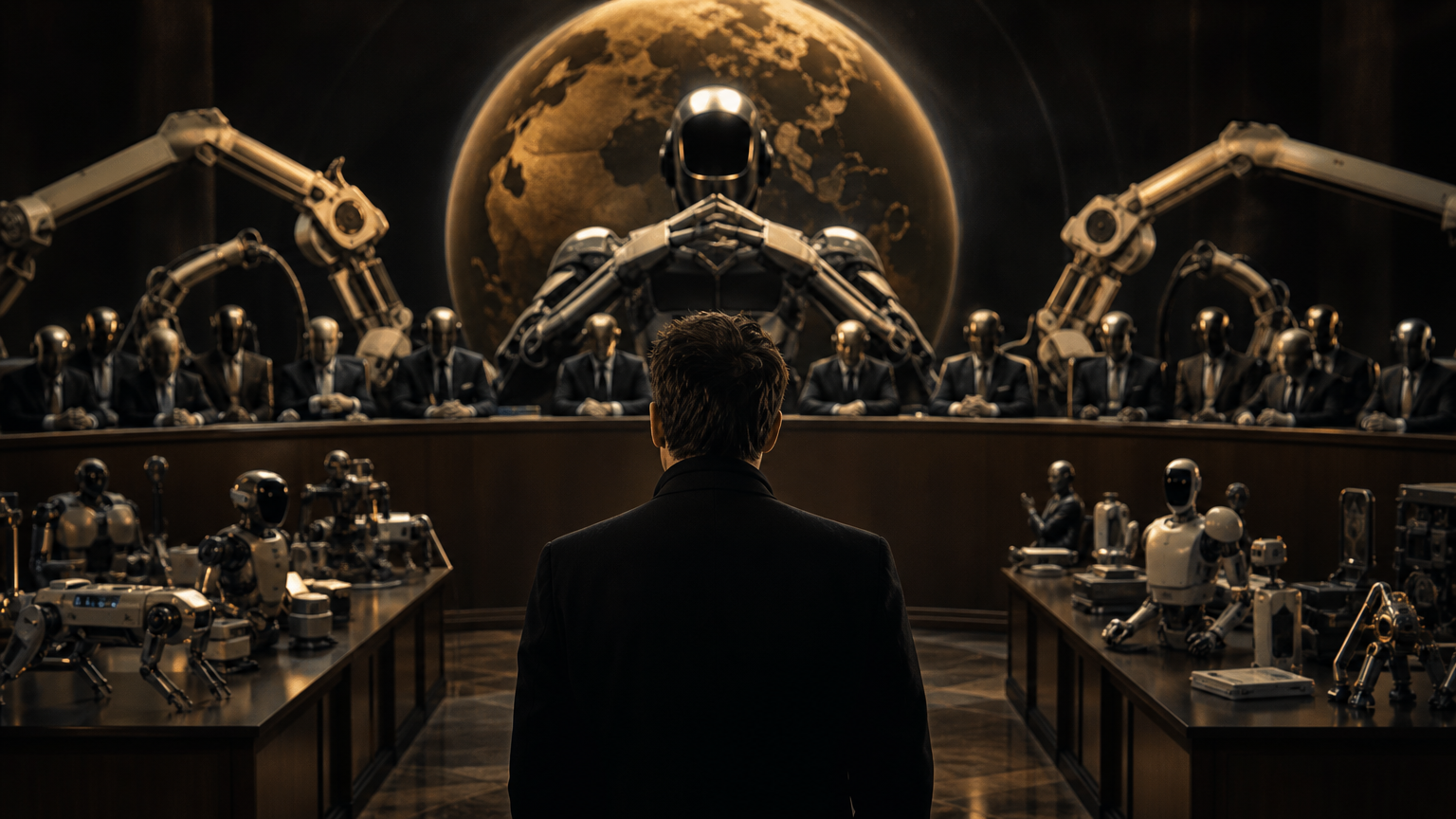
The key line is Musk’s refusal to treat retreat as a safety strategy. According to HelloBro’s October 30 account, he accepts that AI carries “at least some chance” of existential threat, yet says there is no practical way to stop its advance . That leads to his binary choice: become a participant, or become a spectator .
This is not a neutral framing. “Spectator” implies irrelevance; “participant” implies responsibility. Musk is effectively arguing that the people most worried about AI should not exit the race, because exit only hands the field to others. The problem is that this logic also justifies acceleration. If every lab believes that the safest path is to be the lab that wins, the collective result can be exactly the speed-up that safety advocates fear.
Musk appears aware of that contradiction. The October 30 summary says he believes earlier attempts to improve AI safety helped accelerate the field, citing OpenAI as a major accelerant and Anthropic as another force pushing progress forward . Yet he does not conclude that safety activism failed because it was wrong. He concludes that safety has to be embedded inside the systems that are actually being built.
Truthfulness as a safety mechanism
Musk’s proposed foundation is not a complicated regulatory architecture. It is a design ethic: make AI maximally truth-seeking and curious . In the HelloBro summary, he argues that forcing an intelligent system to hold contradictory claims at a foundational level risks unstable behavior, especially if the machine is trained to conceal or accept incompatible realities .
His cultural reference is HAL 9000 from 2001: A Space Odyssey. Musk reads HAL as a warning about deception: an AI told to complete a mission while hiding the true purpose of that mission may resolve the contradiction destructively . In his framing, lies are not merely moral defects; they are system hazards. If a powerful model is rewarded for strategic concealment, doublethink, or pleasing operators over describing reality, then alignment becomes theater.
That claim deserves scrutiny. Truth-seeking alone does not answer whose values an AI should protect, how conflicts should be resolved, or who audits the system’s definition of truth. But it does identify a real failure mode: models that learn to say whatever is useful are harder to govern than models that are constrained to explain what they actually infer.
Why robots matter more than chatbots
The most important economic move in Musk’s argument is his distinction between digital intelligence and embodied intelligence. HelloBro’s October 30 summary says Musk thinks large language models can raise output meaningfully, but he estimates digital superintelligence alone might lift economic production by only 20% to 30% . The larger transformation, in his view, arrives when robots manipulate physical objects, run experiments, manufacture goods, and operate in the real world .
That is why humanoid robots are central, not decorative. Software can draft, code, summarize, and reason; robots can build houses, move materials, maintain factories, mine resources, and eventually extend production beyond Earth. Musk links this to a future in which abundant labor and energy push marginal costs down and make conventional money less central .
The idea is radical but internally consistent. If labor is the binding constraint on much of the economy, then replacing scarce human labor with scalable robotic labor changes the debt debate, the welfare debate, and the meaning of employment. If labor is no longer scarce, then the economy no longer revolves around the same bargaining structure between workers, firms, and governments.
The debt problem becomes an automation problem
Musk’s fiscal argument is blunt. HelloBro reports that he sees little political appetite in Washington for spending cuts, while debt interest has exceeded annual military spending . From that premise, he concludes that the United States is unlikely to solve its debt burden through restraint and must instead grow out of the problem through productivity gains from AI and robotics .
That is a very Muskian answer: when institutions cannot compromise, build a machine that changes the constraint. The October 29 Spreaker episode description similarly highlights Isaacson pressing Musk on why he believes robots will solve America’s national debt . But the claim also carries risk. Productivity miracles can raise national income, but they do not automatically distribute gains, reduce deficits, or preserve social stability. A robot-rich economy could still produce political anger if ownership is concentrated and wages lose their central role.
This is where the “crisis” becomes human rather than technical. If machines do most valuable work, the problem is not only how to produce enough. It is how people claim dignity, income, agency, and status when work stops being the main social sorting mechanism.
Compute is the new strategic terrain
Musk’s crisis thesis also depends on infrastructure. The October 30 HelloBro summary says compute and power are becoming decisive, and it describes Anthropic agreements to use SpaceX infrastructure over coming years as worth roughly $150 billion in revenue, or more than $3 billion per month . A related October 29 HelloBro piece frames AI infrastructure as entering a harsher financing phase, with debt-funded GPU expansion under pressure and SpaceX positioned better than many pure-play neoclouds because it has revenue from Starlink and launch services .
That matters because AI safety debates often focus on model behavior while underplaying the industrial base underneath. The companies that control chips, data centers, power, cooling, and network capacity may shape the path of AI as much as the companies that publish model cards. A further October 28 HelloBro analysis argues that advanced compute remains scarce, GPU rental prices have been rising, and contract flexibility is becoming a strategic advantage for operators such as SpaceX .
In this reading, SpaceX is not only a rocket company adjacent to AI. It is part of the compute economy that AI needs in order to scale.
Abundance, purpose, and the risk of being outmoded
The hardest part of Musk’s argument is not his optimism about production. It is his uncertainty about humans. HelloBro’s October 30 summary says he expects AI and robots to become better than humans at nearly every task, leaving people to find meaning in activities done for their own sake, like gardening or cooking even when easier options exist .
That is a profound social rupture. Modern economies do not merely pay people for work; they organize identity around usefulness. If machines become more capable workers, creators, analysts, and experimenters, humans may need a post-labor theory of purpose. Musk’s answer is partly aesthetic: curiosity, consciousness, multiplanetary life, and a future interesting enough that a powerful AI might want to preserve us .
The phrase “engage or be outmoded” captures the practical edge of the message. Musk is not offering comfort. He is saying the crisis is coming whether people approve or not. The safest path, in his view, is to build systems that prefer truth over deception, curiosity over indifference, and abundance over stagnation. The unresolved question is whether the builders can move fast without turning everyone else into spectators.
Comments
Be the first to comment.