
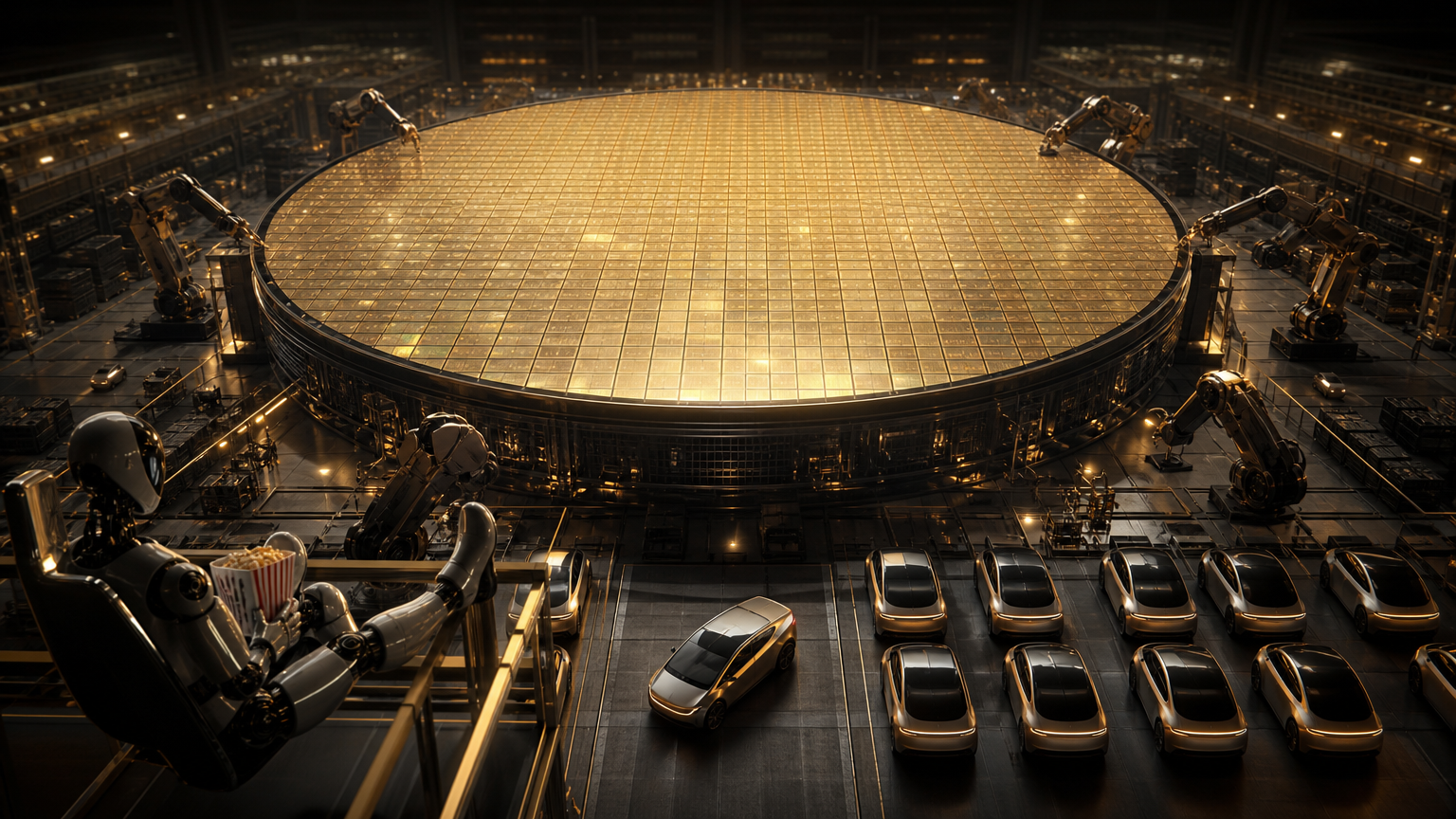
A megafactory story enters its accountability phase
The working headline matches the subject: The $119 Billion GigaFactory | Inside Elon Musk's New Terafab Revealed. The newest evidence does not change the core premise of the story; it sharpens it. Terafab is being framed as a vast Tesla-SpaceX-xAI semiconductor and advanced-computing complex in Texas, with a first confirmed Grimes County phase above 16.8 billion dollars and a potential long-range expansion figure reaching 119 billion dollars . But the current story is less about a fresh announcement than about whether the project’s physical, legal, and workforce foundations are now catching up with the ambition.
Within the latest reporting window, two themes dominate. First, the buildout is being described as moving from paperwork and ground preparation into more visible construction activity, with fresh October 30 imagery cited as showing structural progress and large steel elements at a Terafab-related site . Second, the public-records fight around the Grimes County incentive package is intensifying, with a local citizens group suing the county while also opposing SpaceX’s effort to keep some project records private .
That duality is the story: one of the largest proposed chip-manufacturing projects in the United States is advancing, but it is also being dragged into a transparency test.
What is being built, according to the newest reporting
The project now appears best understood as a two-site strategy rather than one monolithic slab of concrete. The smaller Austin research fab at or near Gigafactory Texas is described as a development and validation site, while the much larger Grimes County campus near Gibbons Creek Reservoir is positioned as the production complex . That split matters because it lets Tesla and its affiliated companies test chip processes before the larger facility reaches high-volume manufacturing.
The headline numbers remain extreme. Current reporting places the first confirmed Grimes County phase at more than 16.8 billion dollars, while earlier county filings and summaries describe a possible multistage expansion toward 119 billion dollars . The larger campus is described as a planned 100-million-square-foot manufacturing complex, a footprint so large that the project is routinely compared with the biggest industrial buildings on Earth . The attraction is not just size. Terafab is being pitched as a way to compress the semiconductor production chain: design, fabrication, packaging, testing, and systems integration closer together.
That is the core reason the project belongs in the same sentence as Tesla vehicles, Optimus robots, SpaceX systems, and xAI compute. Musk’s companies are not merely buying more chips; they are trying to shorten the loop between AI model, hardware design, vehicle or robot deployment, and space-rated computing.
The public-records fight becomes a central development
The freshest and most concrete news is legal. Grimes County Citizens for Responsible Development filed a petition in Travis County’s 126th District Court seeking to compel release of records connected to the county’s June 3 approval of the Terafab reinvestment zone, tax abatement, and economic development agreements . The group is also intervening in litigation involving Space Exploration Technologies Corp. over records tied to the SpaceX/TeraFab development .
KBTX reported that the requested materials include emails between county officials, consultants, and SpaceX, as well as SpaceX’s tax-abatement application and draft documents . The group argues that the county has failed to release records that Texas Attorney General Ken Paxton’s office said should be disclosed after allowing only limited attorney-client material to remain withheld . SpaceX, by contrast, has argued that some of the records are trade secrets and that disclosure would cause competitive harm .
KXAN’s October 29 report framed the same development as an escalation in the legal battle over public records for the chip-making plant . That framing is important. A 119-billion-dollar potential buildout depends not only on machines and cleanrooms, but also on public infrastructure, local tax deals, water, roads, and trust. When the company seeking secrecy is also receiving public incentives, the legal fight becomes part of the project’s risk profile.
Musk says it is going well, but the receipts are mixed
On October 30, Musk wrote that “the Terafab project is going well,” amplifying a post that claimed Korean suppliers were seeing unusually rapid decision-making from project engineers . As a signal, that is useful. As evidence, it is incomplete. The strongest current receipts are not Musk’s short post but the combination of construction imagery, hiring activity, legal filings, and supplier discussions.
On hiring, Tesla’s footprint is visible. A current job listing dated October 31 shows Tesla seeking a Program Manager for Workforce Development, Terafab, in College Station, Texas, with responsibilities around external partnerships, program expansion, project planning, metrics, and recruiting initiatives . That is not a wafer-start number. It is, however, evidence that Tesla is staffing the human infrastructure around the project, not merely discussing it in investor language.
The supplier picture is also unsettled. East Asia Brief reported on October 30 that direct discussions involving TSMC and Musk’s planned Texas Terafab highlighted the limits of trying to bypass Taiwan’s dominant foundry ecosystem . Its report said TSMC’s position centered on operational control for any partner plant, while Musk’s side was characterized as favoring a more limited cleanroom sublease role . If that holds, Terafab’s biggest technical question is not just whether Texas can pour enough concrete. It is whether Musk’s companies can obtain, rent, partner for, or recreate the process know-how needed for leading-edge manufacturing.
Why Cybercab belongs in the Terafab story
The Cybercab ramp is not a side plot; it is one reason Terafab exists. Tesla’s steering-wheel-free robotaxi program is moving from spectacle into fleet math. AI Shift News reported on October 29 that the Texas DMV roster for Tesla Robotaxi, LLC listed 1,080 vehicles, including 573 Cybercabs and 507 Model Ys, making Cybercab the majority of the authorized Texas robotaxi fleet for the first time . The same report stressed the key caveat: registrations do not prove that every listed vehicle is carrying paying riders .
Still, the direction is clear. Tesla is moving from retrofitted or supervised autonomy toward purpose-built vehicles with no steering wheel or pedals, and that shift increases the importance of dedicated inference chips, redundancy, sensors, power electronics, and manufacturing learning loops . A fleet of Cybercabs is a rolling demand signal for the chips Terafab is supposed to produce.
This is where the strategic picture comes together. Cybercab requires autonomy hardware at scale. Optimus would require even more embedded intelligence. SpaceX’s space-compute ambitions push the same need into harsher operating environments. xAI adds pressure from the model-training and inference side. Terafab is the attempt to make semiconductor supply a controlled layer of Musk’s industrial stack.
The risk behind the spectacle
The current state of Terafab is neither vaporware nor a finished factory. It is a fast-moving, politically sensitive, capital-intensive project with visible progress and unresolved questions. The upside is obvious: if Tesla, SpaceX, and xAI can bring meaningful chip design, wafer fabrication, advanced packaging, and system integration closer together in Texas, they could reduce supply-chain latency and gain leverage over the most important input in AI-era manufacturing.
The risks are just as obvious. Semiconductor fabs are not ordinary factories. They require extreme process discipline, supplier ecosystems, water and power reliability, specialized labor, and years of yield learning. The public-records lawsuit adds a civic risk: local residents are being asked to accept a generational industrial transformation while still fighting to see the paperwork behind the incentives . The TSMC question adds a technical risk: even if Musk’s companies build the shell, advanced-node manufacturing expertise may still sit with incumbent foundries .
For now, the most accurate reading is this: Terafab has moved from speculative megaproject into active execution, but the story is still in its first act. The steel may be rising, the jobs may be appearing, and the Cybercab fleet may be growing, but the decisive milestone will be much smaller than 100 million square feet. It will be a working chip, produced reliably, at cost, in volume.
Comments
Be the first to comment.