
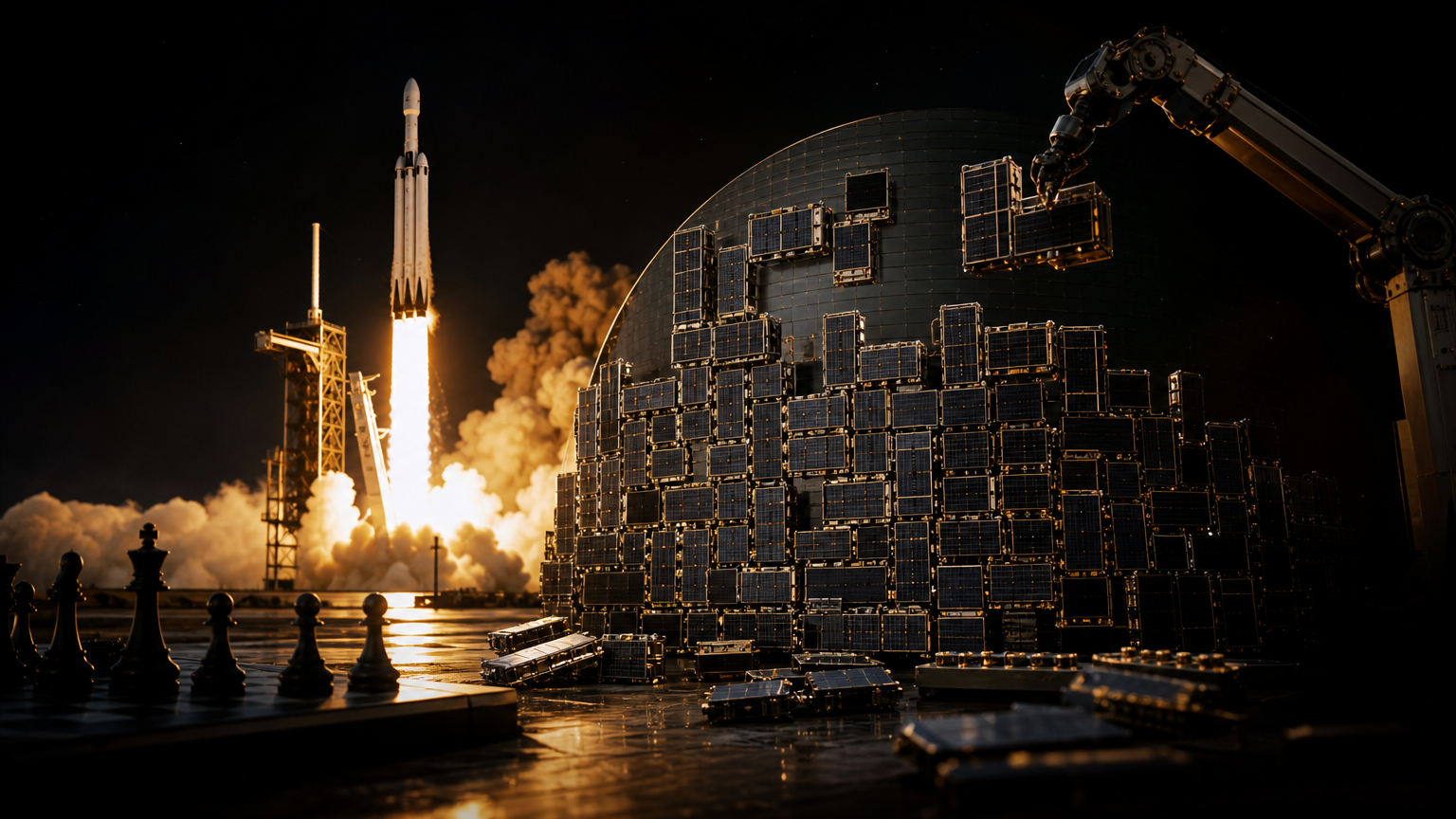
A Halloween launch with a terrestrial shadow
SpaceX’s latest Starlink mission was not a debut of a new spacecraft family, but it still mattered. Falcon 9 launched 27 Starlink satellites from Vandenberg Space Force Base at 12:04 a.m. EDT on October 31, 2026, after lifting off at 9:04 p.m. local time on October 30 in California . The mission, identified in launch coverage as Starlink 15-18, sent another batch of satellites into low Earth orbit and continued the company’s high-frequency replenishment of its broadband constellation .
The rocket’s first stage, booster B1093, completed its 18th flight and landed on the drone ship Of Course I Still Love You in the Pacific roughly eight and a half minutes after launch . SpaceX’s upper stage deployed all 27 satellites about 62 minutes after liftoff, according to launch coverage that cited SpaceX’s confirmation . By one measure reported after the launch, it was the 118th Falcon 9 mission of 2026, and more than 70 percent of those missions had been dedicated to Starlink expansion .
That is the orbital side of the story. The ground side is now equally important: SpaceX is reportedly seeking access to at least 80,000 U.S. cell sites as part of a plan to build a more serious terrestrial wireless presence around Starlink Mobile . If that number holds, it is not a hobbyist network or a rural-only demonstration. It is a proposed footprint in the range that incumbent executives themselves describe when they talk about national mobile coverage .
Why 27 satellites and 80,000 sites belong in the same story
The Halloween launch added capacity to Starlink’s space layer, but a mass-market mobile network cannot live on satellites alone. Satellites can extend coverage into places towers do not reach; towers, fiber, radios, spectrum and back-office systems carry the urban and suburban traffic load that defines the economics of U.S. wireless. That is why the 80,000-site report matters.
Northeast Times reported on October 31 that SpaceX is negotiating for access to at least 80,000 cell sites across the United States, citing reporting that placed Crown Castle among the infrastructure companies involved . Telco Magazine separately reported on October 30 that Bloomberg had said SpaceX was seeking at least 80,000 cell sites and that Crown Castle was one of the major tower companies mentioned in those discussions . Crown Castle’s chief executive, Chris Hillabrant, declined to give customer-specific detail, but said investors could assume the company was talking to all parties; he also described SpaceX’s mobile network ambitions as a possible catalyst for tower leasing and for incumbent investment .
The nuance is important. SpaceX has not publicly confirmed the 80,000 number in the cited reports, and the figure may represent a target, a negotiating position or an estimate rather than signed leases . Still, in telecom, a reported target at that scale sends a market signal. It says SpaceX is studying the boring, capital-intensive part of becoming a carrier: locations, equipment, interconnection, zoning, leases, power, backhaul and maintenance.
The incumbents are not offering an easy shortcut
One path into mobile would be an MVNO deal, where SpaceX sells mobile service while riding on an incumbent carrier’s network. That path looks politically and commercially difficult. Android Central reported on October 30 that T-Mobile CEO Srini Gopalan said the carrier has no plans to enter an MVNO agreement with SpaceX, arguing that such a deal would not open new addressable markets, distribution channels or capabilities for T-Mobile .
Gopalan also described satellite connectivity as complementary, not a replacement for T-Mobile’s fixed wireless and mobile network, particularly in dense markets where the carrier believes it has unused capacity . Android Central noted that T-Mobile’s existing T-Satellite service uses SpaceX technology, but that does not mean T-Mobile wants to give SpaceX a broader route into its core wireless business .
Verizon is drawing a similar line. TheStreet reported on October 30 that Verizon CEO Dan Schulman said satellite connectivity can help in rural or hard-to-reach areas, but he rejected the idea of granting a satellite provider an MVNO path over Verizon’s infrastructure . Schulman estimated that replicating Verizon’s network would require 65,000 to 80,000 macro cell sites, plus backhaul, radio-access equipment and meaningful spectrum holdings; he put the cost of a full buildout at $300 billion to $500 billion and the physical timeline at four to six years .
That estimate may be self-interested, but it frames the challenge. Incumbents want satellite companies as coverage partners, not as retail competitors using their networks. SpaceX, meanwhile, appears to be assembling a different option: satellites in orbit, spectrum rights, and access to the tower grid.
Spectrum is the second hard part
Cell sites without spectrum are real estate, not a network. That is why recent spectrum reporting matters to the 80,000-site plan. Longbridge, summarizing Benzinga reporting on October 30, said SpaceX had agreed to nearly $28 billion in wireless spectrum deals, including approximately $20 billion tied to EchoStar and a reported $8 billion Grain Management transaction . Telecom expert William Webb estimated SpaceX might still need another $120 billion to $130 billion to rival T-Mobile and other major U.S. carriers, with roughly $30 billion to $40 billion for network buildout and much of the rest for additional spectrum .
Other analysts see a lower-cost opening. The same report cited Roger Entner of Recon Analytics as saying SpaceX could start with a rural-first network for $10 billion to $15 billion, excluding additional spectrum purchases . That divide captures the strategic fork: SpaceX could try to match the big three everywhere, or it could begin where Starlink already has a brand, customers and a coverage story.
Regulators are also moving. The Inference reported that on October 29 the Federal Communications Commission advanced a rulemaking that would open 482 MHz of licensed carrier airwaves to satellite-to-phone service and increase eligible Supplemental Coverage from Space bands from five to 13, while stressing that no spectrum had yet changed hands . Telco Magazine likewise reported that the FCC had adopted a proposal to modernize direct-to-device rules and seek comment on expanding the SCS band list .
The strategic meaning
SpaceX’s advantage is not that any single Halloween launch transforms Starlink Mobile. It is that the company can keep launching, replacing, upgrading and densifying the orbital layer while it negotiates on the terrestrial layer. Traditional carriers rebuild through multiyear tower, fiber and spectrum cycles. SpaceX refreshes part of its network by putting another Falcon 9 on the pad.
The 27 satellites from Starlink 15-18 are therefore best understood as one tile in a larger board. They improve and maintain orbital capacity. The reported 80,000 cell-site push suggests SpaceX is also looking at the board underneath: the physical U.S. mobile grid. If those pieces come together, T-Mobile, Verizon and AT&T would not be facing only a satellite broadband company. They would be facing a vertically integrated competitor with launch capacity, satellite manufacturing, spectrum ambitions and a willingness to rent or build terrestrial access at national scale.
The big “if” remains execution. SpaceX needs agreements, radios, backhaul, spectrum depth, regulatory clarity, retail systems and customer trust. But the direction is now clear: Halloween’s 27 satellites kept Starlink’s space machine moving, while the 80,000-site target points to a much more earthly fight for the future of U.S. mobile service.
Comments
Be the first to comment.