
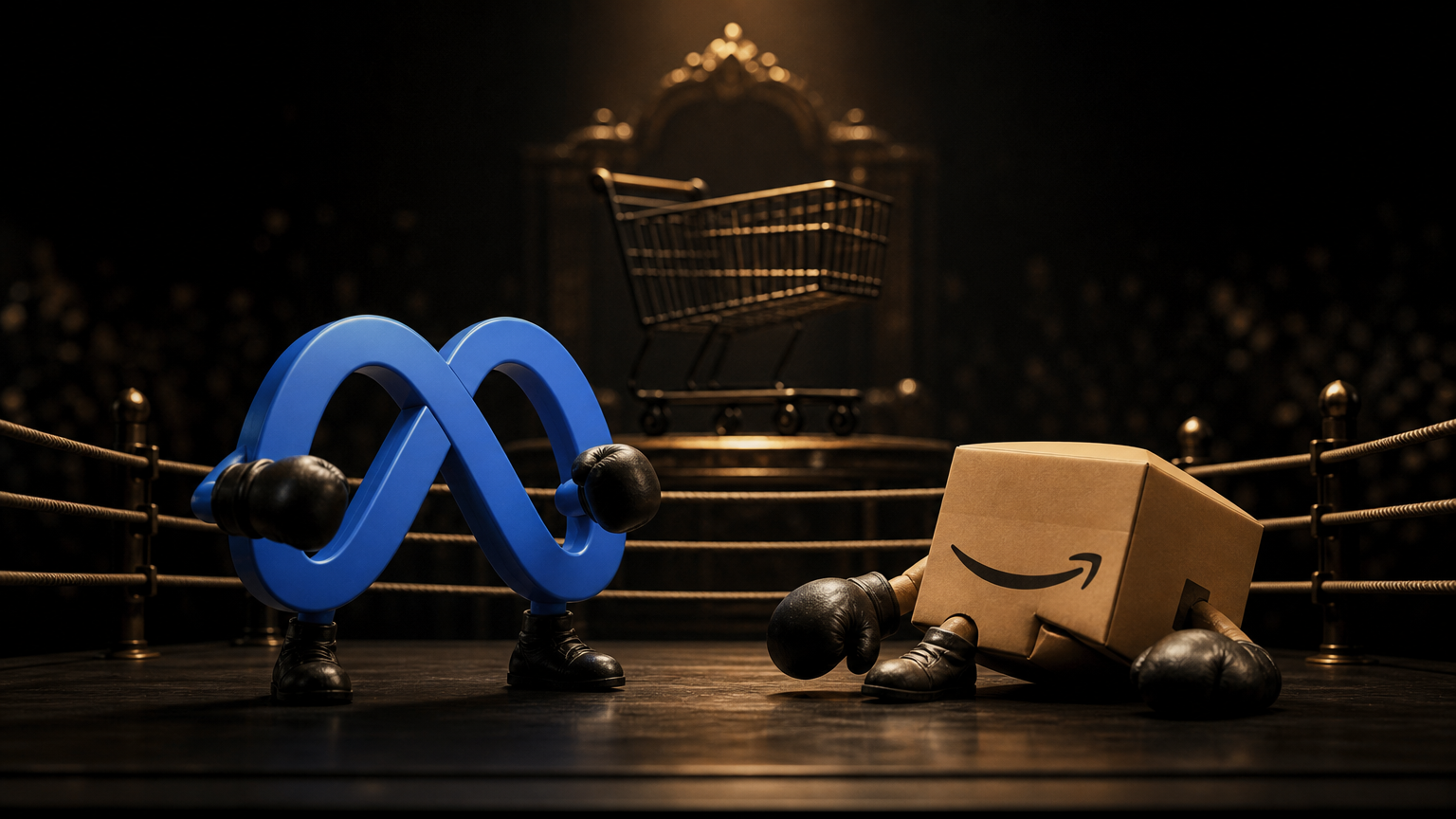
The fight is about who gets to recommend
Meta’s new AI shopping assistant, Muse, has turned a familiar e-commerce rivalry into a platform-control fight. The immediate headline is simple: Meta wants its agent to help users research, compare and buy products, while Amazon wants shoppers to stay inside Amazon’s own app, website and advertising surfaces. But the strategic issue is larger. If consumers begin asking an AI agent what to buy, the most valuable screen in retail may no longer be a search-results page. It may be the answer box.
Seeking Alpha, citing Wall Street Journal reporting, framed Meta’s assistant as a possible threat to Amazon’s nearly 70 billion dollar advertising business because agents can compare prices and products while weakening sponsored placements and Amazon’s role as the default shopping starting point . That is the core commercial tension. Amazon’s retail media business has long benefited from “high-intent” searches: a shopper types “running shoes,” “coffee maker” or “baby monitor,” and brands bid to appear at the moment of purchase intent. Muse changes that journey by inserting Meta’s conversational layer before the shopper reaches Amazon’s ad auction.
This does not mean Amazon is suddenly vulnerable in its logistics, fulfillment or customer relationship. It means the margin-rich part of retail, the recommendation layer, is becoming contestable.
Amazon’s answer: outside agents are not yet better
Amazon Chief Executive Andy Jassy used the company’s latest earnings conversation to downplay the near-term risk from outside shopping agents. According to Fortune, Jassy told investors on October 29, 2026, that very few customers are buying with third-party shopping agents because the experience remains “still not great” and is not more convenient than going directly to a retailer . TechRadar reported the same message on October 30, noting that Jassy was speaking after Amazon’s latest financial results and after Amazon had blocked Meta’s Muse from accessing its online store [5].
That response is partly product critique and partly strategic signaling. Amazon is saying that Meta’s agent may be popular, but popularity is not the same as reliable commerce. Shopping is not only a recommendation problem. It involves inventory freshness, delivery promises, substitutions, payment credentials, returns, fraud detection, customer service and merchant accountability. Amazon’s argument is that those systems are hard to reproduce from the outside.
Still, Amazon’s defensiveness is visible. Fortune reported that Amazon has not joined the group of retailers integrating with Muse, even as Meta has signed up partners such as Shopify, Walmart and Best Buy . Amazon’s refusal matters because Amazon is not just another merchant. It is the place where millions of consumers start product searches, and it sells ads precisely because those searches are close to conversion.
The ad machine under pressure
The timing makes the agentic-commerce debate harder for Amazon to ignore. Amazon announced on October 29 that third-quarter net sales rose 12% year over year to 201.9 billion dollars, while advertising revenue grew 12% year over year excluding foreign-exchange effects . Axios noted that the 12% advertising growth trailed the prior quarter’s 26% year-over-year growth and reported that Amazon’s shares fell in extended trading after the company disclosed heavy AI-related capital spending and weaker-than-expected revenue [4].
Amazon attributed part of the advertising slowdown to timing anomalies, including Prime Day shifting into the second quarter in most large countries, and said it expects advertising revenue to grow in the high teens year over year in the fourth quarter . That explanation may be reasonable. But the broader investor question is not whether one quarter was distorted. It is whether AI agents eventually reduce the amount of human browsing that makes sponsored product ads so valuable.
If Muse or similar agents become the shopper’s first stop, advertisers could ask a new budget question: should they pay Amazon to win a sponsored slot on a page the consumer may never see, or pay Meta to influence the agentic recommendation before the consumer reaches a retailer? That is why this story is not only about chatbot quality. It is about attribution, measurement and who can prove that an ad changed the purchase.
Amazon is building its own agentic wall
Amazon is not merely blocking outsiders; it is building its own AI commerce layer. In its October 29 results, Amazon said Alexa for Shopping, its agentic shopping assistant, was used by more than 400 million customers over the previous 12 months, with customer interactions up 570% year over year . The company also said it added more than 100 capabilities to Alexa for Shopping, letting users complete tasks such as building gift lists, adjusting Subscribe & Save deliveries, managing payments and adding delivery addresses through conversation .
That is a major defensive asset. If Amazon can make its own shopping agent more useful than Meta’s inside Amazon’s retail environment, it can preserve the closed loop that makes its ad business powerful: discovery, sponsored placement, product page, checkout, delivery and measurement. Fortune reported that Jassy said U.S. customers using Amazon’s shopping agent spend 50% more per order than those who do not use it . For advertisers, that kind of data is exactly why Amazon’s retail media system is hard to displace.
Amazon also announced Amazon Ads Agent, a single AI-first advertising platform backed by shopping, browsing and streaming signals, and launched Full-Funnel Campaigns for all U.S. advertisers, allowing Amazon’s AI to plan, execute and optimize campaigns from initial advertiser inputs . In other words, Amazon’s answer to Meta is not simply “keep out.” It is “we will agentify both shopping and advertising ourselves.”
Meta’s wedge: social data plus conversation
Meta’s advantage is different. It does not control the warehouse, delivery truck or Amazon product page. It controls massive social surfaces, identity signals, creator content, messaging habits and conversational interfaces. A shopping agent inside Meta’s ecosystem could personalize product discovery from a different starting point: what users watch, discuss, save, like and ask.
Fortune reported that Meta Chief Executive Mark Zuckerberg said more than 10 million people in the U.S. and Canada had set up Muse since its early September release, and that shopping was the most common use case, with more than a quarter of users engaging in shopping and average purchase size topping 200 dollars . TechRadar also reported Zuckerberg’s claim that Muse had surpassed 10 million setups and had become a leading free app on Apple’s App Store [5]. These figures suggest that Meta has consumer curiosity and early behavioral signal, even if the product is still young.
That matters because the advertising prize is not only the final click. It is the moment a user forms a preference. If Muse learns that a user wants minimalist furniture, trail-running shoes or a birthday gift for a six-year-old, Meta can potentially shape discovery before Amazon receives a search query.
What merchants should watch
For merchants, the immediate lesson is not to abandon Amazon ads. Amazon still has enormous buyer intent, fulfillment trust and closed-loop measurement. But merchants should begin treating agentic shopping as a new distribution surface. Product feeds, images, reviews, availability, return policies and structured product attributes will matter not only for search engines and marketplaces, but for AI agents deciding which products deserve to be recommended.
The second lesson is that platform permission will become part of commerce strategy. Amazon blocked Muse; other retailers have integrated with it . That means agent access is becoming a negotiated business relationship, not a neutral technical capability. A brand’s products may be easily discoverable by one AI agent in one retail environment and unavailable to the same agent somewhere else.
The third lesson is measurement. If an AI agent recommends a product, who gets credit? The retailer that completed the sale, the platform that hosted the agent, the merchant that supplied the catalog, or the ad network that influenced the user days earlier? The next wave of retail media will be fought over those attribution rules.
The Street Fighter music is justified
Meta has not beaten Amazon in shopping. Amazon has not solved the outside-agent threat. What has changed is the battlefield. The shopping cart has entered the chatbot arena, and the most valuable asset may be the right to decide what the shopper sees before checkout.
Amazon still has fulfillment, Prime habits, merchant density and a powerful ad engine. Meta has social context, conversational reach and a chance to intercept product discovery earlier. If agents become the interface for shopping, the winner will not simply be the company with the smartest chatbot. It will be the company that controls recommendations, transactions and proof of performance. That is why Amazon heard the Street Fighter music.
Comments
Be the first to comment.